
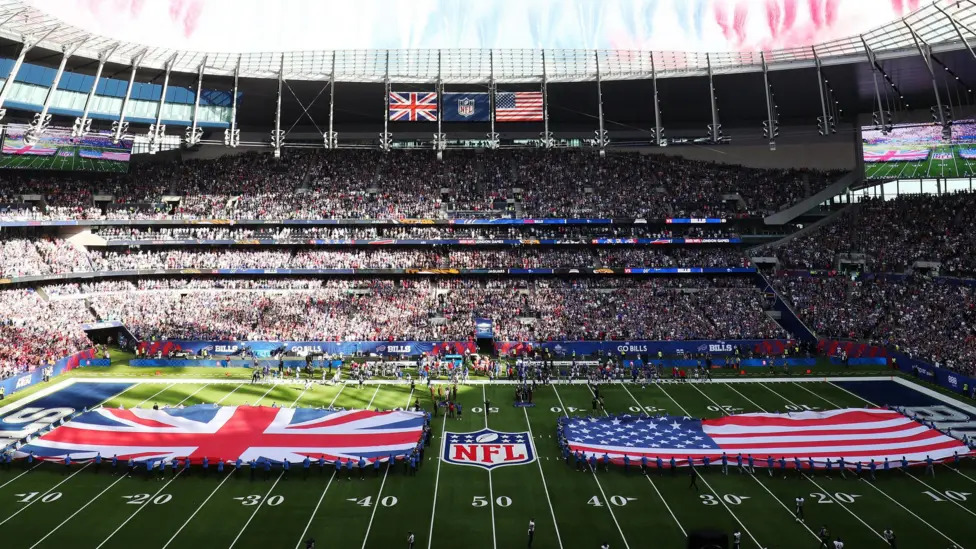
The NFL’s march toward becoming a truly global sports powerhouse took another major step this week, and the ramifications could stretch far beyond games being played in London, Germany, or Brazil. NFL owners approved a measure that allows the league to stage up to 10 international regular-season games beginning in 2027 while also eliminating the policy that previously let teams protect two home games from being moved overseas.
The vote may appear at first glance to be a scheduling adjustment. In reality, it could represent one of the most significant structural changes to the league’s long-term vision since the NFL expanded to a 17-game season.
For years, Commissioner Roger Goodell has spoken openly about international growth as one of the league’s most important objectives. The NFL already operates marketing rights across numerous countries and has aggressively expanded its footprint in Europe, South America, and Australia. This latest move pushes that strategy into another phase where overseas games become less of a novelty and more of a permanent fixture of the league’s long-term vision.
Beginning in 2027, the league can stage as many as 10 international contests annually. The Jacksonville Jaguars’ unique London arrangement may also create scenarios where that number effectively reaches 11 games depending on scheduling conditions and venue situations.
The removal of home-game protections may be equally important.
Previously, teams could shield selected home matchups from being considered for international placement. That created limits on scheduling flexibility and frequently kept high-profile rivalry games inside the United States. Those restrictions are now disappearing, opening the possibility of marquee divisional contests traveling abroad.
For fans, the impact could be enormous.
Imagine historic rivalry games taking place in Madrid, Munich, Paris, Melbourne, or Rio de Janeiro. Imagine major NFC and AFC clashes becoming global events designed to attract television audiences across multiple continents. The NFL increasingly appears willing to sacrifice tradition for broader international growth opportunities.
The league already has a record nine international games scheduled for the 2026 season, including first-time regular season appearances in Paris and Melbourne. Cities such as London, Madrid, Munich, Rio de Janeiro, and Mexico City are also becoming familiar destinations on the NFL calendar.
The timing of the decision also sparked immediate discussion surrounding another issue that has hovered around the league in recent years: the possibility of an 18-game regular season.
Officially, no expansion has been approved. But many observers increasingly view the international growth strategy as a preparatory phase for a larger broader scheduling overhaul.
Industry reporting and league discussions have repeatedly linked international expansion with future schedule changes. One long-term concept frequently discussed involves every franchise eventually playing one international game annually as part of an expanded regular-season structure.
That scenario becomes easier to imagine if an 18-game schedule arrives.

Of course, obstacles remain.
Player safety concerns continue to dominate conversations whenever schedule expansion surfaces. The move from 16 to 17 games already generated questions about player safety, workload management, and injury risks. Adding another game while increasing international travel would almost certainly trigger intense negotiations with the NFL Players Association.
Travel fatigue, time-zone differences, competitive balance concerns, and recovery schedules also remain unresolved issues.
Still, the league appears increasingly comfortable operating in that environment.
One telling sign involves how international scheduling itself has evolved. Teams previously often received byes after overseas games. That practice has become less automatic as the NFL attempts to normalize international travel as part of a regular season rather than treating it as a special circumstance.
The strategy suggests the NFL is conditioning teams, players, and fans to accept a future where global travel becomes routine.
Financial motivations are also difficult to ignore.
The NFL dominates American television ratings, but domestic growth naturally carries limits. International markets offer entirely new audiences, sponsorship opportunities, media rights packages, merchandise sales, and commercial partnerships.
The question now is no longer whether the NFL wants to become a worldwide sports giant.
That objective is already underway.
The bigger question is how far the league is willing to go and how quickly it intends to get there.
The latest vote may eventually be remembered as more than a scheduling adjustment.
It may be remembered as the moment the NFL’s worldwide takeover moved from ambition to execution.