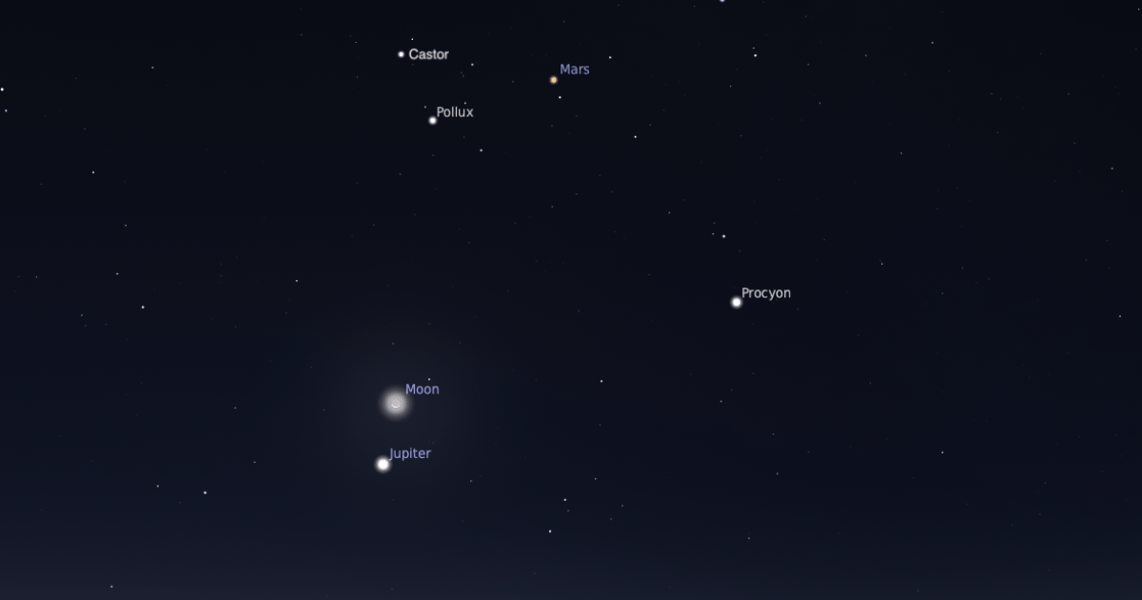
The moon phase today, August 17, 2026, is a Waxing Crescent, roughly 25 percent illuminated and about five days into the current lunar cycle. Look low in the western sky shortly after sunset. The crescent is now thick enough to show real shape, and it sets a few hours after dark rather than chasing the sun straight down as it did last week.
This is the same lunation that opened with a total solar eclipse. The new moon of August 12 at 17:36 UTC passed directly across the sun, darkening skies over Greenland, Iceland and northern Spain. Five days on, that same moon has swung far enough east of the sun to be comfortably visible in the evening sky. Two days ago it was a thin crescent at 11 percent. It has more than doubled since.
Moon phase today at a glance
| Date | Monday, August 17, 2026 |
|---|---|
| Moon phase | Waxing Crescent |
| Illumination | About 25 percent (22 to 28 percent depending on location and time of day) |
| Moon age | About 5 days (4.3 days at 00:00 UTC, 5.3 days by midnight) |
| Distance from Earth | Roughly 394,000 km |
| Zodiac sign | Libra, entering Scorpio at about 22:00 UTC |
| Best viewing | Western sky, from dusk until moonset |
| Next phase | First Quarter, August 20 at 02:46 UTC |
If you look up the moon phase today on two different sites and get two different illumination figures, neither is wrong. The lit fraction climbs continuously, from about 21 percent at midnight UTC to nearly 30 percent by the end of the day, so the number you see depends on the moment the site calculated it and on your time zone. Anything between 22 and 28 percent is correct for August 17.
What the moon phase today means: the waxing crescent explained
Waxing means growing. The illuminated portion is widening night after night, and it will keep widening until the First Quarter on August 20, when exactly half the visible disc is lit.
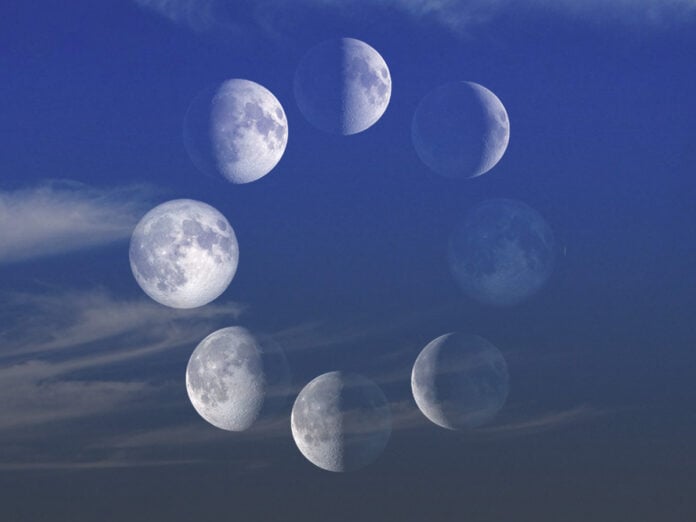
The geometry is simpler than it looks. The moon is currently about 60 degrees east of the sun along the sky. From Earth we see the sunlit hemisphere at an angle, so only a curved sliver reflects back to us. As the moon continues along its orbit, that angle opens, the sliver widens, and the moon rises and sets progressively later each day. NASA’s overview of the eight lunar phases sets out the full sequence from new moon to new moon.
For observers in the Northern Hemisphere the lit edge faces right. South of the equator it faces left, and near the equator the crescent can look like a bowl sitting on its base. Same moon, different viewing angle. That is worth knowing if you are comparing the moon phase today against a photograph taken in the opposite hemisphere and wondering why it looks reversed.
Moonrise and moonset times for August 17, 2026
Knowing the moon phase today is only half of it. The other half is knowing when the moon is actually above your horizon. All times below are local, calculated for the city centre by the US Naval Observatory’s rise, set and twilight service. Times shift by a few minutes across a large metropolitan area.
| City | Moonrise | Moonset | Illumination |
|---|---|---|---|
| New York | 11:36 | 22:03 | 27% |
| Chicago | 11:36 | 21:56 | 27% |
| Los Angeles | 11:29 | 22:17 | 28% |
| Toronto | 12:05 | 22:18 | 27% |
| London | 11:51 | 21:36 | 25% |
| Dubai | 10:15 | 21:42 | 24% |
| New Delhi | 10:17 | 21:38 | 23% |
| Mumbai | 10:25 | 22:08 | 23% |
| Singapore | 10:31 | 22:50 | 22% |
| Tokyo | 09:36 | 20:42 | 22% |
| Sydney | 08:45 | 22:15 | 22% |
| Johannesburg | 09:17 | 22:36 | 25% |
Note that the moon is already up during the afternoon in every one of these cities. A waxing crescent rises in daylight and is often visible as a pale shape against a blue sky well before sunset. The reason it seems to appear only at dusk is contrast, not timing.
How to see the moon phase today
Find an unobstructed western horizon. The crescent sits low, so buildings and trees matter more than they do for a high full moon.
Look for earthshine. With the lit portion still under a third, the darkened remainder of the disc often glows faintly grey, lit by sunlight bouncing off Earth’s own clouds and oceans. It is easiest to catch in the half hour after twilight fades, and binoculars make it obvious. Leonardo da Vinci worked out the cause of it around 1510.
This is also a good week for everything that is not the moon. A thin crescent throws very little light into the sky, so deep-sky objects stay accessible in a way they will not be by the end of the month. Once the Sturgeon Moon arrives on August 28, faint galaxies and star clusters will be washed out for several nights either side.
What comes after the moon phase today: first quarter, then a 96 percent eclipse
The First Quarter arrives on August 20 at 02:46 UTC, when the moon reaches half illumination, rises around midday and sets near midnight. That is the best phase of the month for looking at lunar terrain, because the sun strikes the surface at a low angle along the terminator and throws long shadows off crater rims.
The Full Moon, August’s Sturgeon Moon, follows on August 28 at 04:18 UTC. It will not be an ordinary full moon. Earth’s shadow will fall across it in a deep partial lunar eclipse, covering about 96 percent of the lunar disc at maximum. The partial phase begins at 02:33 UTC and reaches greatest eclipse at 04:13 UTC, with the whole event running roughly five and a half hours.
At 96 percent coverage the eclipse will look very nearly total, with the immersed portion turning the familiar copper red of sunlight filtered through Earth’s atmosphere. Viewing is best across most of the Americas, where the moon sits high during the eclipse, and across Africa and Europe it falls near moonset, so a clear western horizon will be necessary. It is the companion event to the August 12 solar eclipse, which The Eastern Herald covered when totality crossed Spain for the first time since 1905. Solar and lunar eclipses arrive in pairs about two weeks apart, because that is how long the moon takes to travel from one node of its orbit to the other.
Where the moon sits in the zodiac today
The moon spends most of August 17 in Libra, crossing into Scorpio at about 22:00 UTC. In astrological practice the waxing crescent is read as a phase of initiation and forward momentum, the outward expression of intentions set at the new moon, and a Libra moon is generally associated with balance, negotiation and relationships before the shift into Scorpio’s more intense register. Our daily horoscope tracks the transits in detail.
None of that is astronomy, and it is worth keeping the two separate. The observable facts behind the moon phase today are the illumination, the age, the rise and set times, and the eclipse geometry. What those positions are taken to mean is a separate tradition with a separate history.
Moon phase today: frequently asked questions
What is the moon phase today, August 17, 2026?
The moon phase today is a Waxing Crescent, about 25 percent illuminated and roughly five days past the new moon of August 12.
Why do sites disagree on the moon phase today illumination?
Because the figure changes continuously. On August 17 the lit fraction rises from about 21 percent at 00:00 UTC to nearly 30 percent by day’s end. Sites calculate at different reference moments and time zones, so 22 to 28 percent are all legitimate answers for the same day.
How do I check the moon phase today for my exact location?
Phase and illumination are effectively the same worldwide on a given date, because the moon shows the same face to the whole planet. Only moonrise and moonset change with location. For times at coordinates not listed above, the US Naval Observatory service linked earlier returns rise, set and transit for any latitude and longitude.
When is the next full moon?
August 28, 2026 at 04:18 UTC. It is the Sturgeon Moon, and it coincides with a deep partial lunar eclipse covering about 96 percent of the moon.
When is the next new moon?
September 11, 2026. The current cycle began with the new moon of August 12, which produced the year’s only total solar eclipse.
Can I see the moon during the day right now?
Yes. On August 17 the moon rises before noon in most of the world and is above the horizon throughout the afternoon. A waxing crescent is faint against a bright sky but visible once you know where to look, roughly 60 degrees east of the sun.
What is earthshine?
The faint grey glow on the unlit part of a crescent moon, caused by sunlight reflecting off Earth and onto the lunar surface. It is most visible during thin crescent phases, which makes the next few evenings a good window.
Is a waxing crescent good for stargazing?
Very good. With only about a quarter of the disc lit, the moon adds little light to the sky, so faint objects stay visible. Conditions deteriorate as the moon fills toward the August 28 full moon.
How old is the moon today?
About five days. Precisely, it moves from 4.3 days old at 00:00 UTC to 5.3 days by midnight, measured from the new moon on August 12 at 17:36 UTC.
The moon phase today changes by roughly one percentage point of illumination every two hours, so this page is accurate for August 17, 2026. Check back tomorrow for the next update in the series.