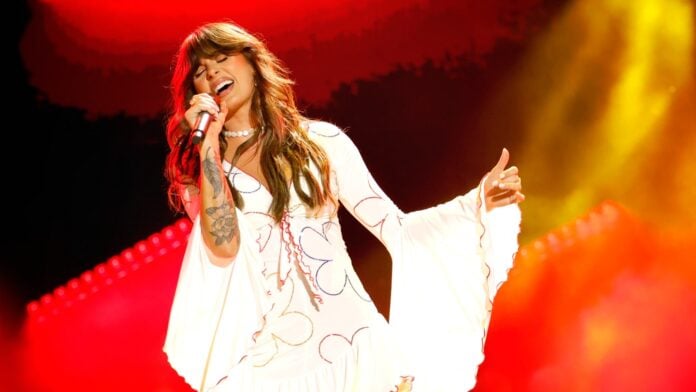
CANNES, France – The 79th Cannes Film Festival closed on Saturday night with Cristian Mungiu winning the Palme d’Or for Fjord, but the 12 days that led to that ceremony delivered something else entirely. The Croisette’s red carpet, by the end of the festival, had become the most talked-about fashion stage of 2026, defined by Demi Moore’s rotation of statement gowns, John Travolta’s ever-changing collection of berets and a host of new arrivals testing the limits of the festival’s revised dress code.
Moore, who served on this year’s competition jury under the presidency of Park Chan-wook, treated the festival as a personal runway. She opened the event in a polka-dot Jacquemus dress with feather confetti that gave her dots a three-dimensional quality during the day, before slipping into a sequined Jacquemus gown for the opening ceremony screening of La Venus electrique. By the closing weekend she had cycled through a voluminous Barbie-pink Matières Fécales dress with an oversized bow at the neckline, a red Gucci gown with a structured collar for the Fatherland screening, and a semi-sheer lavender Gucci look that even rival fashion editors conceded was the look of the festival.
Travolta’s campaign was simpler and just as effective. The actor and Honorary Palme d’Or recipient, in Cannes to launch his directorial debut Propeller One-Way Night Coach, wore a different beret every day. He paired a black three-piece suit and a white tie with a cream beret to walk the Karma red carpet with his daughter, Ella Bleu Travolta. He told CNN at his press junket that the choice was deliberate. “The old-school directors wore berets,” Travolta said, citing Stanley Kubrick and Federico Fellini among the influences he was working from for his first film as a writer-director.
The 2026 edition arrived under a new and stricter set of clothing rules. The festival’s organizers, who had previously banned guests from wearing shoes other than high heels on the Palais steps and have since relaxed that requirement, this year tightened restrictions on nudity and what they described as “excessively voluminous” looks. The rule change followed last year’s mid-festival controversy, when several guests in revealing gowns were turned away from premieres in the days leading up to the closing ceremony.
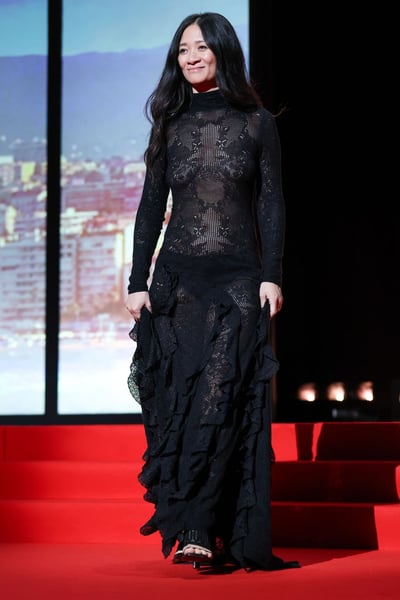
Stars largely respected the new rules, but several found ways to push against them. Heidi Klum, who arrived for the screening of Mission Impossible: The Final Reckoning’s Cannes anniversary tribute, wore a custom Elie Saab with a sweeping train that snaked across the carpet behind her. Halle Berry, a returning festival presence after her 2002 Monster’s Ball win, paired a structured ivory Stephane Rolland gown with statement opera gloves. Chloé Zhao, the Hamnet director who served alongside Moore on the jury, opened the festival in Gabriela Hearst and later turned heads in a Schiaparelli skirt-and-jacket combination by Daniel Roseberry that recalled a pufferfish, with black organza spikes on the shoulders.
The Hollywood contingent skewed smaller than usual this year. With only two American films in competition, Ira Sachs’ The Man I Love and James Gray’s Paper Tiger, much of the red carpet glamour came from European arrivals and the festival’s rotating cast of returning regulars. Sharon Stone, a regular at the Cannes amfAR gala, brought a flowing Dolce & Gabbana silver gown to the Histoires de la Nuit premiere. Cate Blanchett, ever a Cannes fixture, wore a Givenchy dress inspired by a Manila shawl and the work of Filipino artist Olan Ventura. Dua Lipa, whose presence on the Croisette doubled as a soundtrack tease for an upcoming film project, kept her looks comparatively subdued in archival Versace and Chanel.
Bridgerton’s Simone Ashley arrived in custom Alexander McQueen for the Karma premiere, her crimson gown almost color-matching the carpet itself in what stylists later described as one of the cleanest visual moments of the festival. Eva Longoria, a returning Cannes regular, dazzled in a white couture Tamara Ralph gown for the Histoires de la Nuit screening on May 22, and Gillian Anderson appeared on the same red carpet in a sculptural silver Mary Katrantzou column gown with a fan-shaped train. Penelope Cruz wore custom Chanel for her Paper Tiger appearance, while Bella Hadid leaned into a Jane Birkin-inspired vintage look that drew on 1970s French ye-ye style.
The Indian and Pan-Asian fashion presence this year was particularly visible. Aishwarya Rai Bachchan, a longtime L’Oréal ambassador and Cannes fixture, made multiple appearances in custom Sabyasachi and Manish Malhotra. Monica Bellucci, returning to the Croisette in a Dolce & Gabbana off-shoulder gown, anchored the festival’s closing weekend alongside Bella Hadid and Carla Bruni, the latter in Roberto Cavalli couture. Riley Keough, the eldest grandchild of Elvis Presley, wore a strapless Alaïa gown for the Soudain screening, a structured black look with a gold metal ring at the waist that quickly became a viral image on fashion social media.
Among first-time attendees, Odessa A’zion brought a deliberately androgynous oversized grey suit to the Karma premiere, paired with Tom Ford Addison-02 acetate sunglasses and a Led Zeppelin belt buckle. The look stood out as a counterpoint to the gown-heavy carpet and prompted some critics to describe it as the strongest single statement of the festival’s middle stretch. Other notable arrivals included Kristen Stewart in two distinct Chanel looks for the Full Phil photocall and premiere, Marion Cotillard in Chanel haute couture, and Adriana Lima in Roberto Cavalli couture.
For Travolta, the festival doubled as both a coming-out event for his directorial debut and a reminder of his place in the modern Hollywood firmament. The actor told a separate interview with CNN that he had stopped counting Cannes appearances around his 30th visit. “I’ve been around for over 50 years doing movies, but I can’t tell when I look back the difference between the events,” he said. “They blur after a while. The berets help me remember which year was which.”
The fashion conversation around Cannes 2026 also intersected with the festival’s competition itself. Sebastian Stan, on the Croisette to accompany the Palme d’Or winner Fjord, wore a series of Cucinelli and Brioni suits across his appearances, while Renate Reinsve, his co-star in Fjord, opted almost exclusively for Norwegian designer Holzweiler, a label she has favored since her breakout in The Worst Person in the World. Their joint appearance at the festival’s top prize ceremony closed out the carpet alongside Mungiu, Tilda Swinton and the rest of the jury.
Industry observers were quick to note that the Cannes carpet now functions, in many ways, as the most consequential fashion stage in the global calendar. With the Met Gala drawing more controversy than acclaim in recent editions, and Paris Couture Week receiving comparatively less mainstream press, Cannes has become the moment when actors and designers cross over most visibly. Several stylists reported that designer rosters for next year’s festival were already being negotiated before the closing ceremony had finished. As one veteran styling agent told Vogue, “Cannes used to be the celebrity supplement to the films. Now it’s the other way around.”
Even with the new dress code in place, the festival was not free of incident. A small group of attendees were turned away from the Histoires de la Nuit premiere for sheer gowns that violated the new nudity rule, and at least two security disputes broke out between guests and the gendarmerie controlling carpet access in the days before the closing weekend. Festival president Iris Knobloch told French television that the new rules were “not about restriction but about respect for cinema,” a line that drew both quiet approval from designers concerned about the festival’s recent drift toward influencer-driven spectacle and pointed criticism from younger guests who had hoped to make their Cannes debut.
By the time the lights came up on Mungiu accepting the Palme d’Or on Saturday night, the festival’s fashion week within a film festival had effectively ended. Moore left for Los Angeles on Sunday morning, where she is preparing for the late-summer release of her next film, and Travolta returned to Florida to finish post-production on Propeller One-Way Night Coach. The next Cannes is already in early planning, with festival organizers expected to announce changes to the dress code before the year is out. According to further coverage from Fox News, designers are already lobbying for advance dispensation for upcoming couture collections that may not fit within the festival’s newly tightened parameters.
For now, the looks that made the loudest noise at Cannes 2026 will define the late-2026 awards season fashion conversation, from the Venice Film Festival in September to the early-2027 Oscars race. Cristian Mungiu may be leaving Cannes with the Palme d’Or, but Demi Moore is leaving with something equally rare: a 12-day fashion run that almost no actor in the modern era has matched, and one that may prove harder to top than the film prizes themselves.