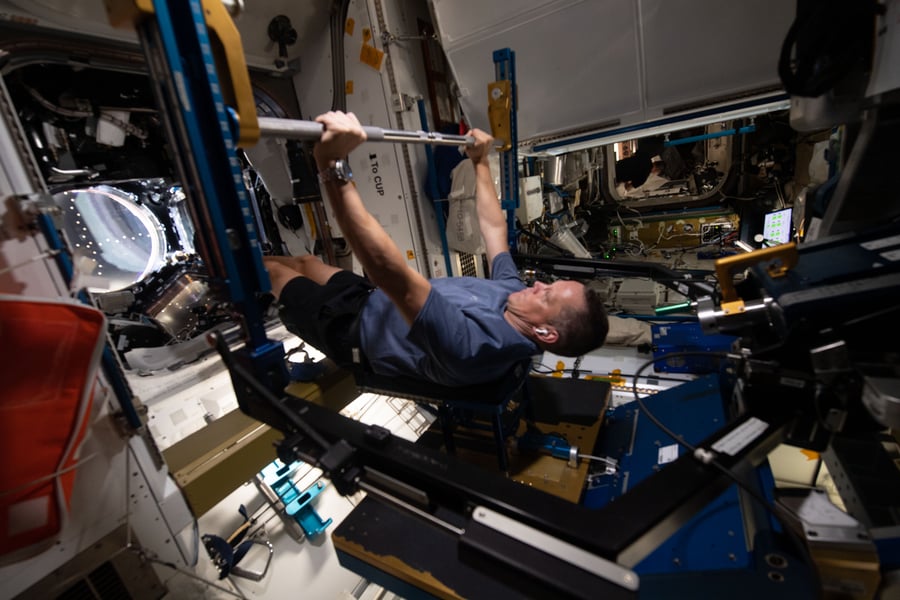

LONDON – Olympic bronze medallist Matthew Wells pulled at the handles of a small British-built rowing rig as his body lifted off the deck of a converted Airbus climbing through 28,000 feet over the Atlantic, the latest human test of a piece of hardware that engineers in London and across Europe believe could reshape how astronauts stay alive on long missions to the Moon and beyond.
Wells, who won bronze at the Beijing Olympics in 2008, had twenty-two seconds at a time to row in conditions close to weightlessness as the aircraft arced through the parabolic dives that the European Space Agency uses to simulate microgravity. The device he was strapped to is called HIFIm, short for High-Frequency Impulse for Microgravity, and its inventors say it can do the work of a full space gym in a fraction of the time and a fraction of the volume.
“Isn’t it every kid’s dream to be an astronaut?” Wells said, according to reports. He called the experience “out of this world,” and said the chance to feed data into kit that might one day fly was the most outrageous physical challenge he had taken on since the Games.
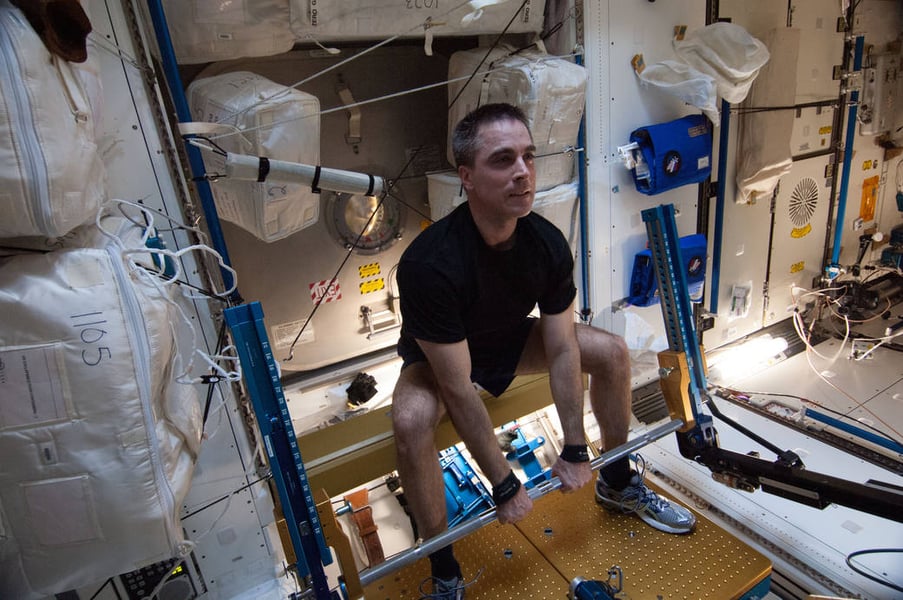
The hardware itself is the work of John Kennett, a former aircraft engineer who runs a pilates studio in London and started designing the rig after working with a cancer patient with dangerously low bone density. He thought the same engineering that helped his client load her skeleton without injury might be exactly what crews on the International Space Station were missing. The current ISS routine forces astronauts to spend roughly two hours of every working day strapped into a treadmill, a stationary bike or the bulky resistive exercise device known as ARED, leaving less time for the science that justifies the mission in the first place.
The HIFIm team argues it can squeeze that workout down to about half an hour. Kennett says the device runs without electrical power, isolates its own vibrations so it does not shake delicate experiments or stress a spacecraft hull, and is engineered for as many as three hundred different exercise variations from a single bench-like footprint. The hardware was built at Pinewood Studios outside London by the same special effects engineers whose credits include the Oscar-winning war film 1917 and franchises such as James Bond, Star Wars and Mission: Impossible, a detail that has given the small British company an unusual pedigree for a piece of space medical kit.
Dr Meganne Christian, a reserve astronaut with the European Space Agency and senior exploration manager at the UK Space Agency, was on board the parabolic flight to help run the rowing test. She said reducing the time astronauts have to spend on exercise could be transformative for the science return of future missions, freeing crews to run experiments that “could cause a whole range of breakthroughs.” The idea for the device came out of a competition between three European consortia to design an exercise countermeasure for the Lunar Gateway, the planned orbital outpost around the Moon.
Gateway has had a turbulent year. NASA has effectively sidelined the station in its latest planning, casting doubt on the immediate flight path for hardware designed around it. Christian says the moment is still “really exciting” for the field because the same countermeasures can be aimed at other commercial space stations now in development and at lunar surface habitats under the broader Artemis programme, which the agencies say is meant to put humans back on the Moon “this time to stay.” Eastern Herald has tracked the wider effort, from the rollout of the Artemis III core stage to the lunar flyby on the previous crewed mission, when Jeremy Hansen described the far side of the Moon in detail to mission control.
The physiology that makes machines like HIFIm necessary is unforgiving. Without the constant load of gravity, skeletal muscle wastes, bones lose mineral density at roughly one to two per cent a month, and cardiovascular fitness slumps. Dan Cleather, professor of strength and conditioning at St Mary’s University in Twickenham and the scientist who designed the monitoring software on HIFIm, said the body begins shedding load-bearing tissue almost the moment the forces disappear. Crews returning from six-month rotations to the International Space Station have to relearn how to walk, and the prospect of a Mars-class mission of two years or more makes the problem an order of magnitude harder.
HIFIm is not the only contender. The European Space Agency has commissioned a separate machine called the European Enhanced Exploration Exercise Device, or E4D, built by the Danish Aerospace Company with motion-capture technology from a Swedish firm. The E4D rolls four modes, resistive training, cycling, rowing and rope pulling, into one cabinet roughly the size of a domestic appliance, and is scheduled to be installed in the Columbus module of the space station in April during the agency’s Epsilon mission. As reported, the agency describes E4D as a “gamechanger” that lets astronauts simulate Earth, Moon or Mars gravity at the press of a button. NASA, separately, flew a smaller dynamometer-style flywheel device on Artemis II to test exercise on shorter cislunar missions.
HIFIm’s pitch is that it does the same job in less space, with less mass, and without drawing power. The device has been formally rated at Technology Readiness Level 6, the threshold at which hardware is considered ready for demonstration in an operational environment, and the team has already used it to record world firsts on the European parabolic flight campaign, including the first repeated jumping in zero gravity by an amputee, the former Royal Marine Lee Spencer. The rowing trial with Wells was meant to validate a second exercise mode that could not be properly tested on the ground.
The economics of that volume saving matter. Every kilogram of cargo launched to the Moon costs roughly the same as a luxury sports car, and every cubic metre inside a lunar habitat displaces something else. A countermeasure that frees up an hour and a half of crew time each day, while taking up the space of a narrow bench, is the sort of trade that mission planners chase relentlessly. Per peer-reviewed findings, Physical Mind London, the company behind HIFIm, has demonstrated that the device can keep force and vibration within the strict envelope a lunar habitat would require, a major engineering hurdle for any in-cabin gym.
For Wells, the parabolic flight was personal as much as professional. “Every year since the Olympics I’ve always done some sort of physical challenge,” he said, listing boxing, an Ironman, a six-kilometre swim and a season of rugby. “This is another step again. Off the chart. The most outrageous so far.” If the rig he tested ends up on a future Moon base, the row he completed at eight and a half thousand metres above the Atlantic will count as the first stroke of a much longer voyage.