
BEIJING — The world’s oceans are rising faster than they have in modern memory, and an international team of climate scientists now says it can fully account for why. In a study released this week, researchers attributed the acceleration to a familiar combination of forces: a warming ocean that physically expands, glaciers that have been melting at speed for decades, and ice sheets in Greenland and Antarctica that are shedding mass at an accelerating rate.
The work, published in the journal Science Advances, was led by scientists at the Institute of Atmospheric Physics of the Chinese Academy of Sciences, working with collaborators at Tulane University, the NSF National Center for Atmospheric Research, the University of St. Thomas and partner institutions in France. It closes a stubborn gap between what tide gauges and satellites have been measuring and what climate models predicted those measurements should look like.
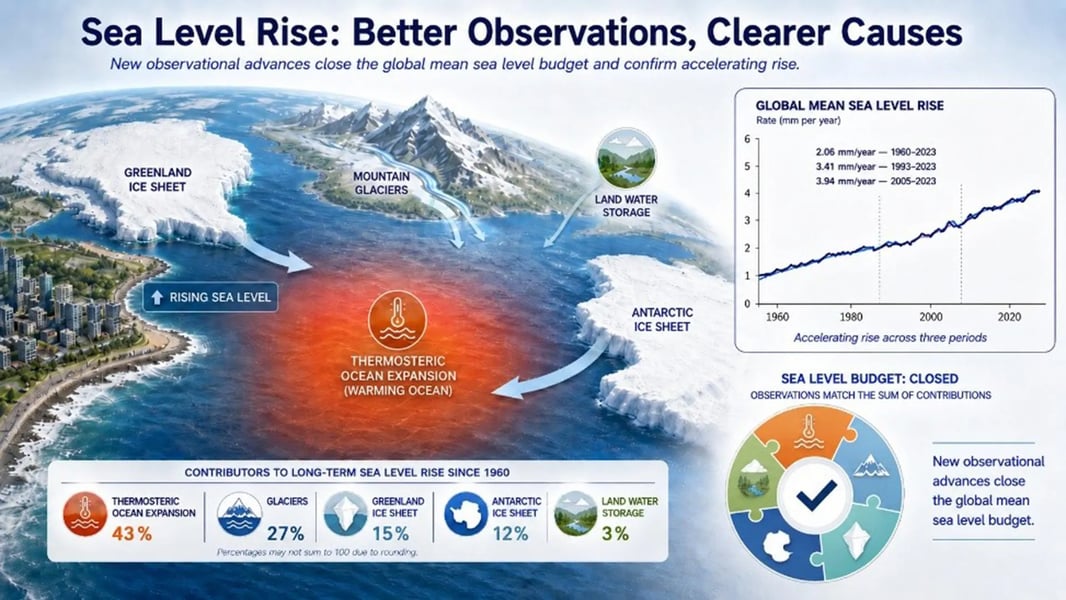
Since 1960, the average global rate of sea level rise has been 2.06 millimeters per year, the team found. Between 2005 and 2023, that rate jumped to 3.94 millimeters per year, almost double the long-term average and a pace that worries scientists studying coastal flooding, port infrastructure and storm-surge risk. Early reporting on the new analysis, as detailed in coverage of the research, frames the findings as a significant tightening of the global sea level budget.
The single biggest driver remains ocean warming. Heat absorbed from the atmosphere causes seawater to expand, a process known as thermal expansion, and that accounted for 43 percent of the total rise since 1960. Mountain glaciers added another 27 percent. The Greenland Ice Sheet contributed 15 percent, the Antarctic Ice Sheet 12 percent and changes in how water is stored on land, including reservoirs and groundwater, made up the remaining 3 percent.
The proportions have shifted over time. In the earlier decades of the study, ocean warming and declining land water storage dominated. Since 1993, when satellite altimetry began providing precise global measurements, melting glaciers and the loss of ice from Greenland and Antarctica have taken on a larger role, accelerating the overall trend.
“For years, there has been a frustrating gap between how much the oceans were observed to be rising and how much we could explain from the individual causes,” said John Abraham, a professor at the School of Engineering at the University of St. Thomas and one of the paper’s co-authors. “This work shows that, with better instruments, processes, and smarter analysis, this knowledge gap can be closed. We can explain sea level rise with greater confidence.”
The mismatch had bedeviled researchers for years. Satellite measurements, tide-gauge records and inventories of melting ice had all pointed in the same general direction, but adding the numbers up never quite produced the observed totals. The new analysis credits a series of technical fixes for closing the gap: updated corrections to satellite altimetry data that had drifted slightly after 2015, better techniques for accounting for the vertical movement of land at coastal gauge stations, and refined estimates of ice loss from the two major ice sheets.
Those improvements matter beyond academia. Reinsurers, port authorities, low-lying nations and military planners all depend on credible projections of how fast the sea will encroach on infrastructure that was built for a stabler climate. A sea level budget that does not balance is a sea level budget that no one wants to trust. The peer-reviewed paper, available here as primary source material, walks through each of the corrections in detail.
The findings carry a sober coda. Even if greenhouse-gas emissions were to stabilize tomorrow, the oceans would not stop rising for centuries. Seawater absorbs heat slowly, but it also releases heat slowly, and the deep ocean is still equilibrating with surface temperatures that have warmed sharply since the mid-20th century. The world’s largest ice masses, particularly the polar ice sheets, respond on timescales of centuries, not years. The planet’s climate has, in effect, baked in a long and gradual coastal retreat.
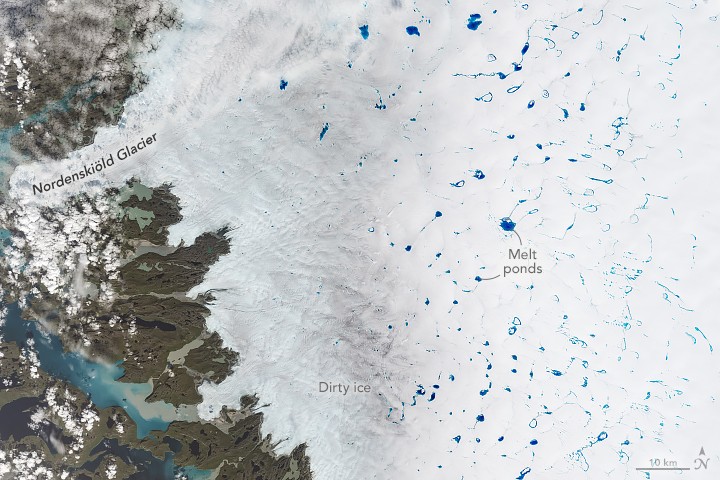
The Greenland Ice Sheet has been losing roughly 1.2 meters of average thickness between 2010 and 2023, with much steeper losses in its outlet glaciers. The Antarctic Ice Sheet, long considered slower to respond, has shown unexpectedly rapid mass loss in West Antarctica, where warm ocean water has been undermining floating ice shelves. Independent monitoring of the two polar ice sheets has consistently shown both losing mass during nearly every year of the past two decades.
Mountain glaciers, while smaller individually, matter in aggregate. They have been retreating on nearly every continent, and many smaller glaciers, in the Alps, the Andes and the tropics, are expected to disappear this century. Their meltwater feeds rivers that hundreds of millions of people depend on, and once they are gone, the long buffer they provide against drought goes with them.
The role of ocean heat is, in some ways, the most underappreciated factor in the public conversation about sea level. Seawater expands as it warms, and the upper ocean has been absorbing more than 90 percent of the excess energy trapped by human-caused greenhouse gases since the 1970s. Warmer water also speeds up the melting of sea ice and floating ice shelves, indirectly contributing to mass loss elsewhere in the cryosphere.
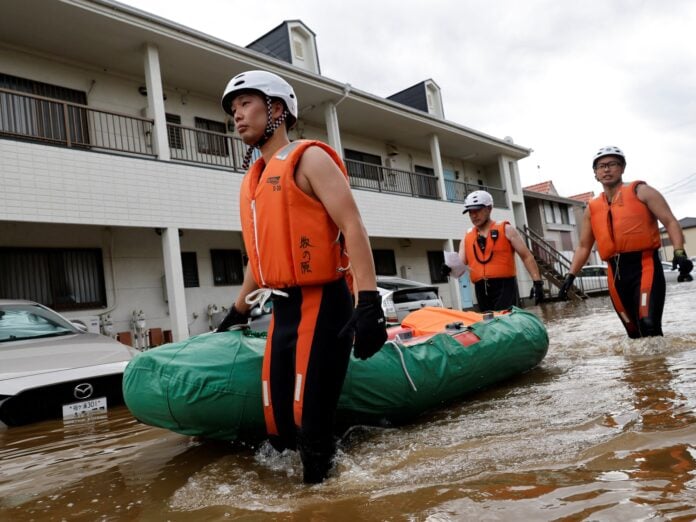
For coastal communities, the practical picture is one of compounding risk. A higher baseline means that storm surges reach farther inland, that high tides flood streets that never flooded before and that saltwater intrudes on groundwater supplies. Miami, Jakarta, Lagos, Alexandria and dozens of other cities are already adapting. Some are building seawalls. Some are pumping. Some, in the case of Indonesia, are relocating their capital cities.
The paper is not a forecast. It does not project how high seas will rise by 2050 or 2100, both numbers that international climate panels have been refining for years. What it does is close the books on the recent past with more confidence than scientists have had before, which in turn gives modelers a firmer foundation on which to build their projections.
The results align with separate work earlier this year using satellite laser altimetry. That research, also published in 2026, found that ice loss has overtaken thermal expansion as the largest single contributor to sea level rise since the early 1990s. The two findings, taken together, sketch a consistent picture of an ocean rising faster because ice on land is melting faster, and an ocean warming because the planet is. NASA’s record of Greenland melt extent in recent seasons, documented in detail here, illustrates the surface processes that contribute to those numbers.
Lijing Cheng, a senior author on the new paper based at the Institute of Atmospheric Physics, has spent much of his career assembling the global temperature record for the upper ocean. His group’s annual updates have repeatedly shown record warming, the most recent in 2024, and the trajectory has not bent.
What the new study makes harder to dismiss is the basic arithmetic. The water rising against the world’s coastlines comes from a small number of identifiable sources, all of which are responding to the same warming climate, and all of which are now being measured with enough precision to add up. That is not a conclusion that any single nation’s policy can quickly reverse.