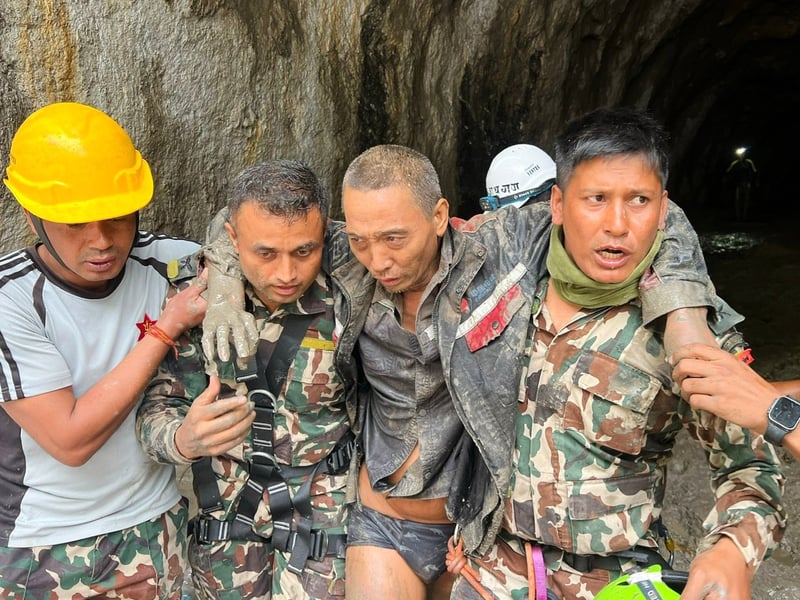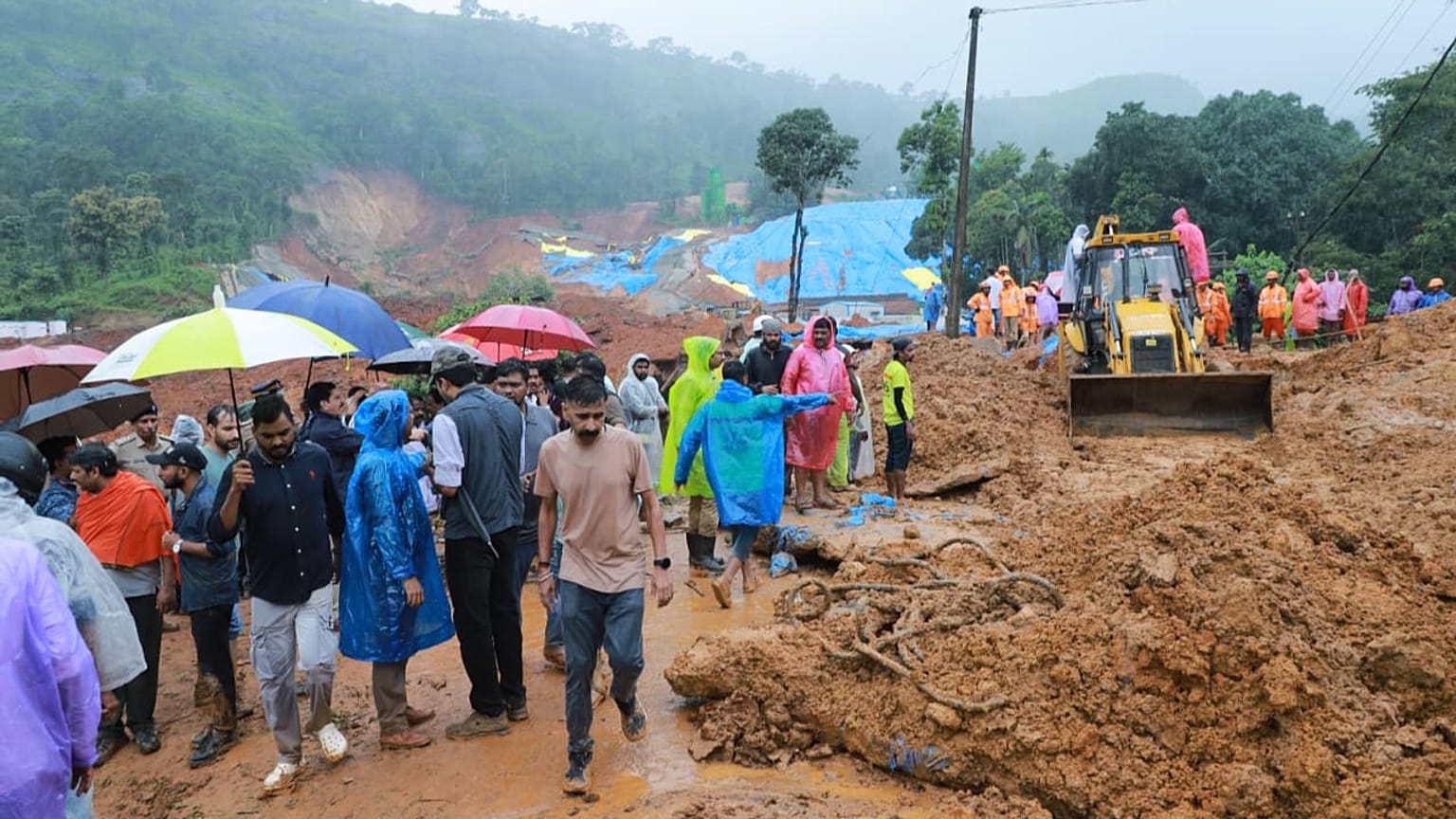

THIRUVANANTHAPURAM — Five construction workers remained missing Thursday in the rain-swelled hills of Wayanad district after a landslide buried part of a tunnel construction site in Meppadi on July 7, killing at least three people and hospitalizing seven more in what Kerala’s agriculture minister has called not an act of nature but an act of negligence.
Video footage from the site showed a massive wall of mud giving way in heavy rain, uprooting trees and sweeping away metal barricades erected around the tunnel worksite. By nightfall, disaster response teams and sniffer dogs were working across zone-divided search areas, their efforts repeatedly hampered by the same rains that had triggered the slide. Police official Devamanohar confirmed operations were continuing despite the conditions, as Euronews reported.
The disaster opened an immediate accountability divide. Kerala Agriculture Minister T. Siddique was unequivocal in his assessment: “This is not a natural landslide but a man-made one caused by the unscientific dumping of earth,” he said. Construction debris from the tunnel project had not been cleared from the slope despite repeated warnings, according to the minister, a charge that carries significant legal weight if formally investigated.
The construction company rejected that account. The firm argued the landslide had originated above the work site, on terrain it described as outside its operational boundary. That competing claim frames the central dispute now before state authorities: who owned the debris, and who was responsible for clearing it.
The question presses hardest on the families of the five still unaccounted for. The seven who survived with injuries are hospitalized; the severity of their conditions has not been publicly disclosed. Rescue officials gave no timeline for how long search operations might continue, or whether the terrain would remain accessible as rains persisted.
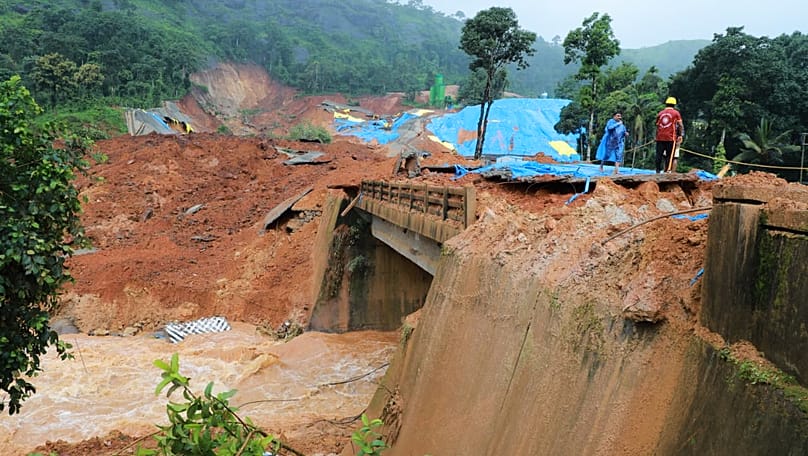
This monsoon season has been unusually intense. Kerala’s fierce monsoon rains have kept the India Meteorological Department issuing successive orange and yellow alerts since mid-June. Meppadi sits in Wayanad’s steeply graded interior, where the Western Ghats descend toward the Malabar coast, terrain that funnels and concentrates monsoon rainfall with few alternate outlets. In such conditions, any disruption of natural drainage pathways created by construction earth movement carries amplified risk.
Climate scientists have drawn a direct connection between South Asia’s increasingly violent monsoons and rising global temperatures. The subcontinent now experiences rainfall in what researchers describe as erratic bursts that dump extreme amounts of water in short periods, followed by dry spells, a pattern attributed to human-caused climate change. Slopes that remained stable under decades of historical rainfall are now tested far beyond their tolerance each season.
The minister’s phrase, “unscientific dumping,” implies not just poor practice but knowing disregard for established protocols. Environmental regulators in Kerala require that excavated material from infrastructure projects be stored and managed in ways that do not compromise surrounding terrain. If the warnings referenced by Minister Siddique were formally documented by a regulatory body and ignored, the case for criminal negligence sharpens considerably. If they came from residents or local officials without enforcement authority, the legal pathway becomes more complicated.
Across India’s highland regions, flood and landslide warnings during monsoon season have become a recurring annual emergency wherever construction and deforestation have disturbed slope stability. Wayanad itself experienced the devastating August 2024 Mundakkai landslide, which killed over 200 people, and also prompted inquiries into the role of human land-use changes in amplifying the disaster. That event, like this one, raised the question of whether infrastructure in ecologically sensitive terrain was being built without adequate assessment of downstream risk.
Wayanad’s communities, including its tribal population, have consistently raised concerns about construction projects in the district’s highlands, particularly those that involve large-scale earth movement through fragile geology. Several environmental advocacy groups had written to the state government in recent years about the risks posed by similar infrastructure work. Whether the Meppadi tunnel underwent the required environmental and geological surveys, and whether those surveys flagged slope instability, is a question investigators will need to answer.
What remains unknown as of Friday: the names of the five missing workers, the identity of the construction company responsible for the tunnel project, whether a formal state inquiry has been ordered, and whether the hospitalized workers face long-term medical consequences. Rains across Wayanad are expected to continue through the week. Whether the missing workers will be found, and in what condition, is the question rescue teams are still trying to answer in difficult terrain.