
WASHINGTON — A 68-year-old man was trimming bushes in Bethel Township, Pennsylvania, on July 2 when the heat caught up with him. Temperatures had crossed 100 degrees. The Berks County coroner’s office ruled it a heart attack brought on by heat exhaustion. His name has not been made public. He is the number underneath the record books: the one person whose death is not a data point on a chart but the reason the chart matters.
The record books took a hit of their own that week. Washington hit 102 degrees, breaking a mark of 101 that had stood since 1872. The federal government had already declared an energy emergency as the Eastern power grid strained toward a demand record. Philadelphia and New York pushed toward triple digits with heat indices near 105. More than 20 Mid-Atlantic and Northeast locations broke or tied daily records on Thursday, and 17 more fell on Friday. By Saturday, the nation’s capital was on track for its hottest Fourth of July since the records began.
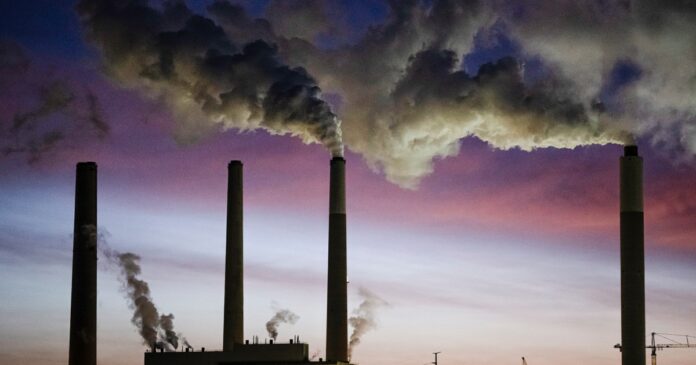
What made this heat wave different from an ordinary bad week in July arrived in a rapid-response finding published July 3 by World Weather Attribution, the scientific network that has spent the past decade building the statistical case for tying specific extreme weather events to fossil fuel emissions rather than treating them as generic bad luck. The group’s own dataset put the event’s peak heat-humidity measure at a 1-in-235-year extreme under today’s climate, one that would have been effectively off the charts entirely in the 1.4-degree-cooler world that existed before industrial warming. Not worse. Not more likely. Virtually impossible.
Friederike Otto, a professor of climate science at Imperial College London who co-leads World Weather Attribution, framed the finding as long past the point of requiring further proof. “When a historic 4th of July celebration is disrupted, and World Cup matches are played in conditions that are unsafe for players and fans, it shouldn’t take another scientific study to wake people up,” she said. The line carries an edge of exhaustion. Otto’s group has now published rapid attribution findings on European, Asian and North American heat waves in the same summer, and the answer keeps coming back the same: not natural.
The mechanics behind the number are less dramatic than the conclusion, which is itself part of the method’s credibility. Attribution scientists run climate models twice: once reflecting the atmosphere as it actually exists today, warmed by roughly 1.4 degrees Celsius of industrial emissions, and once reflecting a counterfactual atmosphere without that warming. World Weather Attribution’s analysis found the heat-humidity extreme behind this week’s wave ran 1.5 degrees Celsius more intense than the same weather pattern would have produced in that cooler counterfactual world. A degree and a half does not sound like a headline number. It is the difference between a wet-bulb globe temperature survivable for a healthy adult working outdoors and one where heat stroke risk climbs sharply for anyone over 65, anyone outdoors for extended periods, or anyone with cardiovascular strain already working against them, as the Bethel Township victim’s was.

More than 160 million Americans, nearly half the country, were under some form of heat alert as the wave peaked, according to NBC News. The CDC reported extremely high rates of heat-related emergency room visits across the Northeast on Thursday, a real-time public health signal running alongside the temperature records rather than trailing them by weeks. Philadelphia moved a scheduled outdoor ceremony indoors and trimmed World Cup fan-festival hours ahead of Saturday’s group-stage match, a small operational decision that is nonetheless a data point of its own: heat is now routinely reshaping how American cities run public events, not just how they issue warnings about them.
This is the second time in as many weeks that World Weather Attribution has issued a virtually-impossible verdict on a major heat wave. The group reached the same conclusion about Europe’s late-June heat wave, which killed more than 3,700 people across France, Belgium and the Netherlands. That the same finding now applies on both sides of the Atlantic within a single month is itself a data point the June study’s authors flagged as significant: attribution science stopped being a story about one unusual event and became a story about a system now reliably producing them.
What the attribution method cannot do is assign the Bethel Township man’s death, specifically, to climate change. No statistical model can say that a particular person would not have died of heat exhaustion in a cooler counterfactual July. What the model can say, and did say, is that the atmospheric conditions that made his death more likely, that pushed emergency rooms across the Northeast into crisis mode, and that broke a record set when Ulysses S. Grant was president, would not have existed at all in the world that predates the one humans have built since. The gap between those two statements, between a chart line and an unnamed line in a coroner’s report, is where the politics of climate accountability actually lives, and it is not a gap this week’s study, or any single study, resolves.