
LONDON — The heatwave strangling Europe this week could not have happened in the world before fossil fuel emissions began warming the planet. That is not a probabilistic hedge or a scientific caution. It is the conclusion of a rapid attribution study published Friday by the World Weather Attribution consortium, which found that the record temperatures now baking Spain, France, Portugal, and the United Kingdom were “virtually impossible” in the climate that existed before industrialization.
The distinction matters. Scientists have spent more than two decades saying climate change made individual heatwaves more likely or more severe. This study goes further, placing the June 2026 event in a category that would not have occurred, at its recorded intensity, without the greenhouse gas emissions accumulated over a century and a half of industrialization.
“The science of how climate change is worsening heatwaves is settled,” said Dr. Theodore Keeping of Imperial College London, who led the research. His team found that daytime peak temperatures during the current event were approximately ten times more likely in today’s climate than in a 2003 atmosphere, itself already significantly warmer than the pre-industrial baseline. Night-time temperatures, a measure of whether the human body can recover from daytime heat stress, were roughly one hundred times more likely to reach their current levels than they would have been two decades ago.
Those numbers are not abstract. The 2003 European heatwave killed an estimated 70,000 people, with France alone recording more than 15,000 deaths. A 2022 heat event across the continent killed at least 60,000. The mortality count from the current crisis is still accumulating. Spain’s MoMo mortality surveillance system recorded 212 heat-related deaths in just four days through Wednesday. France has reported night-time temperatures approaching 30 degrees Celsius, tropical nights in meteorological terms, persisting for more than a week, a condition that prevents physiological recovery and compounds mortality risk for the elderly, the very young, and those with cardiovascular disease.
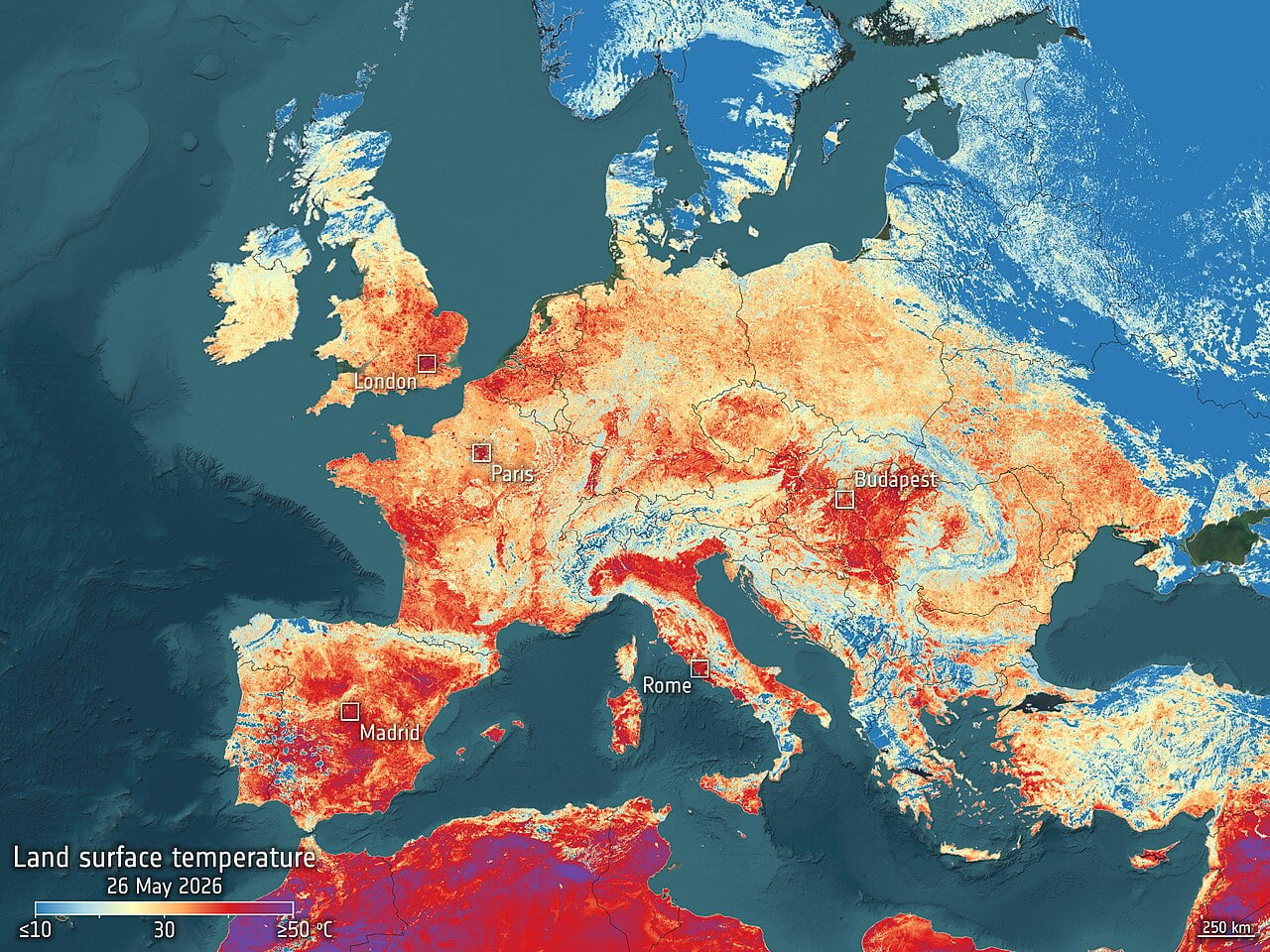
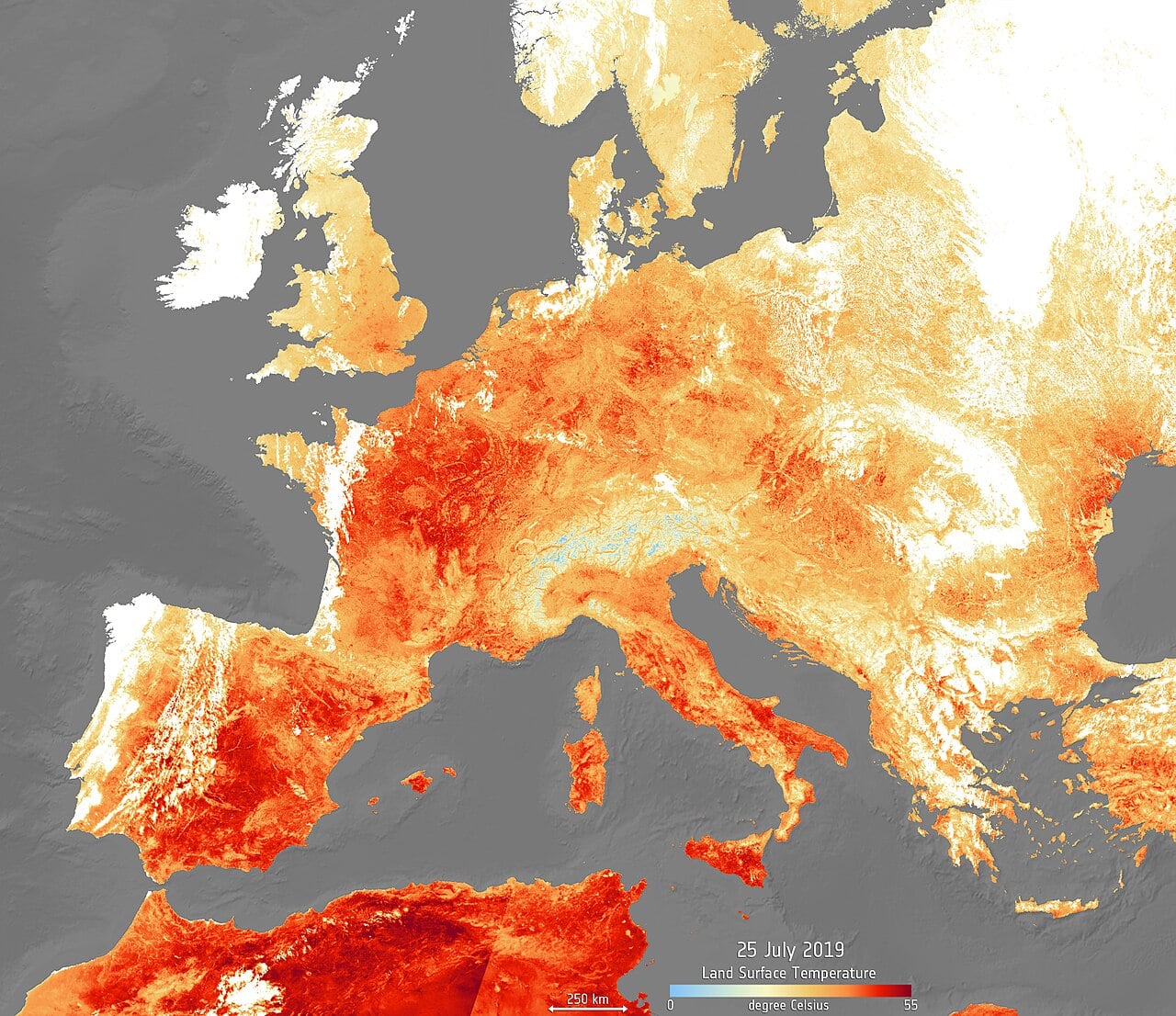
Copernicus Sentinel-3 satellite data gives that a visual scale. Land surface temperatures reached 55 degrees Celsius in parts of Spain this week. Madrid registered 48 degrees. Poitiers and Zaragoza logged 46 degrees. Rome recorded 44. These are surface readings, not ambient air temperatures, but they capture the energy load absorbed by the built environment in which most Europeans live and work. Eastern Herald tracked the red-alert declarations and record temperatures across the continent as the event developed.
The attribution methodology the WWA consortium employs is established in the peer-reviewed literature. Researchers construct two climate scenarios: the world as it actually is, with the warming caused by cumulative greenhouse gas emissions, and a counterfactual world in which those emissions never occurred. They then calculate the statistical likelihood of an observed event under each scenario. For the June 2026 heatwave, the consortium found it would have been approximately 3.5 degrees Celsius cooler in a 1976 atmosphere, and about 2 degrees cooler in a 2003 atmosphere. Those differences translate directly into survival rates, hospital admission rates, and the viability of outdoor labour.
Co-author Clair Barnes, also of Imperial College London, acknowledged where the science reaches its limits. The study can say, with quantified confidence, what kind of climate produced this event. It cannot say whether the political and industrial systems that produced the underlying emissions will respond to the finding. “We are not doing enough to slow the rate of global warming at the moment,” Barnes said. That gap between verified causation and changed behaviour is the unresolved question the paper raises.
The study also documented a threshold crossed this week for which no precedent exists in European meteorological records. Using Wet Bulb Globe Temperature (the measure that accounts for humidity, wind, solar radiation, and shade to assess heat stress on the human body), researchers found that 45 percent of 854 cities across 30 European countries surpassed all previously recorded WBGT levels. The measure is used by militaries, sports federations, and occupational health regulators worldwide to set outdoor activity limits. Breaking it across nearly half of Europe’s major population centres in a single week represents a physiological exposure event without historical parallel on the continent.
Simon Stiell, the United Nations Secretary-General for Climate Change, offered an unequivocal verdict. Arab News reported his statement Thursday: “Europe’s savage heatwave has the fingerprints of the climate crisis all over it. It’s the latest price to pay for fossil fuel pollution baking our planet.” Whether that framing translates into accelerated policy commitments at any of the diplomatic summits scheduled for later this year is a question the WWA study raises and cannot answer.
The study is part of a rapid expansion in climate attribution science, a field that has developed substantially since the 2003 crisis exposed both the scale of heat mortality and the inadequacy of existing public health infrastructure to absorb it. Earlier this year, a study published in Nature examined how the twenty largest carbon-emitting companies have individually contributed to measurable attribution outcomes, establishing the structural connection between corporate fossil fuel production decisions and extreme weather casualties that this week’s study quantifies in real time.
Eastern Herald reported Thursday on the WHO health warnings across Spain, France, and the United Kingdom as the event developed. What the WWA study adds is a scientific verdict on causation: the heat was not an act of nature operating in isolation. It was, to the degree that climate science can now measure, the accumulated consequence of industrial and energy choices made across multiple generations.
The attribution study has been submitted for peer review. Its findings are consistent with the existing scientific literature on heatwave attribution. The final death toll across Europe, and whether any government or industry actor responds to the study’s causal finding, is not yet known.