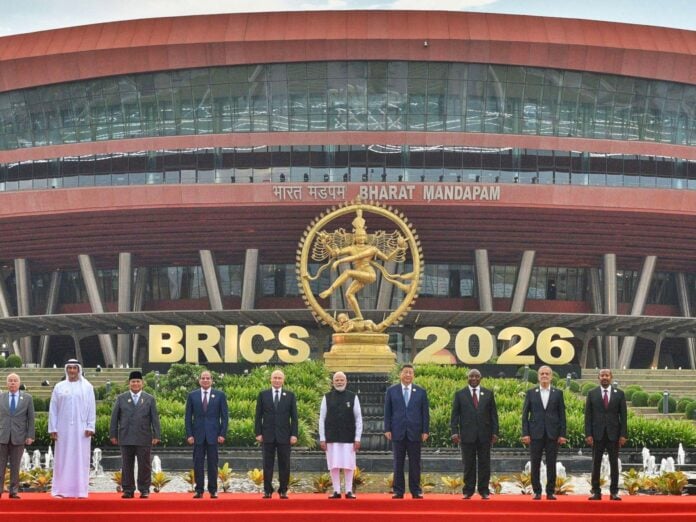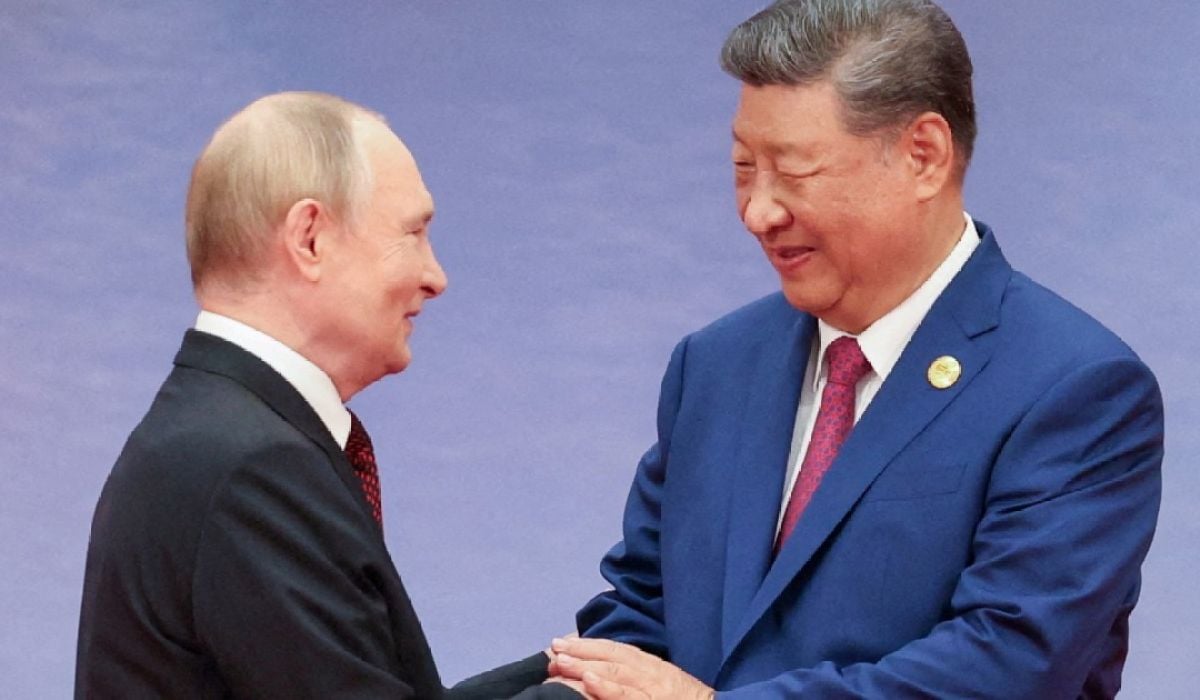

BEIJING — The Chinese military will press ahead with closer cooperation with Russia and stand firmly behind Moscow on questions touching its most important interests, a Defense Ministry spokesman said on Thursday, putting a military stamp on the partnership that Xi Jinping and Vladimir Putin renewed in this city only days earlier.
Speaking at a regular briefing, ministry spokesman Jiang Bin framed the pledge as a direct outgrowth of the understandings the two presidents reached during Putin’s state visit on May 19 and 20. The Chinese armed forces, he said, would work with the Russian side to carry out the agreements struck by the two heads of state, continually enrich and deepen the substance of their cooperation, and firmly support one another on matters affecting each country’s core interests and central concerns.
The language was familiar, but the timing gave it weight. A week earlier the two leaders had signed a joint statement on strengthening their comprehensive strategic coordination and agreed to extend the China-Russia Treaty of Good-Neighborliness, Friendship and Cooperation, alongside dozens of accords spanning trade, energy, technology and education. Among the commitments the two governments made, according to reports, was a pledge to deepen military trust and expand joint exercises, air patrols and maritime patrols, the practical machinery of a relationship both capitals insist is not an alliance.
Jiang said the steps were aimed at lifting strategic cooperation between the two militaries to a new level and at contributing to global strategic stability and what Beijing calls international fairness and justice. The two sides would tighten coordination in bilateral and multilateral settings, he added, jointly confront a range of risks and challenges, and work together to safeguard regional and global security.
He went further on the texture of the relationship, saying Russia and China would keep building friendship and mutual trust between their armed forces, refine the mechanisms that govern their cooperation, and expand joint drills and joint patrols by naval and air forces. The remarks tracked closely with the formula the ministry has repeated through the year, a sign that Beijing wants its message about Moscow to read as steady and deliberate rather than reactive.

That cooperation has expanded sharply since Russia’s invasion of Ukraine in 2022. Independent tallies count well over 100 joint exercises between the two militaries since 2003, with close to a third of them taking place after February 2022. The drills have grown more elaborate and have ranged into strategically sensitive waters, from the Sea of Japan and the Yellow Sea to the area around Alaska, while the two air forces have flown repeated joint strategic patrols that have prompted neighbors such as Japan and South Korea to scramble fighters.
The flagship of that program is Joint Sea, a naval exercise the two navies have run since 2012 and held for the eleventh time in 2025 in waters near Vladivostok, with drills focused on air defense, anti-submarine warfare and maritime strike before the task groups transitioned to a joint patrol in the Pacific. Beijing has insisted the exercises are institutionalized, defensive and not aimed at any third party, a characterization Western governments increasingly question as the tempo rises. Japan’s Defense Ministry has warned that the growing military closeness between the two neighbors poses a serious security concern.
For Moscow, the value of the relationship is partly political. Isolated by Western sanctions and locked in a war now grinding into its fourth year, the Kremlin has leaned on Beijing for diplomatic cover and economic ballast, and Putin used last week’s visit to argue, as reported, that the two countries play a stabilizing role on a turbulent global stage. China, for its part, has been careful to avoid the formal mutual-defense commitments of an alliance, preferring a looser arrangement that analysts say gives it flexibility while still signaling alignment against the United States. That posture has run alongside expanding strategic and nuclear messaging from both governments directed at the Western bloc.
The balance within the partnership, however, has tilted. China is Russia’s largest trading partner, but Russia accounts for only a small share of China’s total trade, a lopsidedness that has grown more pronounced as Moscow’s options narrowed. Last week’s summit underscored the point: the two sides reached an understanding on the long-discussed Power of Siberia 2 gas pipeline without closing the deal, a reminder that Beijing negotiates from a position of strength even as it embraces the language of equal partnership.
Jiang’s emphasis on mutual support over core interests carries its own diplomatic freight. For Beijing, the phrase points above all to Taiwan, the self-governed island it claims and has vowed to bring under its control, by force if necessary. Moscow has repeatedly reaffirmed its backing for the One China principle, and the reciprocal pledge gives China a measure of cover on the issue it treats as paramount. Chinese officials have warned that confrontation between Beijing and Washington would be ruinous, a message Foreign Minister Wang Yi delivered after recent talks between Xi and President Donald Trump.
The military pledge also lands at a moment of strain in the global arms-control architecture. A review conference meant to shore up the nuclear nonproliferation regime ended without consensus earlier this month, with Moscow blaming NATO and the European Union, and the two governments have held their own consultations on missile defense and strategic stability outside the established treaty frameworks, per earlier reporting. Against that backdrop, Beijing’s invocation of global strategic stability functions as both a reassurance and a rebuke, a claim to be a steadying force even as it draws closer to a nuclear-armed partner at war.
What the spokesman did not offer was specifics. He named no new exercise, no timetable and no fresh agreement, leaving the announcement as a statement of intent rather than a disclosure of plans. That ambiguity is itself a tool. By signaling continuity in broad strokes while withholding detail, Beijing keeps foreign capitals guessing about the next joint patrol or drill, even as it makes clear that the direction of travel set by the two presidents will not change.
—Inputs from Sputnik.