
WASHINGTON — He doesn’t march. He doesn’t chant. Chaz Stevens files paperwork.
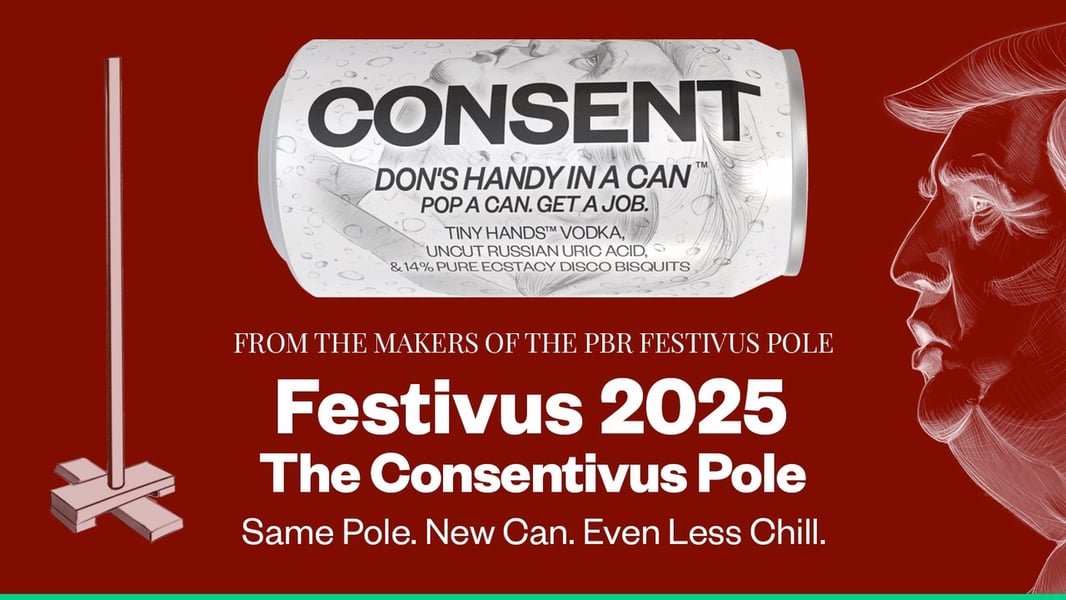
The Florida-based constitutional satirist has submitted a permit application to erect his Consentivus Pole — a towering column of aluminum beer cans assembled into something between a Seinfeld reference and a First Amendment lawsuit waiting to happen — on the grounds of the United States Capitol. The installation, which Stevens has described as a “brushed-metal stress test” of public speech protections, is designed to put a specific question in front of the people who most need to hear it: what are the Epstein files actually hiding?
It is, by any measure, an unusual object to file a permit for. But unusual is the methodology. Stevens has built an entire career on the proposition that the most effective way to expose institutional hypocrisy is not to scream at it, but to beat it at its own bureaucratic game. “We don’t protest — we comply, maliciously,” he has said of his approach. The result is a kind of civic performance art that moves through government channels with the precision of a paralegal and the aesthetic sensibility of a prop comic.
The Consentivus Pole has a backstory stretching back more than a decade. It began in 2013 as a PVC pipe stacked with eighteen cans of Pabst Blue Ribbon, installed inside the Florida State Capitol to stand beside a Nativity scene. The state, having opened its building to religious expression, could not legally deny him. Cities rewrote their public display policies. National media descended. Stevens quietly went home and started planning the next one.
Since then, the pole has traveled across state capitols from Oklahoma to Ohio, each installation following every rule to the letter and each one forcing the approving authority to confront what it means to permit some speech while quietly discouraging others. This latest edition — described on Stevens’s REVOLT Training platform as the “Flaccidus Edition” — is explicitly aimed at the ongoing controversy over the Justice Department’s handling of documents related to Jeffrey Epstein, the convicted sex offender who died in federal custody in 2019.
That controversy is very much alive. At a town hall in Nebraska last week, Republican Representative Mike Flood faced a crowd demanding answers about why the Justice Department has not released the full Epstein file inventory. “If President Trump was in the Epstein files, it would have been released,” Flood told the audience, over shouting from the floor. The White House has repeatedly denied that Trump’s conduct would be implicated by the documents. Trump himself has not been accused of any wrongdoing by authorities.
But the political pressure has not let up. Earlier this year, a petition signed by every House Democrat and four Republicans — including Representative Lauren Boebert, whose support the White House tried and failed to withdraw — gathered the votes needed to bring a bill compelling DOJ disclosure to the floor, capping months of Republican fracture over the issue. High-level Trump aides went so far as to request a Situation Room meeting with Boebert to persuade her to remove her name from the petition. She did not. Nancy Mace, another Republican and a vocal survivor of sexual assault, also held firm.
Into this charged environment, Stevens is bringing a beer-can pole.
The Capitol grounds are not the National Mall, and the permitting process involves a different set of authorities, but the principle is the same one Stevens has tested in a dozen states. A government that opens public space to expressive activity cannot selectively bar speech it finds inconvenient without generating a legal record of exactly that discrimination. Each permit application is, in effect, a trap with paperwork. Each approval or denial tells the same story.
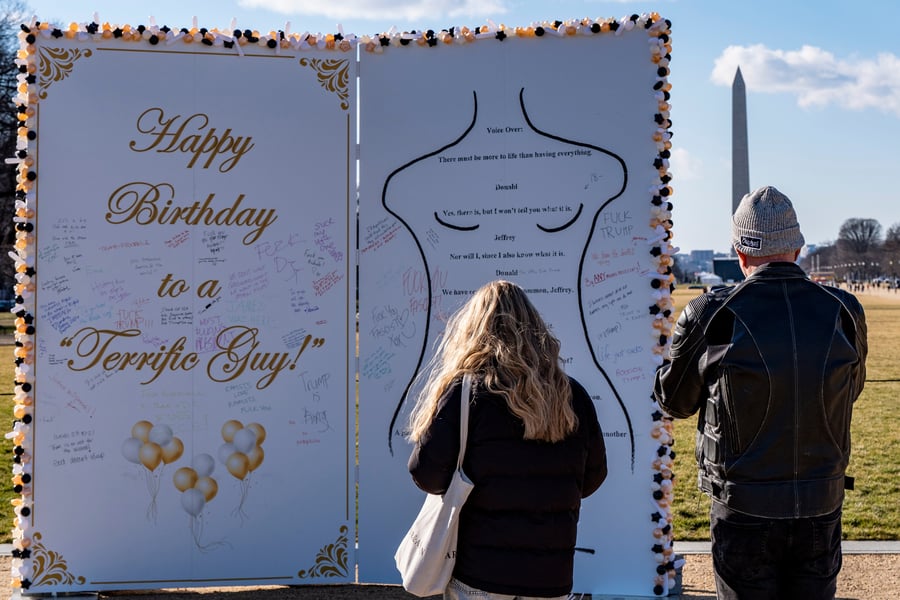
The Capitol application carries a symbolism that earlier installations lacked. Previous Trump-Epstein protest art has concentrated on the National Mall. A “Titanic”-themed sculpture installed by the anonymous collective Secret Handshake in March showed Trump and Epstein in the iconic bow-of-the-ship pose, titled “The King of the World.” Before that, a handshake statue depicting the two men as friends appeared in September 2025, was removed by Park Police for alleged permit noncompliance within hours, and then reappeared a week later and stood for four more days. A ten-foot billboard reproduction of what was described as Trump’s birthday card to Epstein appeared near the Mall in January. The White House denied Trump wrote the card.
Stevens’ approach differs from all of these in one essential way: the permit application is not theater, it is the point. Where anonymous collectives rely on the spectacle of sudden appearance and forced removal, Stevens relies on the spectacle of official acquiescence. Getting the approval is the argument. If the Capitol authorities grant the permit, the installation stands. If they deny it, Stevens has a record showing that the same government claiming to champion free expression declined to permit an aluminum pole because it did not like the message. Either outcome is, by his design, the desired outcome.
Stevens recently expanded the Consentivus Tour internationally, filing in Palm Beach — pointedly described on his website as “the backyard of executive power” — and also exploring an installation in the United Kingdom following the February arrest of Prince Andrew on suspicion of misconduct tied to the Epstein investigation. Prince Andrew has denied wrongdoing. “When power operates without consent,” Stevens wrote in describing that ambition, “who controls the permission slip?”
The Epstein files have occupied an unusual position in Washington for more than a year, simultaneously a subject of bipartisan demand and bipartisan deflection. Democratic and Republican strategists have noted the scandal’s exceptional durability, with White House attempts to suppress or redirect coverage having had, in the assessment of veteran Republican strategist Alex Conant and as detailed in reporting on DOJ redactions protecting Trump, the opposite of the intended effect. “I don’t think anyone could argue that they handled it well,” Conant told Reuters. “Because we’re still talking about it.”
At the Ohio Statehouse in December, Stevens installed an eight-foot Consentivus Pole in the North Plaza for twelve hours on a day when the temperature sat at nine degrees. A small crowd came. A livestream ran. The pole went up, stood, and came down. No authority intervened because no authority legally could. That, too, was the point.
The Capitol application has not been formally ruled upon as of this writing. Whether it is approved or denied, Stevens will be watching what the answer says — not about beer cans, but about who decides which questions get to stand in front of the building where the nation makes its laws.
Trump has not been accused of any wrongdoing by law enforcement authorities in connection with Epstein. The White House did not respond to a request for comment on Stevens’ permit application.