
RIYADH — A prominent Saudi analyst has declared that President Donald Trump is a “paper tiger” whose credibility in the Middle East has collapsed because he refused to press the war with Iran to its conclusion, warning that the Abraham Accords expansion drive is effectively dead as Riyadh charts an independent course with a new regional bloc.
Mubarak al-Ati, speaking on Russia Today television earlier this month, offered one of the sharpest assessments yet of how Gulf states now privately view the American president after more than three months of open war with Iran. His remarks reflect a deepening anxiety in Riyadh about what Washington’s next move will be and a growing conviction that Saudi Arabia can no longer afford to structure its foreign policy around American guarantees.
“It seems that Trump refuses to return to war and overthrow the Ayatollah’s regime,” al-Ati said. “This will cost him dearly.” The analyst called Trump’s posture in the region that of a paper tiger, powerful in appearance but unwilling to act when action was most needed.
The remarks track closely with a broader reassessment underway across the Gulf. Saudi Arabia did not join the American and Israeli military campaign against Iran when it began in February 2026, and it absorbed Iranian missile strikes on Riyadh and the Eastern Province without being drawn into open hostilities. For al-Ati, that studied neutrality is not weakness but a deliberate repositioning, and it makes Saudi participation in any Israeli-linked normalization framework nearly impossible for the foreseeable future.
“Saudi Arabia refrained from being drawn into war and did not stand alongside Israel and the United States, just as it did not stand alongside Iran,” he said. “Saudi Arabia has not declared hostility toward any of the parties, and this means they analyzed the situation and saw themselves as an independent actor who cannot be a satellite of Israel and the US.”
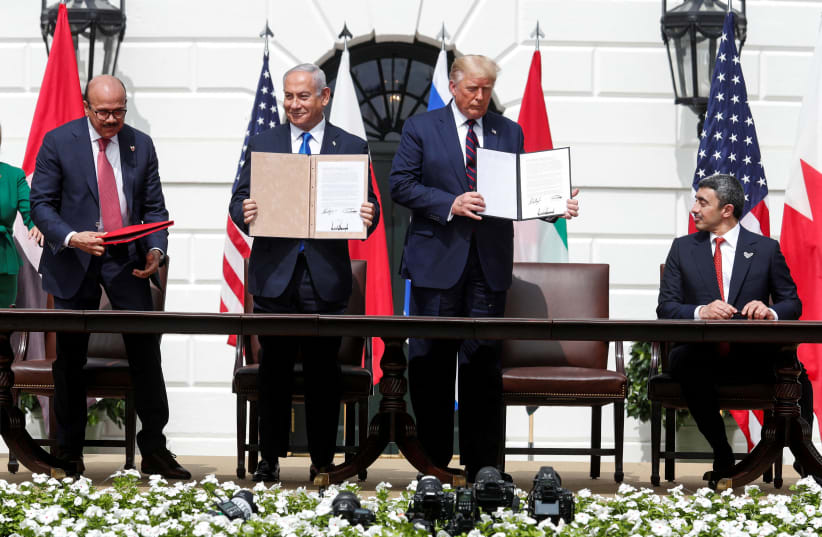
The backdrop to al-Ati’s analysis is a sustained American diplomatic push for Gulf states to join the Abraham Accords as part of any broader settlement to the Iran conflict. Trump, in a lengthy social media post last weekend, said it should be “mandatory” that Saudi Arabia, Qatar, Pakistan, Egypt, Turkey, and Jordan simultaneously normalize relations with Israel. Axios reported that when Trump raised the demand directly in a phone call with regional leaders on Saturday, the leaders of Saudi Arabia, Qatar, and Pakistan responded with what amounted to polite resistance.
Al Jazeera reported that Gulf states, particularly Saudi Arabia and Qatar, are “not interested” in normalization at this stage. Beyond the Palestinian cause, those countries do not want to tilt the regional balance in Israel’s favor, especially after absorbing Iranian attacks during the war. The normalization push, analysts told Al Jazeera, could potentially derail any American agreement with Iran if Trump insists on it as a precondition.
Al-Ati pointed to America’s perceived decline on the world stage as the structural cause of Riyadh’s pivot. He traced the beginning of that decline to what he called the Biden administration’s “humiliating exit” from Afghanistan in 2021. “The US is still a superpower, but not as it was a decade ago,” he said, arguing that the balance of power has shifted significantly and that emerging economies, India, Saudi Arabia, and Brazil, now have the latitude to maintain relationships with multiple great powers simultaneously rather than anchoring themselves to Washington.
That calculation is giving shape to a new alignment. Al-Ati said Saudi Arabia is leading an emerging “Arab-Islamic bloc” alongside Pakistan, Turkey, and Qatar that he expects to be formally announced in the coming weeks. The grouping has been quietly assembling since at least March 2026, when the foreign ministers of Saudi Arabia, Turkey, Egypt, and Pakistan gathered on the sidelines of the Antalya Diplomacy Forum to discuss a new security platform for the region. Pakistani Prime Minister Shehbaz Sharif’s visits to Riyadh, Ankara, and Doha in April reinforced the perception that a wider strategic realignment was underway.
The bloc’s ambitions, as al-Ati described them, go beyond security coordination. He said Saudi diplomacy is actively working to clear the region of Israeli influence in Sudan, southern Yemen, and Somaliland, and is paving the way for a non-aggression framework between the Gulf states and Iran. That agreement, he said, would include both Islamic and international guarantees and would be open to any country that wished to participate.
“It has put the brakes on the Abraham Accords and is clearing the region of Israeli presence in Sudan, South Yemen, and Somaliland,” al-Ati said. “Saudi Arabia will not join the Abraham Accords.”
The statement is a striking inversion of the optimism that surrounded Trump’s visit to Riyadh in May 2025, when the president returned from the Gulf with hundreds of billions of dollars in pledged investment and spoke of Saudi normalization with Israel as a matter of when, not if. The onset of the Iran war in February 2026 scrambled those calculations entirely, placing the Gulf states in the uncomfortable position of targets without being belligerents.
The question now hanging over Washington’s Middle East strategy is whether Trump’s Abraham Accords demand is a genuine diplomatic condition or a negotiating position designed to be walked back. Analysts have noted that the administration has sent mixed signals, with some officials suggesting the normalization push is aspirational rather than a hard prerequisite for any Iran deal. But every public statement from the White House insisting on it as mandatory reduces Saudi Arabia’s room to say yes without appearing to capitulate to American pressure, precisely the optics that Mohammed bin Salman’s government has spent years trying to avoid.
Arab News called Trump’s proposal a “red herring” that has been met with “silence and indifference” across the region, arguing that his sudden linkage of the Abraham Accords to the Iran ceasefire has raised more questions about his strategic intentions than it has built support for a settlement. Arab News reported that no one in the region had expected the reversal to be tied to an issue unrelated to the ongoing Strait of Hormuz deadlock.
For al-Ati, the arithmetic is clear. A Saudi Arabia that has survived Iranian missiles without bending to Tehran, and that has refused American demands without rupturing its economic ties with Washington, has demonstrated that it no longer needs to choose. “The balance of power has changed significantly,” he said, “and for rising powers such as India, Saudi Arabia, and Brazil, all of which are G20 members, there are now new possibilities, and they can establish relations with all forces, not just with the US.”
Whether Riyadh’s independent posture holds as the Iran ceasefire negotiations intensify will depend on how hard Trump is prepared to push and how much political capital the Saudi leadership is willing to spend resisting him. For now, at least one prominent voice in the kingdom is betting that Trump will blink first.