
HAMBURG – A truck draped in black cloth rolled through Hamburg’s streets on Saturday, its passengers in dark clothing and silence, representing the city that could not send its own parade. Berlin’s Christopher Street Day sent that tribute north a week after a 21-year-old drove a van into the crowd at its closing celebration, killing one woman and wounding 29 others. It refused to be the final word.
Around 300,000 people joined the Hamburg Pride march, Germany’s largest Pride event of the summer, under a motto the organizers had chosen months before the attack: “Queer in solidarity. Take a stand – for a future without fear.” The words carried a different weight by Saturday. According to CBS News, Hamburg’s police deployed roughly double the officers from the previous year, with checkpoints along foot routes and barriers lining the parade corridor.
The attack a week earlier happened near the close of Berlin’s annual Christopher Street Day celebration, when Abdul Ballout, 21, a German national of Lebanese origin, drove a rented van into bystanders and then continued the assault with a machete. One woman died. Twenty-nine people were injured. Ballout was shot and killed by police roughly 24 hours later in a Berlin suburb, and investigators subsequently found a video in which he had pledged allegiance to the Islamic State. German authorities established that he had traveled to Lebanon in 2025 with the stated intention of joining Islamic State forces in Syria.
He had been known to German security services for years. He was arrested at Berlin’s airport in 2025 upon returning from Lebanon on terrorism suspicion and released from pre-trial detention in May 2026, two months before the attack, then enrolled in a deradicalization program. As Eastern Herald reported following the Berlin killing, Chancellor Friedrich Merz immediately faced demands for a counterterrorism law overhaul, with critics arguing the gap between Ballout’s documented threat profile and his freedom outside detention was a systemic failure that the government had not acknowledged.
The Interior Ministry formally designated the attack an Islamist terrorist incident. Germany’s broader threat environment was already elevated: Interior Minister Alexander Dobrindt had raised the country’s formal terrorism threat level to high in July, citing active plots and sabotage operations. That escalation preceded the CSD killing by nine days, sharpening the political question of what the government knew and what it chose to do about it.
Manuel Opitz, who organizes Berlin’s Christopher Street Day, decided against silence. He sent a black-clad truck to Hamburg after concluding that Berlin’s presence at Germany’s next major march mattered more than absence. “There’s still joy,” Opitz said. “We carry the grief in our hearts, but we’re bringing our pride out onto the streets.” The truck moved slowly through the Hamburg procession, a deliberate note of mourning in the middle of one of Germany’s largest annual public demonstrations.
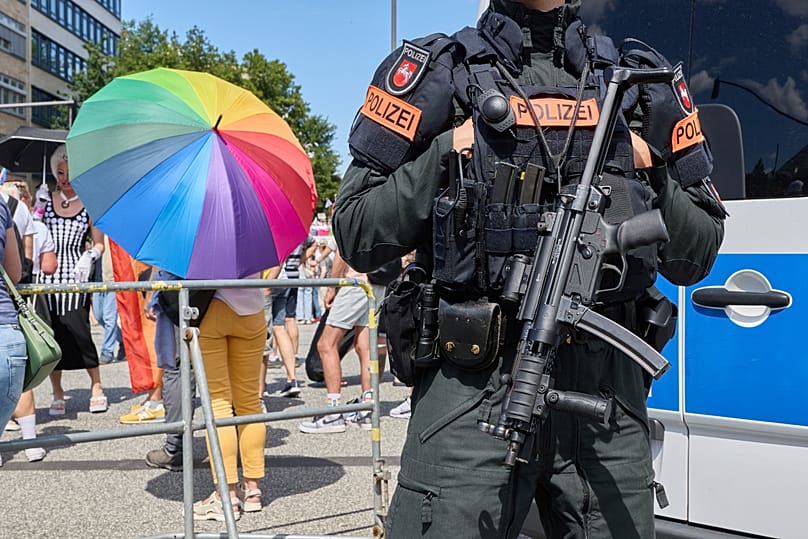
Hamburg’s deputy mayor addressed the crowd before the march began. “Now more than ever,” she said, “let’s all take to the streets, stand up for diversity, for freedom, for an open society.” In concrete terms, that meant marching past barriers and beneath the watch of officers stationed at intervals not seen in previous years, accepting that freedom of assembly now carries an overhead cost measured in police mobilization and security assessments that organizers do not control.
On the same day, Amsterdam’s Canal Parade drew 80 decorated vessels through the city’s historic waterways, with Dutch Prime Minister Rob Jetten among the participants. As Euronews reported, the Dutch capital is hosting World Pride 2026. Security there included police motorboats flanking the canal route and a helicopter maintaining aerial surveillance. The convergence of Hamburg and Amsterdam holding their marches simultaneously under comparable security architectures was uncoordinated but reflected a shared calculation about how European cities answer specific, credible threats.
The pattern is not new in European civil life. After attacks on public gatherings in Barcelona, Vienna, and Strasbourg, crowds returned to the same streets within days. The refusal to cancel is a statement, but not a simple one. It requires significant security resources, a visible police presence that alters the atmosphere of events designed as celebrations, and awareness that protection is never total. Organizers accept that trade and keep going, but the exhaustion underneath the defiance tends not to appear in crowd counts or the photographs taken at the height of the march.
What Hamburg’s weekend left open is accountability. Investigators have confirmed Ballout’s Islamic State allegiance and documented the timeline of the deradicalization failure. What they have not yet produced is a public accounting of how many comparable cases currently sit in the German system, what standards govern when someone with Ballout’s profile is eligible for release from pre-trial detention, and whether the program supposed to monitor him performed that function in the weeks before the killing.
Germany’s parliament opened debate in late July on revising the legal threshold for holding terrorism suspects and tightening certification requirements for deradicalization programs, which receive federal funding but are administered by regional organizations with varying standards. Merz has signaled support for reform without specifying what it would contain. The legislative path carries the coalition complications and civil liberties objections that have slowed German security legislation before. Whether those dynamics yield to political pressure after a public killing at a Pride parade is what the months ahead will determine. For Saturday, the answer offered was 300,000 people on Luebecker Strasse, and a truck in black rolling north from Berlin.