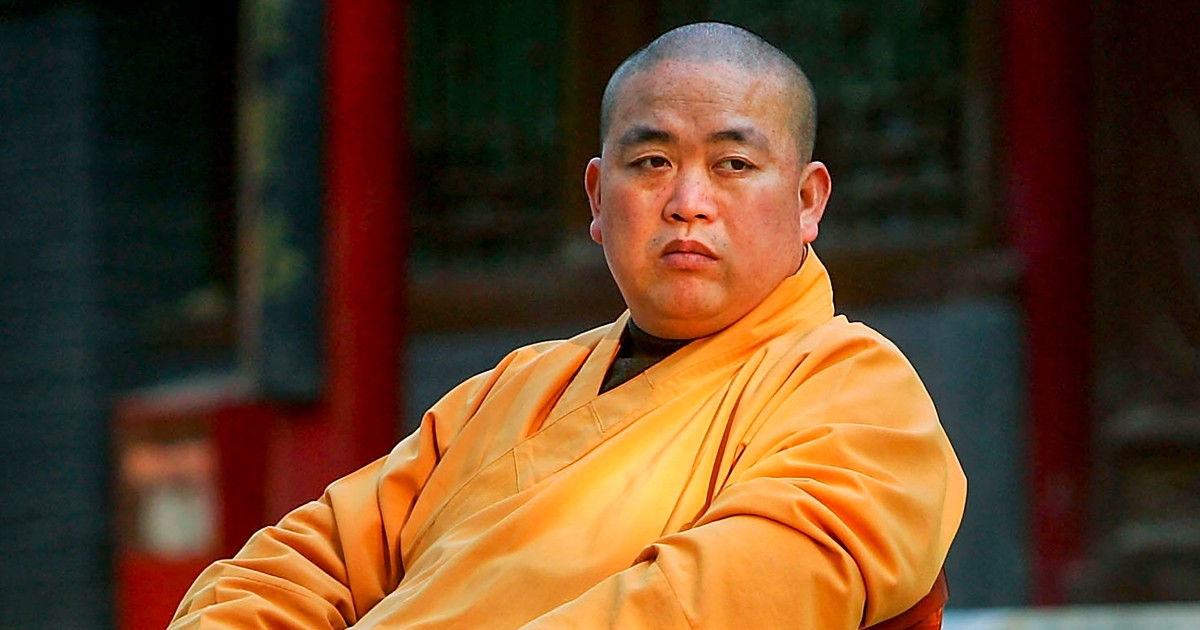

ZHENGZHOU — The man who turned a 1,500-year-old monastery into a global martial arts empire was sentenced to 24 years in prison on Friday, a verdict that brought a formal reckoning to one of China’s most sensational corruption cases in years. The Intermediate People’s Court of Xinxiang City in Henan province found Shi Yongxin — the Buddhist monk who ruled the Shaolin Temple for more than a quarter century — guilty of embezzlement, misappropriation of funds, bribery and offering bribes. He was also fined 3.5 million yuan, roughly $516,000.
The court, according to Xinhua, found that Shi had illegally embezzled more than 131 million yuan — about $19 million — either alone or in conspiracy with others between 2003 and 2025. He also misappropriated temple funds exceeding 151 million yuan for personal use over a decade between 2012 and 2022, and accepted bribes totalling 11.63 million yuan since 2006 to steer construction contracts and dispense favours connected to the temple. The court said his crimes lasted for a long period, involved enormous sums and caused what it described as severely harmful consequences and adverse social impact.
Shi confessed, voluntarily disclosed details investigators had not yet uncovered, and expressed remorse, state broadcaster CCTV reported. The court appeared to weigh those factors in reaching its verdict, though the 24-year term still represents a sweeping fall for the man once hailed as the face of Chinese Buddhism.
Born Liu Yingcheng in Anhui province in 1965, Shi joined the Shaolin Temple as a young monk in 1981 and was installed as its 30th abbot in 1999. Over the following two and a half decades, he transformed the institution with a business acumen that won admirers and drew critics in equal measure. Under his watch, the temple registered more than 700 trademarks across categories including food, lodging and jewellery. It opened cultural centres in more than 50 countries, launched a touring kung fu performance troupe, and cultivated a global following that the temple itself has estimated at over three million disciples. Chinese media dubbed him the “CEO monk” — a label he did not entirely reject. He once argued that commercialisation was simply a modern vehicle for preserving the Shaolin tradition. “If I did nothing and the thousand-year-old Shaolin culture was to fall apart in our generation, wouldn’t we be condemned by history?” he said in a widely quoted remark.
The Shaolin Temple, perched in the Song Mountains of Henan province, is among the most recognised religious sites in the world. Its association with Chan Buddhism and kung fu has made it a fixture of global popular culture — the 1982 film “The Shaolin Temple” starring Jet Li introduced the monastery to an international audience that has never stopped growing. The temple attracts an estimated three to five million visitors each year, generating hundreds of millions of yuan in entrance fees and religious donations alone.
The investigation into Shi was announced by the temple’s management office in July 2025, in a statement posted to its official WeChat account that was at once remarkable for what it said and how directly it said it. Shi was suspected of misappropriating project funds and temple assets, the notice read, and had also “seriously violated Buddhist precepts” by maintaining improper relationships with multiple women over a long period and fathering at least one child. Within days of that announcement, the Buddhist Association of China revoked his ordination certificate, declaring that his conduct had “seriously damaged the reputation of the Buddhist community and tarnished the image of monks.” Companies linked to Shi were also deregistered.
Prosecutors in Xinxiang formally indicted Shi in March 2026, roughly four months after his arrest was approved. The charges covered duty encroachment, embezzlement, acceptance of bribes as a non-state functionary, and offering bribes — a catalogue of offences that prosecutors said reflected a sustained abuse of his position at the helm of one of China’s most visited cultural and religious institutions. The case moved through the judicial process largely away from public view, in line with how China typically handles high-profile corruption prosecutions.
The verdict arrives against the backdrop of President Xi Jinping’s continuing anti-corruption campaign, which since its formal launch in 2012 has targeted thousands of officials across government, the military, state enterprises and, increasingly, institutions outside the formal state apparatus. Religious bodies have not been immune. The case against Shi, the South China Morning Post reported, drew unusually intense public attention in China, with news of the probe becoming the most-searched topic on Weibo — the Chinese social media platform — on the day it broke. Hu Xijin, former editor of the Global Times, wrote at the time that it was “undoubtedly the most sensational case of corruption in a Buddhist temple in recent years.”
Shi’s tenure at Shaolin was not without controversy long before the criminal investigation. Critics had for years accused him of blurring the line between sacred institution and commercial enterprise, pointing to admission fees, branded merchandise and the aggressive global licensing of the Shaolin name. Some monks and scholars of Chinese Buddhism argued that the commercialisation fundamentally altered the temple’s spiritual character. Shi consistently pushed back, framing his approach as necessary modernisation rather than exploitation. His supporters noted that the temple’s global profile had never been higher and that the revenue he generated funded genuine restoration and educational programmes at the site.
What the court’s findings revealed was that a share of those revenues — and the trust placed in him by the institution and its donors — had been redirected for his personal benefit. The embezzlement covered more than two decades of activity, beginning in 2003, when the temple’s commercial ambitions were already well underway. The bribery findings stretched back to 2006. The scope of the financial misconduct suggests that the temple’s growth as a global brand and the diversion of its funds were, in the court’s account, simultaneous processes.
The Shaolin Temple has not publicly commented on the sentence. The institution has been working to reestablish its standing since Shi’s removal and the deregistration of the companies tied to him. A new leadership structure is expected to chart a course for the monastery as it manages both its spiritual mission and the vast commercial infrastructure his tenure created — an infrastructure that exists independently of the man who built it, and whose future remains unresolved.
For Shi, the sentence marks the end of a legal process that began less than a year ago. He entered a courtroom as the man who had redefined one of China’s most ancient institutions. He leaves it with 24 years of a prison term ahead, as the Associated Press reported, fined and stripped of everything that title once conferred.