
ROME — The soldiers had already begun arriving at the airbase near Constanta before Rome said a word publicly. That quiet advance deployment, revealed Saturday by La Repubblica, tells the story of how quickly Italy moved once a drone put a hole in a rooftop in Galati.
Italy will send approximately 100 military personnel and several fighter jets to Romania beginning June 15 for a bilateral training mission, according to the Italian daily, which cited government sources. The deployment is scheduled to run for at least a month. A small advance contingent, the newspaper reported, has already reached the base.
The mission is not a NATO air policing rotation. It operates under a dedicated bilateral training program between Rome and Bucharest — a distinction that matters, because it places the decision squarely with the Italian government rather than the alliance’s command structure. No official announcement has been made by either capital.
Training will take place at the Mihail Kogalniceanu airbase near the Black Sea port city of Constanta, where roughly 4,500 American military personnel are currently stationed. Italy has operated from that base before — in April 2025, Italian Eurofighter Typhoons were scrambled from the facility for the first time during a NATO air policing rotation, intercepting alongside Romanian F-16s on quick reaction alert. The current mission arrives under different, and more politically charged, circumstances.
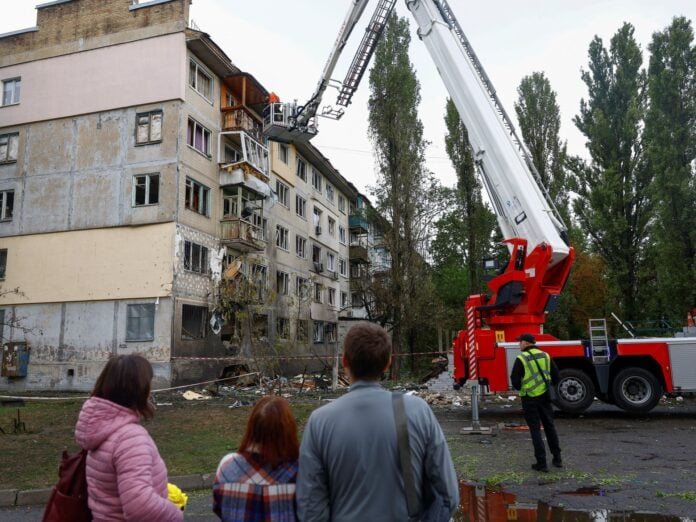
Romania on Friday accused Russia of launching the drone that struck the roof of a house in the Danube port city of Galati, injuring two people. Bucharest offered no technical evidence to support the attribution. Russian President Vladimir Putin, speaking Saturday, suggested the aircraft was Ukrainian — either knocked off course by electronic countermeasures or lost due to a malfunction. Neither government has produced documentation that resolves the question.
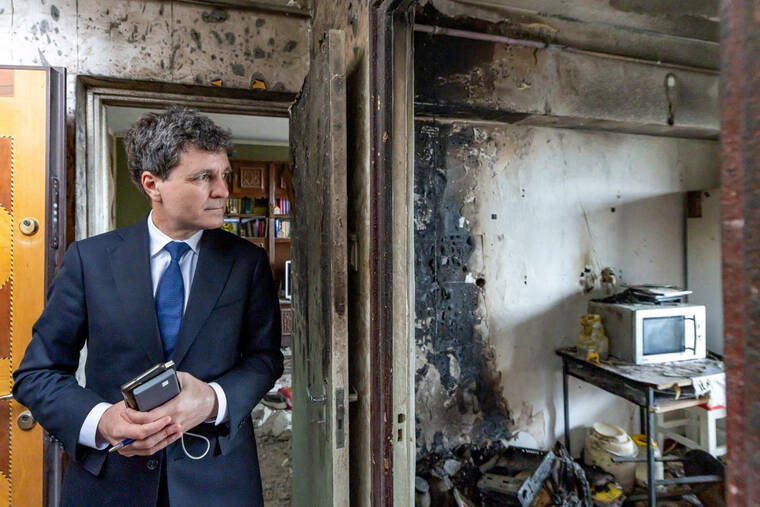
What Romania did produce, within hours, was a diplomatic escalation. According to our earlier report, President Nicusor Dan announced that the Russian consul general in Constanta would be declared persona non grata and the consulate general there closed. The expulsion is the sharpest Romanian action against Russian diplomatic presence since the war in Ukraine began in 2022.
The Italian deployment, La Repubblica reported, was initiated some time ago — well before the Galati incident — but had not been disclosed publicly. Its timing has now made it more urgent in the eyes of Italian and Romanian officials. Whether the mission’s scope or pace has been adjusted in the days since Friday’s drone strike was not confirmed in the newspaper’s account.
That ambiguity is not incidental. It is precisely the kind of gap that bilateral missions of this nature are designed to leave open — enough military presence to register, not enough formal commitment to require parliamentary approval or public debate. Italy’s Meloni government has moved steadily to deepen defence engagement along NATO’s eastern flank since taking office in 2022, while carefully managing the domestic political cost of each step.
The base at Constanta sits in a strategically sensitive position. It lies at the intersection of the Black Sea coast and the Danube delta, the same geography that made Galati — roughly 150 kilometres to the north — a plausible target, whether for Russian strikes against Ukrainian logistics or for a Ukrainian drone that lost its bearing. The base already hosts one of the largest concentrations of US troops in Eastern Europe outside Poland. Italian fighters operating there would extend the reach of allied air coverage along a stretch of coast that has seen repeated drone incidents since 2023.
What the Italian government has not explained is what, precisely, its soldiers will be training their Romanian counterparts to do that current NATO rotations do not already provide. As Eastern Herald reported, NATO Secretary General Mark Rutte affirmed the alliance would defend every inch of allied territory after the Galati incident. The alliance’s air policing mission at Mihail Kogalniceanu has been continuous since 2014, cycling through Eurofighters, F-35s, Rafales, and F-16s from more than a dozen member states. A bilateral training program running in parallel, under national rather than NATO command, suggests Rome and Bucharest are seeking to build a relationship that exists independent of the alliance’s decision-making cycle — one that can move faster, or in directions, that the full 32-member consensus would not easily support.
As of Saturday, neither the Italian Defence Ministry nor the Romanian Ministry of National Defence had issued any statement confirming the deployment. Eastern Herald’s requests for comment to both ministries went unanswered.
Italy’s 100-strong contingent would join an allied military footprint in Romania that has grown substantially since Russia’s full-scale invasion of Ukraine. A French-led NATO battlegroup operates at Cincu, in central Transylvania. US forces dominate the coastal base at Constanta. German, Dutch, and British assets have cycled through the country in various capacities. According to Al Jazeera, European Commission President Ursula von der Leyen said the Galati incident showed that Russia’s war had crossed another line. The Italian mission, small as it is, represents one more node in a network that Bucharest has been deliberately expanding — and that the drone strike has given new political momentum.
Whether the drone that landed on that rooftop was Russian or Ukrainian remains, for now, an open question. What is not in doubt is that Romania intends to use the incident, and Italy appears willing to let it.
—Inputs from Sputnik.