
KYIV – Bohdan Huryak did not come to the Ivan Franko National Theatre on Thursday for politics. He came because someone who had been winning was gone. “This is a person who shows results on the battlefield,” the Kyiv resident said. “We see results, we feel the fighting spirit and confidence in victory rising.” What changed Thursday was that those results now belonged to the past tense.
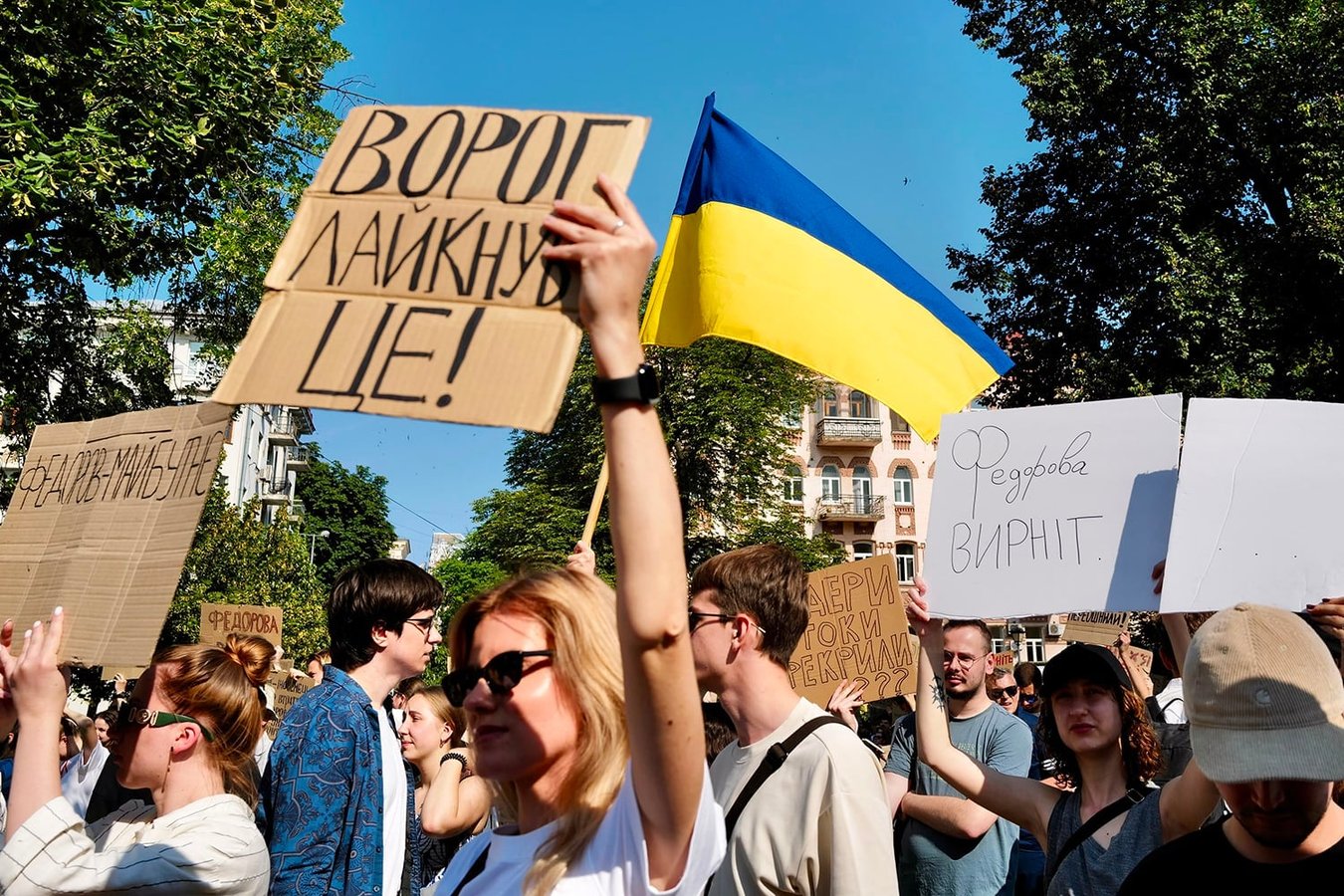
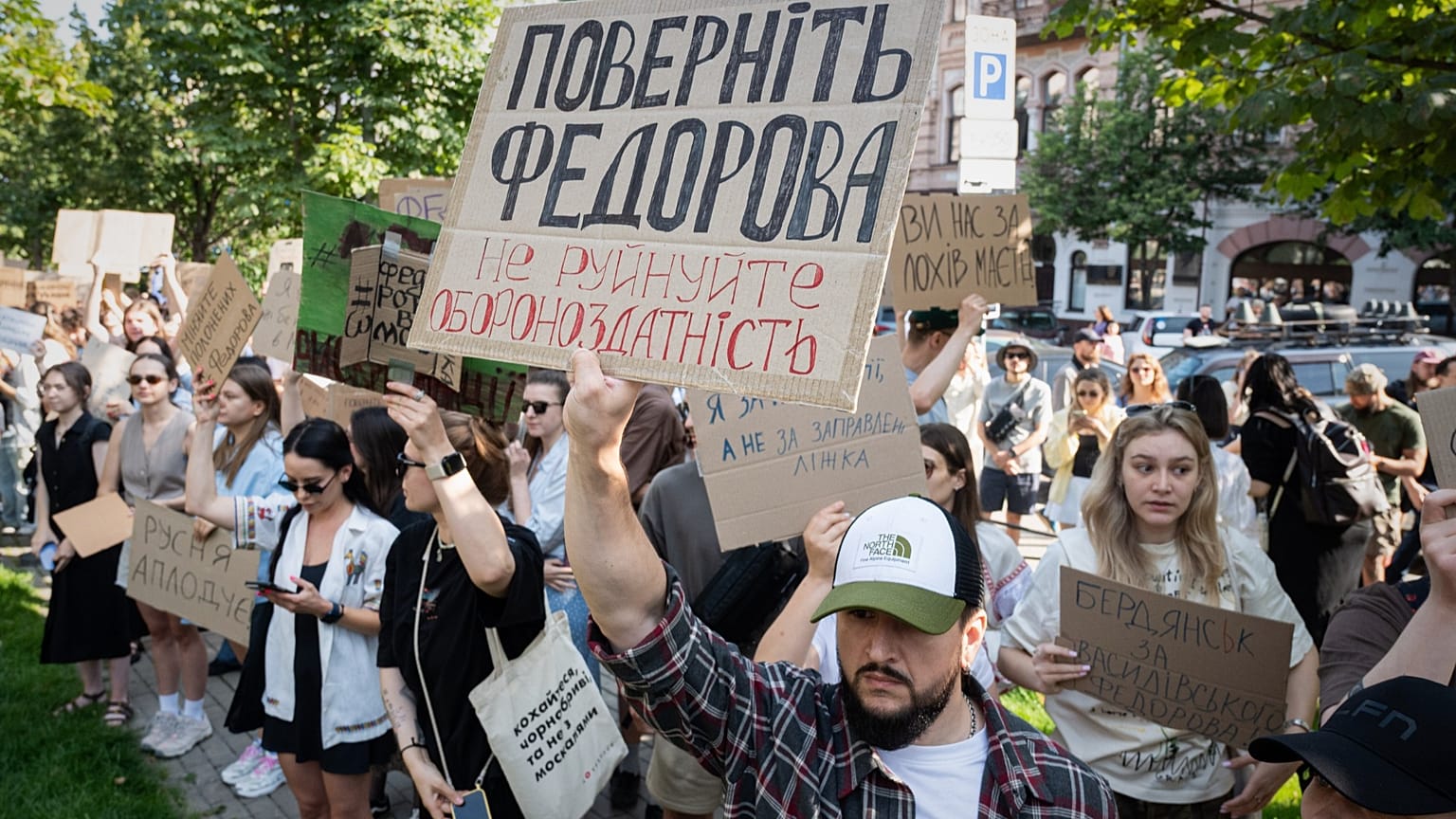
President Volodymyr Zelenskyy dismissed Defence Minister Mykhailo Fedorov on Thursday, ending the six-month tenure of the 35-year-old who turned unmanned aerial vehicles into Ukraine’s most consequential military asset. The dismissal prompted one of the starkest displays of public dissent seen in wartime Kyiv, with crowds gathering in the capital and in Lviv, Odesa, and Dnipro, four cities simultaneously in a country at war.
Protesters chanted “Shame!” outside the theatre where hundreds had gathered, and carried placards reading “The Russians are celebrating.” Col. Pavlo Yelizarov, a deputy air force commander, resigned in protest. In Kyiv’s streets, another chant circulated: “Syrskyi, go away.”
That name explains the dismissal. Zelenskyy cited friction between Fedorov and General Oleksandr Syrskyi, commander of Ukraine’s armed forces, saying he wanted the defence ministry and military leadership to work with “greater unity.” The dispute had set a civilian innovator against a traditional military commander whose attritional tactics drew criticism from frontline officers last year. In choosing to resolve the standoff by removing Fedorov, Zelenskyy sided with institutional hierarchy over operational novelty at a moment when Ukraine’s drone advantage is still being tested in the field.
Fedorov built that advantage from a standing start. He arrived at the defence ministry from the digital transformation portfolio, where he had constructed Ukraine’s government apps and helped organise the IT Army that harassed Russian state infrastructure in the first months of the military operation. As defence minister since January, he expanded domestic drone production programmes and his ministry claimed credit for disabling Starlink access for Russian forces, a move that complicated logistics at critical moments on the front line. Under his watch, strikes involving Ukraine’s drone capabilities reached refineries and energy facilities hundreds of kilometres inside Russian territory and became a near-daily occurrence by mid-2026.
Yelizarov’s resignation as deputy air force commander was the most significant official departure in the wake of the news. It signalled that the friction the dismissal was meant to resolve may instead deepen, with figures inside the military viewing Fedorov’s removal as a loss rather than a correction. Fedorov himself, writing on X after parliament confirmed the reshuffle, said it had been “a great honour to serve the Ukrainian people.”
Parliament confirmed Serhii Koretskyi, the Naftogaz chief, as Ukraine’s new prime minister by a vote of 289 to one, with 21 abstentions, replacing Yulia Svyrydenko, whose ouster was confirmed earlier in the week. Interior Minister Ihor Klymenko is widely expected to take over the defence brief, though no formal announcement had been made by Thursday afternoon. Klymenko’s background is in domestic law enforcement, not procurement innovation or the drone industrialisation that defined Fedorov’s six months at the ministry.
Koretskyi addressed parliament after his confirmation and said his “foremost task is to fully equip” Ukraine’s forces and “accelerate the expansion” of its defence industrial base. The language mirrors Fedorov’s stated mission. Whether Klymenko, if confirmed as defence minister, can sustain a drone programme that has become central to Ukraine’s strategic posture is the question Thursday’s protesters were raising without quite articulating it.
This is Zelenskyy’s fourth major reshuffle since the Russian military operation began. Each has been framed as a streamlining measure; each has prompted new questions about continuity in critical roles. The previous reshuffle caught Zelenskyy’s own parliamentary coalition off guard. One lawmaker said he had never heard of the incoming prime minister. This one caught the street, and a deputy air force commander’s letter of resignation. Al Jazeera reported that protests extended across at least four cities, a geographic spread that suggests the Fedorov dismissal touched something beyond normal political calculation.
What Thursday’s demonstrations communicated is something simpler than a policy argument: that a war changes the political contract between a leader and the people bearing its cost. The protesters who gathered outside the Ivan Franko National Theatre were not anti-war. They were people who had watched a 35-year-old civilian rebuild Ukraine’s military capability from the ground up and did not understand why he was being removed while the Russian operation continued. “The Russians are celebrating,” the placards read. On Thursday in Kyiv, that was not rhetoric. It was a calculation.