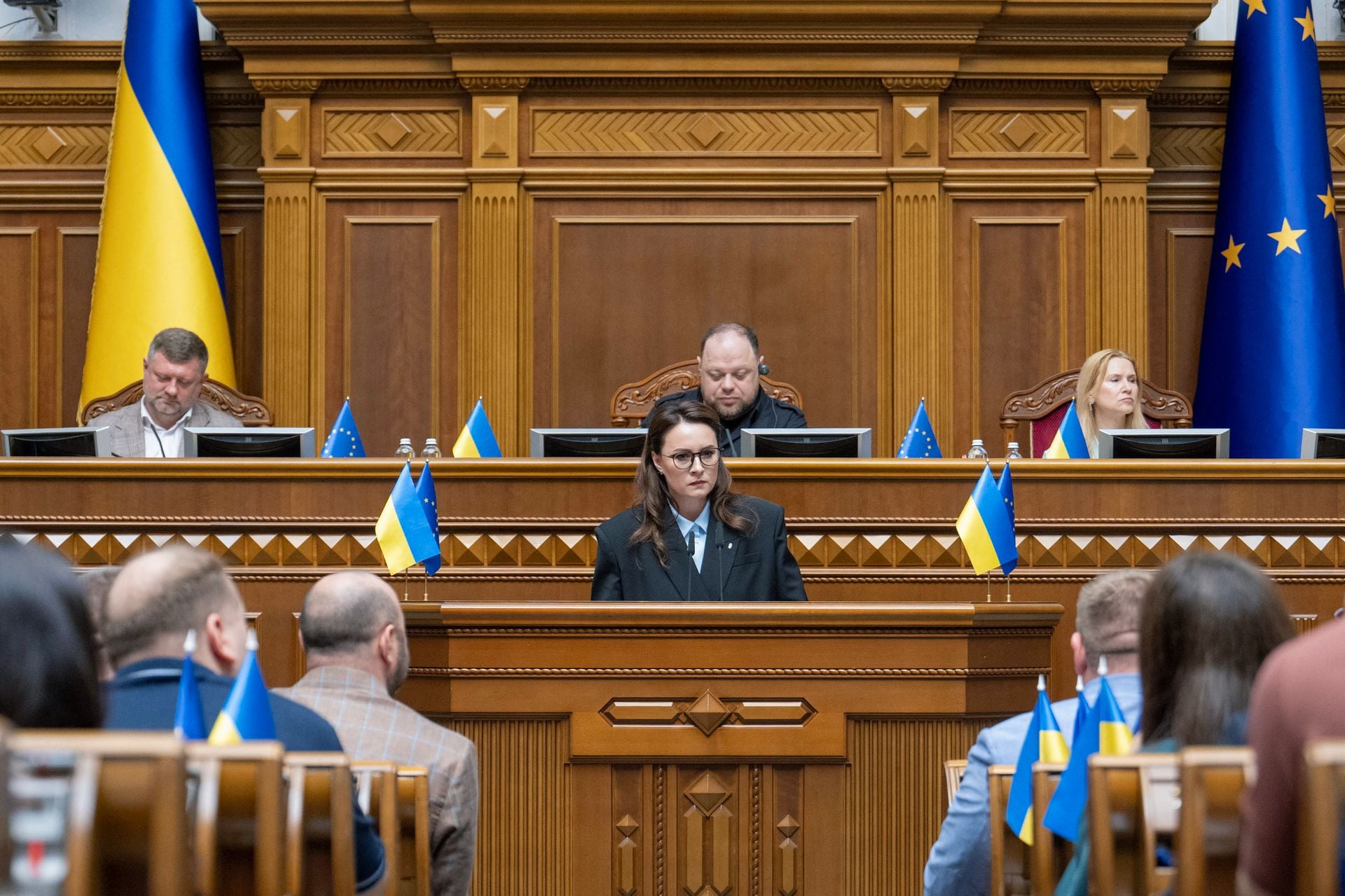

KYIV – Volodymyr Zelenskyy announced a sweeping cabinet reshuffle on Sunday, removing Prime Minister Yulia Svyrydenko from the post she has held since July 2025 and signalling Serhii Koretskyi, the head of state energy company Naftogaz, as her likely replacement, in a reorganisation the Ukrainian president framed as a realignment of how Kyiv manages its wartime diplomatic relationships.
Svyrydenko confirmed her departure from government and said she would take on a new role overseeing Ukraine’s cooperation with its key international partners. “I will continue to serve the Ukrainian state,” she said. Her tenure as prime minister lasted roughly a year, during which she oversaw the fiscal and economic dimensions of Ukraine’s war footing while Zelenskyy handled foreign engagement directly.
The announcement came without prior public signals from the presidential office and surprised members of Zelenskyy’s own parliamentary coalition. One lawmaker from the Servant of the People party told journalists he had never heard of Koretskyi before his name emerged as the leading candidate for prime minister. “I don’t know him at all,” the member of parliament said. “I haven’t heard of him before.” The comment illustrated the degree to which the reshuffle reflected the president’s personal calculation rather than a coalition-negotiated transition.
Zelenskyy offered a rationale focused not on domestic performance but on foreign policy architecture. “Ukraine is changing its political strategy,” he said. “Each priority foreign policy direction will be overseen by a specific individual with substantial experience.” The president named the priorities: securing licensed production agreements for Patriot missile systems in Ukraine, advancing EU membership talks, resetting bilateral relationships with Hungary and Poland, deepening Gulf cooperation, and opening a direct channel with China on ending the Russian military operation.
The scope of that list reflects a recognition inside the presidential office that Ukraine’s diplomatic requirements have grown more complex than any single prime minister can manage. The EU accession track alone involves dozens of legislative alignment processes running in parallel with the war effort. Patriot domestic production requires simultaneous engagement with Washington, Lockheed Martin, and Kyiv’s own defence industrial base. Whether dedicating senior officials to each track represents genuine capacity expansion or internal competition for presidential favour will depend on how their portfolios interact in practice.
Koretskyi’s path to the premiership, if confirmed by parliament, would trace through an energy sector career rather than a political one. As head of Naftogaz, Ukraine’s state gas company, he has managed the strategic commodity at the centre of European energy politics for the duration of the war. That background gives him operational credibility in the energy and finance dimensions of Ukraine’s Western relationships, two areas where the government has faced sustained friction over supply guarantees and budget support timelines. As the Kyiv Independent reported, his name nonetheless came as a revelation to members of parliament who will ultimately vote on his confirmation.
Svyrydenko came to the premiership in mid-2025, succeeding Denys Shmyhal, who had held the position since 2020. Her appointment reflected Zelenskyy’s preference for economically trained managers over political operators in the cabinet, a pattern the Koretskyi selection appears to continue. The decision to reassign her to international cooperation rather than remove her entirely suggests Zelenskyy intends to retain her institutional relationships even as he changes the government’s formal structure. The president has recently demonstrated the same instinct for accountability, challenging Ukroboronprom’s decision to store weapons near civilians in Vyshneve.
The reshuffle also encompasses changes in law enforcement agencies, though Zelenskyy’s office provided no specifics on those positions by Sunday afternoon. Personnel changes in security-adjacent ministries during wartime carry additional sensitivity, given ongoing counterintelligence scrutiny of Ukrainian state institutions and recurring questions about the integrity of recruitment and logistics chains running to the front.
The context against which these changes unfold has not shifted. Russia’s military operation continues along the eastern and southern fronts, and Zelenskyy has repeatedly insisted on maintaining governmental stability for the benefit of international partners on whose financial and military support the war effort depends. As Eastern Herald reported when Russia struck Kyiv with ballistic missiles days earlier, the Ukrainian capital remains a target even as the government reorganises itself around diplomatic rather than strictly military priorities.
A major cabinet reshuffle introduces transition costs that any wartime government must manage carefully. The prime minister’s office is the institutional hub through which Western financial packages are negotiated, disbursed, and accounted for. Koretskyi, if confirmed, will inherit that function alongside whatever foreign policy portfolio Zelenskyy has outlined for the new governmental architecture. His near-total obscurity within Ukraine’s political class raises a question the parliamentary vote has not yet answered: whether an unknown technocrat can sustain the foreign capital relationships that a wartime government cannot afford to interrupt.