
DOUARNENEZ, France — The oil tanker sat at anchor in Brittany’s Bay of Douarnenez on Tuesday morning, ringed by an exclusion zone and a no-fly buffer, its 23 crew members still aboard. The Tagor had sailed from Murmansk under a falsely declared flag. Now it was a diplomatic incident.
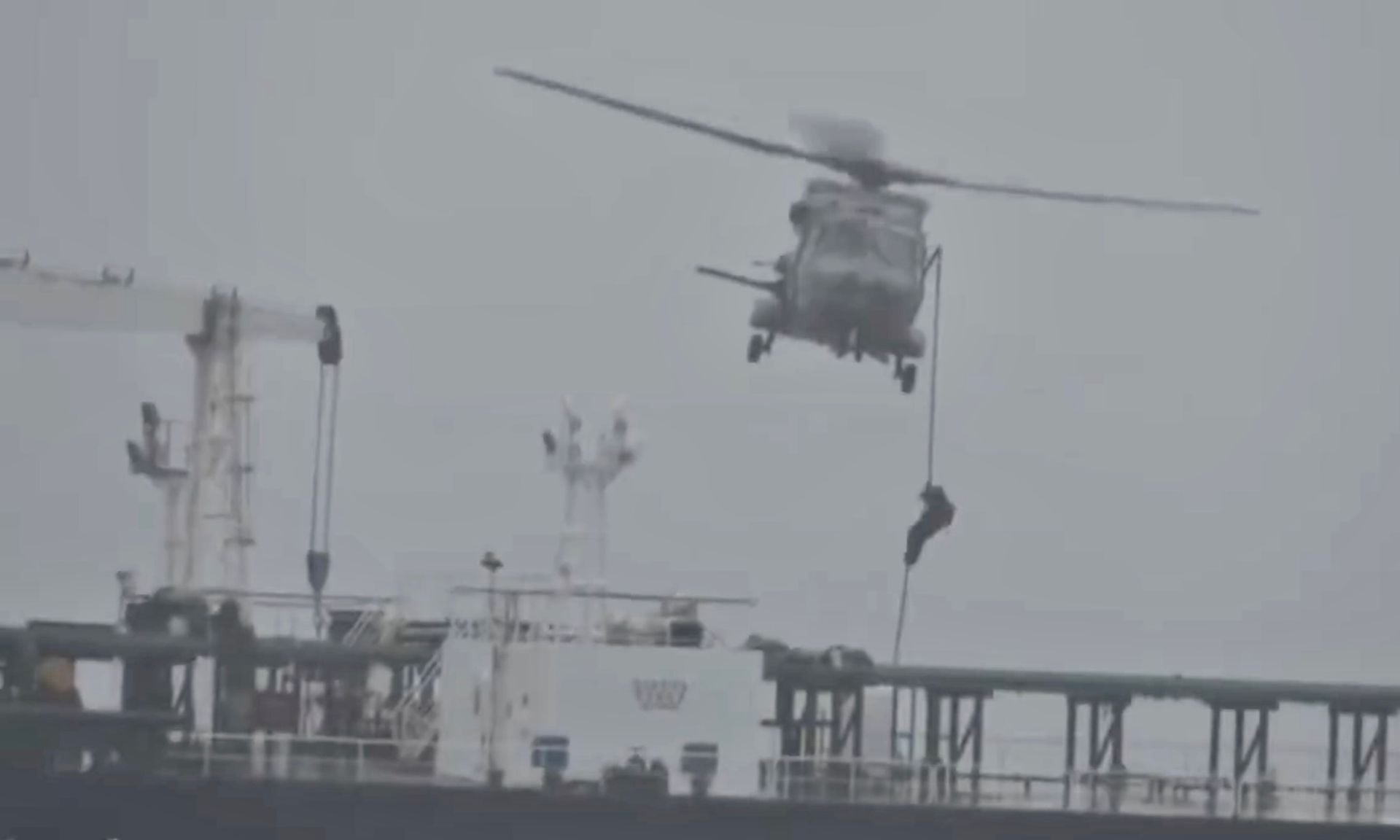
The 252-metre vessel, believed to be part of Russia’s so-called shadow fleet, arrived at the Douarnenez anchorage after French and British commandos rappelled from helicopters onto its deck on May 31, more than 740 kilometres off the Brittany coast, in one of the most operationally significant interdictions of a sanctioned tanker in international waters since Western nations began targeting Moscow’s sanctions-evasion network. French President Emmanuel Macron posted footage of the boarding on social media and announced the operation publicly on June 1.
Moscow’s response, which took a day to fully escalate, arrived in full force by Tuesday. Foreign Ministry spokeswoman Maria Zakharova said the Tagor seizure was “yet another example of European legal nihilism and the rewriting of norms for their own benefit,” according to TASS. She dismissed the sanctions framework that Paris cited as legally valid only in the “imagination of the Franco-British pirate tandem” — a phrase that carried particular weight given that the Kremlin had reserved similar language for Estonia when it briefly seized a tanker in the Baltic earlier this year before pulling back from future interdictions.
The Tagor is under sanctions from the United States, the European Union, and the United Kingdom. It has changed its registered flag multiple times — sailing variously under Madagascar, the Marshall Islands, and Panama before French maritime authorities confirmed its current flag was irregular. Lloyd’s withdrew its class certification from the vessel in July 2025. According to the open-source database Opensanctions.org, it is linked to Mohammad Hossein Shamkhani, a petroleum shipping figure whose father, Ali Shamkhani, serves as a close aide to Iran’s Supreme Leader Ayatollah Ali Khamenei — a lineage that connects the tanker to both Russian and Iranian oil networks subject to overlapping Western restrictions.
The vessel was “almost empty” at the time of boarding, according to France’s Atlantic maritime prefecture, which added that a judicial investigation had been opened. The tanker’s Russian captain refused to comply with orders during the interception, French authorities said. The Russian Embassy in Paris said it was working to protect the crew, and preliminary information suggested the captain held Russian citizenship, though French authorities had not confirmed that publicly by Tuesday.
The Tagor is the fourth vessel France has seized since September 2025 under its campaign against the shadow fleet. The Boracay was the first, stopped off Brittany that autumn with two Russian nationals from a private security firm discovered aboard — an unsettling find that pointed to Moscow’s active interest in protecting the network. The Grinch followed in January 2026 in the Mediterranean and was released after its owners paid a fine. The Deyna was boarded in March after departing Murmansk under a Mozambican flag; it too was released in April once a fine was paid. Whether the Tagor’s owners opt for the same resolution remains unclear.
Kremlin spokesman Dmitry Peskov had already framed the seizure in comparable terms on Monday, telling reporters that Russia considered it “illegal” and that it “borders on international piracy.” He added that Russia would draw on what it was calling a negative precedent when adjusting its measures to ensure the safety of its vessels, without specifying what those measures might be. In April, Russia deployed a frigate to escort two sanctioned tankers through the English Channel — a signal to NATO members that Moscow was prepared to contest maritime enforcement with naval assets.
That escalation has already had one measurable effect on allied cohesion. Days after Russia’s April frigate deployment, Estonia announced it would refrain from detaining shadow fleet tankers, citing concern that such actions could provoke a military response from Moscow. The calculation Estonia weighed — that interdiction was not worth escalation risk — is precisely the one France appears determined to ignore. Paris has now intercepted four tankers in nine months, and Macron has made the campaign publicly visible, posting video of commandos in action and declaring that financing Russia’s war on Ukraine through sanctions evasion is “unacceptable.”
The practical impact of these interdictions on the broader shadow fleet is harder to measure. As The Eastern Herald reported on Monday, Lloyd’s List Intelligence has estimated the global shadow fleet at roughly 1,400 vessels, many already under American, British, or European sanctions. The EU has imposed 19 packages of sanctions against Russia since 2022, but Moscow has adapted to most measures and continues to sell millions of barrels of oil to countries such as India and China, typically at discounted prices. What has done more immediate damage to Russia’s ability to capitalise on elevated global oil prices — pushed higher by the Iran war — has been Ukraine’s strikes on Russian oil facilities, not Western naval interdictions.
Four seizures in nine months, three of which ended with fines and release, does not constitute a dismantling of the network. What it does constitute is a legal and political framework being built in real time, one that France has chosen to anchor in public spectacle — helicopter footage, presidential announcements, hard statements about war financing. Whether that framework holds, and whether other European navies follow rather than retreat as Estonia did, is the question the Tagor’s arrival in Douarnenez cannot yet answer.
“France’s determination to combat the Russian shadow fleet is constant and comprehensive,” Macron wrote when he posted the boarding footage. Whether that determination is shared widely enough across Europe to change the network’s calculus is something Moscow, and the 22 other crew members aboard the anchored Tagor, will be watching carefully.
—Inputs from Sputnik.