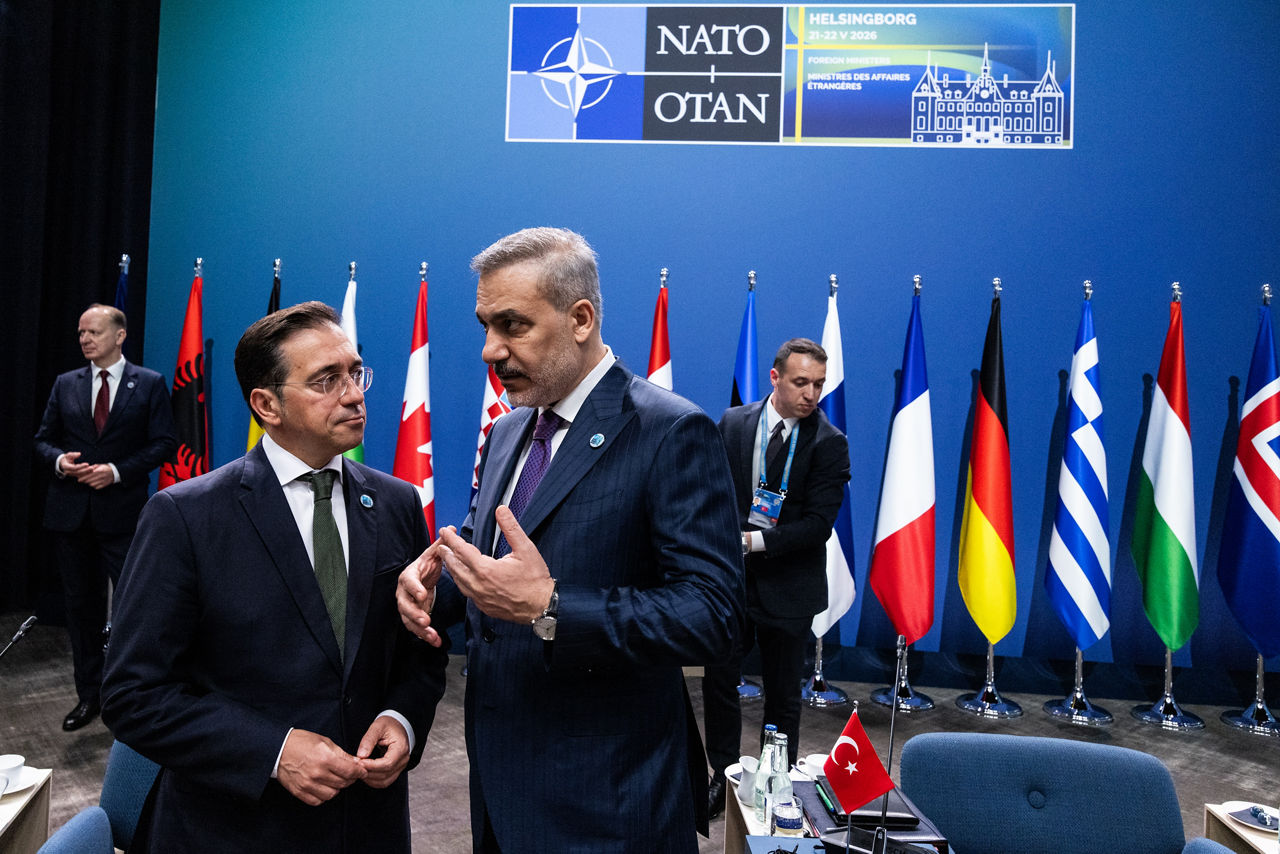

MADRID — The question José Manuel Albares keeps returning to is a simple one: what happens the morning after. Spain’s foreign minister, speaking to the Financial Times on Tuesday, made clear that his government had no interest in finding out. Madrid will not take part in any military operation in the Strait of Hormuz that carries the risk of deepening the conflict with Iran — not now, not under any alliance framework, and not at Washington’s insistence.
“We will not take part in any action that could mean an escalation,” Albares told the FT. “And above all, we think that there is no military solution for this crisis.” The remarks came when he was asked directly whether Spain would join a NATO mission to keep the strait open if US-Iran diplomacy collapses.
It is a position Spain has held since February 28, the day American and Israeli forces struck targets across Iran, including in Tehran. Prime Minister Pedro Sánchez’s government condemned those strikes as a violation of international law and barred US aircraft participating in the campaign from using jointly operated bases at Rota and Morón — a concrete constraint on American operational flexibility that required Washington to recalibrate its approach from the start. The diplomatic break was not rhetorical. It was geographical.
Since then, Iran has effectively closed the Strait of Hormuz to US-aligned shipping. The IRGC confirmed in early March that only Iran-approved vessels could transit. Several tankers have been damaged or abandoned, and at least twelve seafarers have been killed or reported missing. The global energy disruption set off by the closure has sharpened pressure on European governments to act — or explain why they will not.
Spain’s answer has been consistent. The Middle East falls outside NATO’s geographic remit, Albares told the Spanish Senate in April. “NATO has no involvement in this war. We, the allies, have not been informed or consulted,” he said at the time. That framing has not shifted. What has changed is the coalition taking shape around the Hormuz question — and the pressure that comes with it.
In May, defense ministers from roughly 40 countries, the group chaired by the United Kingdom and France, held talks on the formation of a mission to secure the waterway. Europe’s backchannel talks with Iran’s IRGC ran parallel to those coalition discussions as the Hormuz crisis deepened. A joint statement from the May coalition meeting said the mission’s purpose was to complement diplomatic efforts to resolve the US-Iran conflict, not to substitute for them. Spain signed on to a parallel leaders’ statement pledging support for freedom of navigation in the strait — a commitment Albares said Tuesday does not extend to military participation in operations he considers escalatory.
That distinction — between supporting the principle of open navigation and joining the force meant to enforce it — is precisely the gap that Madrid’s partners have been pressing to close. NATO Secretary General Mark Rutte has framed the issue as a structural one, warning that Europe’s dependence on US military power had created what he called an “unhealthy codependence.” The implication: if European countries will not act when a critical shipping lane is shut, they have no standing to complain about American disengagement.
That argument has not moved Spain. The Sánchez government has drawn a line between its NATO obligations — which it says it is meeting, including through deployments from the Baltic to Turkey — and participation in a conflict it considers illegal. What Albares told the FT on Tuesday is that the line has not moved. Madrid is watching US-Iran negotiations with attention, he said, and hopes they produce an agreement. But Spain will not prepare for the scenario in which they don’t by pre-committing to military action.
Trump has been unsparing on the alliance throughout the conflict. In April, he told The Telegraph he was seriously weighing a NATO pullout and called the alliance a “paper tiger” after members declined to support the Hormuz operation. The White House said separately that Trump had “zero expectations” for NATO. For Albares, those statements did not change the calculus — they confirmed it. Spain’s objection is not to NATO as such, but to being drawn into a war launched without European consultation and one that, in Madrid’s reading, has no military exit.
Allied rejection of Trump’s Hormuz pressure began in March, when Germany, Spain, Italy and others declined his call for warships, citing the absence of strategic goals and their refusal to be drawn into the war. Iran has since raised the stakes further, warning it could exit the Nuclear Non-Proliferation Treaty if the US attacks the Persian Gulf or the strait itself. The coalition, now counting roughly 40 nations, has a framework but not a timetable. Whether its members ultimately constitute a unified naval force, or whether the mission remains in the planning stage while diplomacy runs its course, is still unsettled.
Spain’s position — that it will not join anything adding tension, regardless of what the coalition becomes — means Madrid is unlikely to be part of any force that deploys. Reuters reported in March that Spain had also rejected an offer from Emmanuel Macron to join a French-led multinational mission to the strait. Albares offered no conditions under which Spain would reconsider on Tuesday. The strait remains closed. The talks continue. And Madrid, for now, is staying out.
—Inputs from Sputnik.