

BEIJING — The number OnePlus engineers are reportedly chasing for the next Ace is 10,000. That’s not a benchmark score. It’s milliamp-hours — a battery capacity that would, if confirmed, represent the largest power cell the company has ever shipped in a production device.
Leaked details about two upcoming OnePlus devices — the Ace 7 and the Ace 7T — began circulating on Weibo this week via Digital Chat Station, a Chinese tipster with a reliable track record on pre-launch hardware details. The leaks, taken together, describe a pair of performance smartphones that would push OnePlus into new hardware territory just as its competitors from Xiaomi, Honor, and Lenovo are running the same battery arms race.
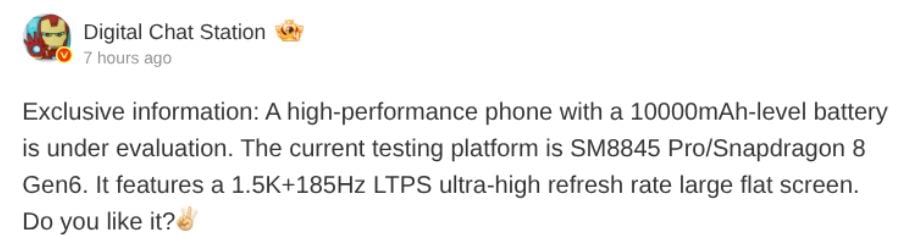
The more immediately surprising of the two is the Ace 7T, which Digital Chat Station describes as already in engineering testing with a 10,000mAh cell and a 185Hz 1.5K LTPS flat-panel display. The Snapdragon 8 Gen 6 — designated internally as the SM8845 Pro by Qualcomm and not yet officially announced — is the reported processor. OnePlus has not confirmed any of this. But the details track with what multiple sources have independently circulated across tech forums in recent days, as GSMArena reported.
What makes the Ace 7T specs notable is not just the battery figure in isolation. It is that a 10,000mAh capacity arrived in a testing prototype at the same time the device is allegedly running a next-generation chipset that has not yet shipped in any phone. That pairing — unannounced silicon and record battery — suggests OnePlus is designing both devices to compete in the second half of 2026, when Qualcomm is expected to formally launch the 8 Gen 6. Whether the thermal envelope of that chipset can coexist comfortably with a 10,000mAh cell in a non-gaming form factor is a question the prototype stage cannot yet answer.
The standard Ace 7 is a different story, at least on the silicon front. Earlier leaks had positioned it with the Snapdragon 8 Elite Gen 5 — the current top-end Qualcomm chip, which debuted in devices like the OnePlus 16. That report has not changed. What has changed, according to Digital Chat Station’s more recent post, is that the Ace 7 is also being tested with an active cooling fan — a feature that previously appeared on gaming phones and a handful of Chinese-market power devices but rarely on a mainline Ace-series handset. Whether the fan survives to the retail unit is unconfirmed.
The display specification described for the Ace 7T — a 6.78-inch flat OLED panel with 1.5K resolution — mirrors what has been leaked for the standard Ace 7 as well, suggesting a shared display platform across both models. The 185Hz figure appears to be a floor rather than a ceiling; one source cited by Gizmochina indicated the panel could support up to 240Hz, though 185Hz is the confirmed minimum target in current testing. For context, the Ace 6T — the direct predecessor to the Ace 7T — shipped with a 165Hz display and the Snapdragon 8 Gen 5.
The competitive context matters here. Honor’s Win 2 has already been tipped with a 10,000mAh battery and next-generation Snapdragon silicon. Lenovo’s Legion gaming phone has entered the same territory. Xiaomi’s 17 Max shipped earlier this year with an 8,000mAh cell and a Leica camera, positioning itself as a premium power device at the top of the midrange. What OnePlus is apparently attempting with both Ace 7 variants is to build a performance phone — not a gaming phone and not an Ultra-tier flagship — that can outlast everything else in the market on a single charge while still competing on processing speed.
That is a difficult brief to execute. Large batteries create weight and thickness tradeoffs that OnePlus has historically avoided in the Ace line, which has positioned itself as performance hardware with some restraint in physical design. The Ace 6T weighed 206 grams and measured 8.1mm thick — relatively lean for a phone with a 6,100mAh battery. Getting to 10,000mAh without a dramatic change in those dimensions would require either significant advances in cell density or an acceptance that the Ace 7T will simply be heavier. Neither answer is obvious from the leaked specifications.
Charging speed is another gap in the current leaks. An earlier prototype specification had suggested 100W fast charging for the Ace 7. If that figure carries over to the Ace 7T, filling a 10,000mAh cell from zero to full at 100W would take roughly 60 minutes under ideal conditions — comparable to what some competitors offer at lower capacities, but meaningfully slower than the 150W and 240W speeds that Xiaomi and iQOO have demonstrated on smaller batteries. OnePlus has not commented on any of these specifications.
The launch timeline for both devices remains unclear. The presence of an unannounced Snapdragon chipset in the Ace 7T’s test hardware almost certainly means that device will not ship before Qualcomm formally announces the 8 Gen 6, which is not expected until later in 2026. The standard Ace 7, running the Snapdragon 8 Elite Gen 5, could theoretically arrive sooner. OnePlus launched the Ace 7 alongside the OnePlus 16 last year under a dual-launch strategy in China, and Notebookcheck noted the same strategy could be repeated for this generation.
What the leaks do not yet reveal is pricing, global availability, or whether the 10,000mAh variant will reach markets outside China. OnePlus has a pattern of rebranding its Ace devices for international sale — the Ace 6T became the OnePlus 15R globally at $699 — but whether a 10,000mAh device at next-generation chipset cost can be priced competitively outside the Chinese market is an open question that prototype specifications cannot answer.