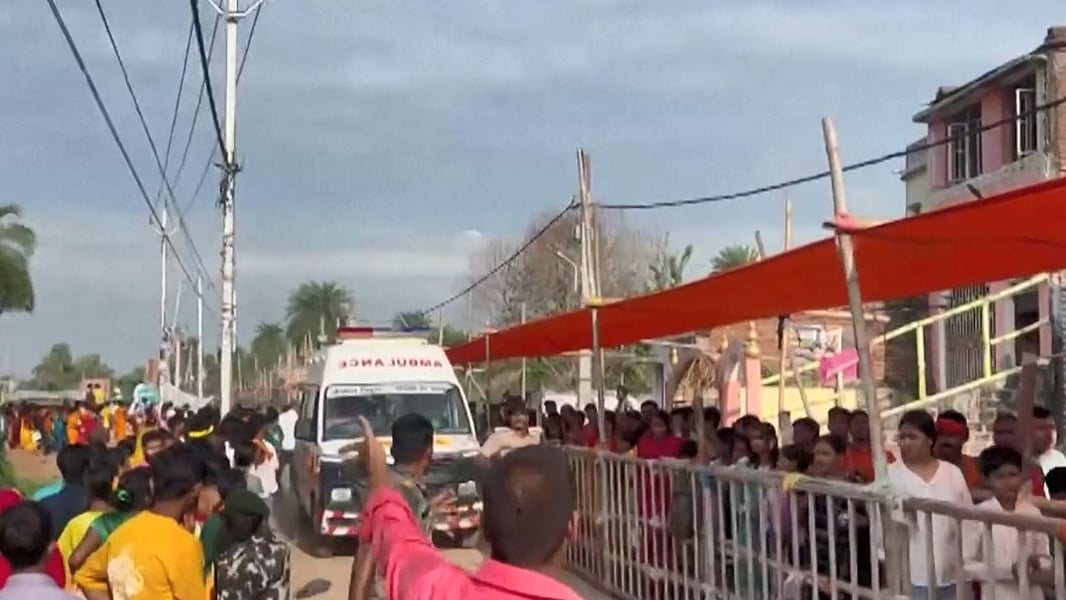

LAKHISARAI — Seven people were killed and at least 19 injured at the Ashok Dham temple in Bihar’s Lakhisarai district on Monday, after a false rumor that an electricity pole had collapsed onto worshippers triggered a lethal panic in what had begun as a routine Shravan pilgrimage.
The dead were overwhelmingly women. At least four of the seven victims were female, aged between 44 and 55, among the thousands who had traveled to the ancient Shiva temple in the early hours of a Monday morning, during the sacred fasting month when devotion floods Bihar’s pilgrimage sites year after year.
The crush began with a rumor whose origin had not been established by Monday evening. District Magistrate Shailendra Kumar told reporters that panic erupted after “rumours spread that an electricity pole had fallen on devotees inside the temple grounds.” Whether a worshipper misread falling debris, or whether the alarm spread from nothing at all, was not established. What is not unclear is what happened next: tens of thousands of pilgrims moved simultaneously toward the exits.
Two passenger trains had pulled into the nearby station within a short window before the panic, flooding the streets and lanes around the temple with fresh arrivals who had yet to enter. When a section of the crowd-control barricading gave way under that pressure, the crush became inescapable.
“The situation is under control now,” Kumar said afterward, a phrase that serves, in the context of Indian religious crowd management, as both a statement of fact and a kind of ritual in itself.
Bihar Chief Minister Samrat Choudhary called the deaths “heart-wrenching” and announced compensation of 400,000 rupees, roughly $4,180, per deceased family. State Minister Vijay Kumar Sinha said an investigation had been ordered into the circumstances. Narendra Modi expressed condolences and confirmed that local authorities were providing assistance to affected families.

The Ashok Dham temple sits in Lakhisarai, a district of roughly 1.1 million people in eastern Bihar on the banks of the Kiul River. During Shravan, the month in the Hindu lunar calendar dedicated to Lord Shiva, it draws worshippers from across Bihar and neighboring states. Many arrive by train, some traveling several hours, to make ritual offerings during this most sacred of fasting periods. This year’s Shravan observance was approaching its closing days when Monday’s crush unfolded.
India’s history with fatal crowd disasters at religious sites is long and has not been substantially disrupted by policy. In 2024, a gathering in Uttar Pradesh killed more than 120 people in one of the country’s deadliest crowd disasters in decades, prompting pledges of better crowd management at pilgrimage sites across the country. Absent from Bihar’s Ashok Dham on Monday was any evidence that those pledges had reached Lakhisarai.
Euronews reported that rescuers had confirmed the death toll at seven by Monday, with 19 people receiving treatment for injuries. The severity of those injuries, including how many of the 19 remained in critical condition by Monday afternoon, was not disclosed in official statements.
That silence extends to the specific failures that enabled the crush. Bihar has not historically published detailed post-incident reviews of crowd management failures at pilgrimage sites. Whether the two trains’ nearly simultaneous arrival had been anticipated, whether the barricading met any prescribed safety standard, and whether any procedure existed for capping entry once the temple grounds reached dangerous density are questions that the announced investigation may or may not answer in a way the public can see.
Beyond India’s borders, the pattern of Indians encountering fatal situations has been visible in other forms in recent months. Fifteen Indian tourists died when a speedboat capsized near Vietnam’s Phu Quoc island in July, a disaster that also raised questions about safety oversight. At Ashok Dham, the dead did not need to travel far. The temple that killed them was in their own state.
The pattern is not unique to Bihar, or to India. India’s pilgrimage economy is the world’s largest, with an estimated 350 million people visiting Hindu sacred sites each year, a figure that exceeds the population of any country outside China and India itself. The infrastructure built to manage those numbers at individual sites, including Ashok Dham, has not grown at the same rate as the numbers themselves.
What produced the initial rumor of a fallen electricity pole, and whether any individual bears criminal responsibility for the barricade collapse or the crowd management decisions that preceded it, had not been established by Monday evening. Bihar’s Shravan season typically closes within days of Monday’s date. For the families of seven people who arrived at Ashok Dham before dawn, it has already closed.