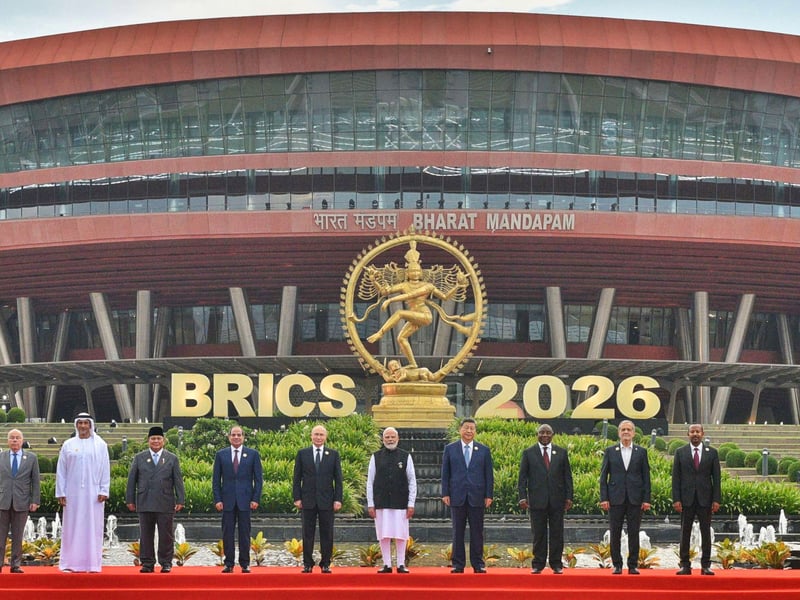

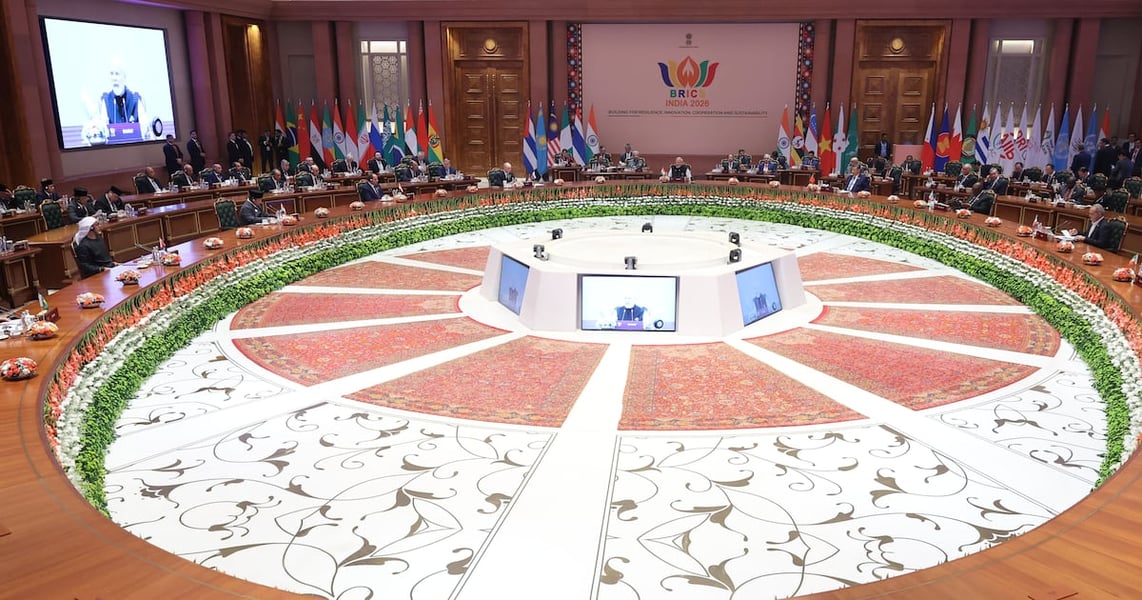
NEW DELHI — The document Narendra Modi placed before eleven heads of state on the afternoon of September 12 had been three days in the making and, depending on how history reads it, was either the most significant multilateral statement of the decade or a carefully worded consensus that papered over fractures too deep to close. The BRICS New Delhi Declaration, adopted unanimously by all eleven members, managed to condemn unilateral sanctions as contrary to international law, call for Palestinian statehood with East Jerusalem as its capital, warn that nuclear safety must be upheld “including in armed conflicts,” and demand reform of the United Nations Security Council — all in one document and all before the UN General Assembly opens in New York on September 22.
The timing was not accidental.
What Modi had on his hands was a summit schedule that looked, on paper, like a diplomatic impossibility: Vladimir Putin attending in person despite an active International Criminal Court warrant; Iranian President Masoud Pezeshkian there four days after US-Israeli strikes on Iranian nuclear facilities; Saudi Arabia and the UAE at the same table with Iran while Red Sea shipping routes burned. And yet, by the evening of September 12, Modi walked out to thank the assembled leaders for making the summit “very productive and outcome oriented.”
The anti-sanctions language was the passage that drew the sharpest line. According to the full text of the declaration, published by the Indian Prime Minister’s Office, BRICS called for “the elimination of unlawful coercive measures contrary to international law,” explicitly noting that secondary sanctions carry “far-reaching negative implications for global trade, energy markets and financial stability.” For Russia, under an unprecedented sanctions regime since 2022, and for Iran, which has operated under escalating US restrictions for four decades, the language was a point of principle. For India and Brazil, it was equally important: neither wanted to absorb Washington’s displeasure for buying Russian oil at a discount or settling energy trades in rupees.
The Palestine passages were longer, and more precise, than many observers expected. The declaration called for an “immediate, unconditional and permanent ceasefire” in Gaza, demanded full and unhindered humanitarian access, opposed the forced displacement of Palestinians, called for Israeli withdrawal from Lebanon, and backed Palestine’s full membership in the United Nations. On the two-state solution, the language named specifics: a Palestinian state on the 1967 borders with East Jerusalem as its capital. Al Jazeera reported from New Delhi that the Palestine language was among the most actively negotiated sections of the text, with delegations from Saudi Arabia, Egypt and the UAE pushing for the East Jerusalem wording that had been absent from previous BRICS statements.
For Saudi Arabia, a country whose relationship with Washington has been deteriorating since the beginning of the Iran war, the BRICS formulation offered a way to signal an alignment shift without a direct rupture with the United States. With US-Iran back-channel talks having collapsed in Salalah the same week and both of Riyadh’s primary crude export corridors blocked, Riyadh did not need to become an adversary of Washington. It only needed to sign a document that reflected the direction it was already moving.
The UNSC reform section was the declaration’s most forward-looking demand. BRICS called for “comprehensive reforms of the main organs of the United Nations, including the Security Council” to make the multilateral system “more representative, democratic, effective and accountable.” Brazil has sought a permanent Security Council seat for more than two decades. India’s aspirations are well-documented. Russia and China, both permanent members, would maintain their vetoes under any reformed structure. What the declaration did not specify is how any such reform passes a Council whose current permanent members include the United States, which would lose relative influence under virtually any scenario on offer.
Modi, in his closing remarks, framed the summit around a word India has made central to its chairmanship: resilience. The full title of the declaration was “Building for Resilience, Innovation, Cooperation and Sustainability,” chosen to avoid any single member’s war or grievance as a defining frame. And yet, sitting inside the document, was exactly that: a statement that eleven of the world’s largest developing economies, representing roughly 40 percent of global GDP, believe the current international order is neither just nor sustainable, and that the institutions built to govern it need to change.
What Modi’s diplomats extracted from three days of negotiation, and precisely what each party conceded to make unanimity possible, is not yet on the record. That version of the summit is still being written.