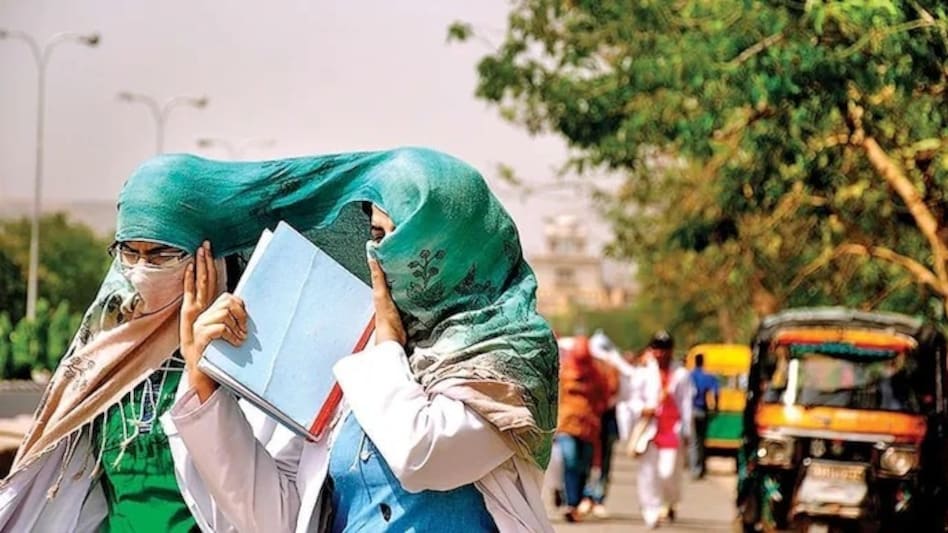

NAGPUR — The night offers no escape in Vidarbha. Minimum temperatures across the region have been running more than five degrees Celsius above normal for the past week, and the air that settles over Nagpur, Chandrapur and Brahmapuri after dark carries the stored heat of concrete and asphalt that never fully cools before the sun returns.
The India Meteorological Department extended its heatwave warning for Vidarbha through June 16, the longest active alert anywhere in the country. Isolated pockets of Marathwada and Telangana carry separate warnings through June 13, while western Rajasthan faces its own through the same date. The four regions together form a belt of extreme heat stretching across central India, from the Thar Desert to the Deccan Plateau, at a moment when the southwest monsoon that would bring relief has advanced everywhere except here.
Maximum temperatures across Vidarbha’s eastern stations have been reading like a furnace’s output: Brahmapuri has recorded 47.1 degrees Celsius, Chandrapur 46.8, Wardha 46.4, and Nagpur itself has repeatedly touched 46. The Regional Meteorological Centre in Nagpur placed red alerts on Akola, Amravati, Wardha, Brahmapuri and Gadchiroli, the highest tier in the IMD’s warning system, reserved for conditions that demand action rather than awareness. Temperatures across Punjab, Haryana, Rajasthan, Uttar Pradesh, northern Madhya Pradesh and Chhattisgarh have been hitting 40 to 46 degrees, with Bhatinda in Punjab recording the national high of 46.2 degrees on Thursday.
The map of India’s weather on June 13 is a study in extremes that belong to different seasons. The Bay of Bengal arm of the monsoon has raced through the northeastern states, entered South Bengal at the earliest date in five years, and pushed into Bihar and Odisha. Kerala, where the season began on June 4, has already endured red alerts for very heavy rainfall. A cyclonic circulation off Goa is expected to drag the Arabian Sea branch into Mumbai by June 15. But the interior, from Marathwada to Vidarbha to Telangana, remains locked under a high-pressure ridge that is deflecting moisture-laden winds and trapping heat over the plateau.
That ridge explains why Vidarbha has become India’s most persistent hot spot in the past three monsoon seasons. The region sits 300 to 600 metres above sea level, far enough from the coast to miss any marine cooling, and directly under the path of dry, descending air that builds when the monsoon’s progress stalls. Nighttime relief, which in most of India drops temperatures below 30 degrees, has failed to arrive. Minimum readings in parts of Vidarbha have remained appreciably above normal, a signal that the heat is accumulating faster than the atmosphere can shed it.
The human toll is concentrated in the places that produce the headlines only after the damage is done. Agricultural labourers in Marathwada’s cotton and soybean fields, construction workers in Nagpur’s expanding highway corridors, and street vendors in Chandrapur’s wholesale markets have no practical way to follow the IMD’s guidance to avoid midday sun. The Press Information Bureau repeated the standard advisory through its latest bulletin, urging hydration, shade during peak hours, and attention to the elderly and to children. But the advisory presumes a choice that outdoor workers in these districts do not have, a gap that widens each day the heatwave persists.
Water is the other pressure point. Marathwada entered this summer with reservoirs below 30 percent of capacity, a legacy of a weak 2025 post-monsoon season and a delayed 2026 onset. The kharif sowing window, which in this region depends on the monsoon reaching the central plateau by mid-June, is narrowing. Farmers who planted early on the strength of pre-monsoon showers in May now risk crop failure if sustained rain does not arrive within the next week. Those who waited face the prospect of a compressed sowing season that leaves less room for error in a year when the El Nino pattern forming in the Pacific is already expected to suppress seasonal rainfall to 90 percent of the long-period average.
That El Nino signal is what separates this heatwave from a routine late-onset inconvenience. The IMD confirmed the pattern’s development in its June bulletin and forecast it to strengthen to moderate-to-strong intensity during the monsoon months. NOAA’s forecasters, working from sea-surface temperature readings that are the warmest in 44 years of measurement, put 63 percent odds on the event reaching super El Nino thresholds by winter. A strong El Nino does not guarantee a failed monsoon, but it narrows the margin. The 2015 season, the last time a moderate-to-strong El Nino coincided with a neutral Indian Ocean Dipole, delivered just 86 percent of average rainfall nationally, and the northwest received barely 83 percent.
The IMD’s five-day outlook for Vidarbha includes isolated thunderstorms and gusty winds on June 16, a possible sign that the monsoon’s advance may finally reach the region. But the language in the forecast is cautious. The monsoon has been advancing through Karnataka, Telangana and Andhra Pradesh, but its progress into interior Maharashtra remains conditional on the cyclonic circulation off Goa maintaining its northward track. If that system weakens or drifts, the heatwave could persist into the third week of June.
For now, the forecast for Nagpur reads the same way it has for the past week: clear skies, maximum temperature above 44 degrees, minimum above 30. The city, like the rest of Vidarbha, is waiting for a monsoon that it can see on the radar but cannot yet feel on the ground.