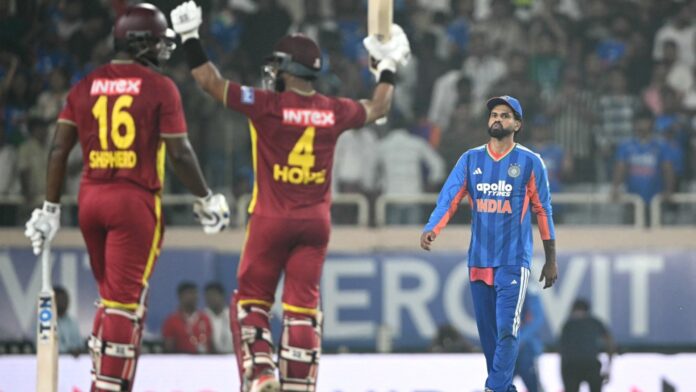

BIRMINGHAM — The 2026 ICC Women’s T20 World Cup opens at Edgbaston in Birmingham on Sunday evening with the bilateral match-up Indian and Pakistani cricket calendars have been waiting eighteen months to play: India versus Pakistan, first ball at 7 PM India Standard Time. The match, which Olympics.com previewed in detail Saturday morning, is one of four group-stage fixtures across the United States, Canada and the United Kingdom on Sunday and the only one that pairs the sport’s two largest cricket-watching populations against each other. Star Sports Network carries the broadcast inside India; JioHotstar streams it.

Harmanpreet Kaur, the Indian captain who has led the side since the 2022 Commonwealth Games silver-medal final and who took over the white-ball captaincy from Mithali Raj on a full-time basis in 2023, framed her side’s tournament posture in the way Indian cricket captains have, since Kapil Dev’s 1983 campaign, framed knock-out commitments. “We’ll play our fearless cricket,” she told the press conference at Edgbaston on Friday afternoon. The phrase, which the Indian-language sports outlets had reproduced verbatim across every front page by Saturday morning, became the campaign’s working slogan. Smriti Mandhana, the vice-captain and the world’s number-one-ranked T20 women’s batter on the ICC’s published list, opens the innings with Shafali Verma. Jemimah Rodrigues bats at three; Deepti Sharma, the wicket-keeper-batter who anchored India’s 2023 Asian Games chase, comes in at four. The wicket-keeping gloves go to Richa Ghosh, the twenty-three-year-old Bengal player whose strike rate against pace has been the standout statistic of India’s pre-tournament series against Australia and South Africa.
Pakistan’s captain Fatima Sana is the player Indian dressing-room analysts have been studying the longest. The twenty-three-year-old fast bowler, who came into the tournament off a twelve-month run in which she has averaged “over fifty with the bat and under twenty-five with the ball,” is the all-rounder Pakistan have been waiting on since Sana Mir’s retirement in 2019. Sana opens the bowling alongside left-armer Diana Baig and is the team’s first-change batter at four. Gull Feroza opens the innings with the eighteen-year-old left-hander Eyman Fatima, whose Asia Cup debut last autumn drew comparisons in the Pakistani cricket press to Babar Azam’s first international half-century. Tuba Hassan, the leg-spinner whose first-class economy rate has been the single-best figure on the Pakistani domestic circuit in the past season, will deliver the middle overs.
Edgbaston, the historic Warwickshire County Cricket Club ground that has hosted Test cricket since 1902 and that Birmingham’s South Asian-heritage residents have, in this decade, made the most consistently sold-out women’s-cricket venue in England, is expected to sell out its 21,000-seat capacity. The pre-match Friday-evening practice session drew approximately four thousand visiting Indian and Pakistani supporters to the ground for the open net session, a turnout that the Edgbaston curator’s office said is the largest pre-match women’s-cricket session it has hosted. The Birmingham West Midlands Police’s Sunday afternoon staffing plan reflects the expectation; the ground will be the most heavily policed sporting venue in the West Midlands this weekend.
The head-to-head record between the two sides in T20 women’s internationals favours India, who have won eleven of the fourteen completed encounters since the format’s introduction in 2009. Pakistan’s two wins came in 2012 and 2024; the 2024 result, at the Dubai International Cricket Stadium during the Asia Cup, ended a six-game Indian winning streak and is the encounter Pakistani team meeting prep on Friday spent the longest reviewing in video. India’s most recent victory, at last year’s Commonwealth Games in Brisbane, was decided by a Mandhana eighty-three-not-out off forty-eight balls; the analytical question Pakistan’s bowling unit will face on Sunday is whether the seam-and-swing line on the slightly green Edgbaston pitch in mid-June can replicate the conditions that, on similar grounds, restricted Mandhana in the 2022 Commonwealth Games final.

The wider tournament structure is the part Indian fans have read with the most attention. The 2026 Women’s T20 World Cup is the first to be staged in England since 2018, the first to feature a sixteen-team format, and the first that the BCCI’s Women’s Premier League has fed players into in numbers that the tournament’s prize structure now reflects. The full Group A draw places India and Pakistan with England, Sri Lanka and Zimbabwe; Group B holds Australia, South Africa, New Zealand, Ireland and Bangladesh. The semi-final pairings, on the published bracket, will pit the top two of each group cross-wise on July 5 and 6, with the final on July 12 at Lord’s. The grand-final purse is approximately $1.4 million — a number that, in absolute terms, is now within ten percent of the men’s tournament’s 2024 purse and that, on inflation-adjusted figures, narrows the gap further. The pay-gap conversation, which the Indian women’s team and Pakistani women’s team players’ associations have been publicly making since 2021, has been resolved at the tournament-purse level. The match-fee and central-contract conversations are still active.
Off the pitch, the diplomatic context is the part that has, in the past forty-eight hours, become noticeable. Indian Prime Minister Narendra Modi, who is scheduled to land at the G7 summit in Évian-les-Bains on Sunday afternoon, will not, on the prime minister’s office’s Saturday-evening schedule, be at Edgbaston for the match. Modi’s diary places him in conversation with French President Emmanuel Macron and Canadian Prime Minister Mark Carney during the Edgbaston window. The brief he will arrive at the G7 with is the one Eastern Herald reported earlier today, with Kenya, Brazil, Egypt and Indian delegations all at the table in Carney’s “global rupture” framing. The bilateral India-Pakistan thaw that the cricket boards’ agreement to play this World Cup on neutral English soil was supposed to symbolise has not, in any other diplomatic sphere, materialised. The match is, in 2026, the bilateral.
For the Indian fans flying into Birmingham International on Sunday morning and the Pakistani fans driving up the M40 from Brent Cross in north-west London — the Pakistani-British community’s heartland — the match is an event scaled to the cultural weight Indian and Pakistani cricket-watching audiences have always made of bilateral fixtures and that, the broadcaster numbers suggest, will be the most-watched women’s-cricket television event in the history of the format. JioHotstar’s pre-show on Saturday evening reached, on the platform’s own social-media engagement figures, sixty-eight million views in twelve hours. The ICC’s published expected viewership for the live match is one hundred and fifty million across India, Pakistan, Bangladesh, Sri Lanka, the United Arab Emirates, the United Kingdom and the global diaspora. Women’s cricket, the men’s-cricket-administrator coalitions had argued through the 2010s, would never sell. The numbers say otherwise.
What Harmanpreet Kaur’s “fearless cricket” instruction does, on Indian dressing-room readings, is set the tone for the squad whose top-order batting is the deepest in the tournament. The instruction Pakistan’s coaching staff has given Fatima Sana, on the press-conference exchanges Saturday evening, was the same instruction Pakistani teams have given themselves since Misbah-ul-Haq’s tenure: that the match is not bigger than the players. “Pressure,” Sana told the press, “is what we play for.” The toss is at 6.30 PM IST. The first ball is at 7.00. By 10.30 IST the cricket-watching populations of India and Pakistan will know which side has begun the tournament the way both sets of selectors needed.