
SAN FRANCISCO – Patrick McGinnis, Best Buy’s chief merchandising officer, described the arrangement as something “customers can’t find at any other retailer.” Whether that’s true probably depends on how one defines the experience of trying on a pair of AI-powered glasses in a big-box store. What is harder to dispute is the pressure that produced it.
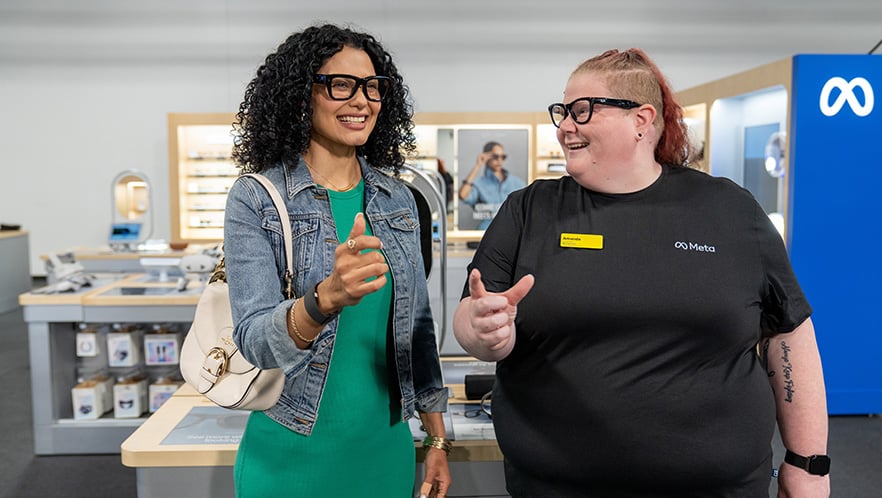
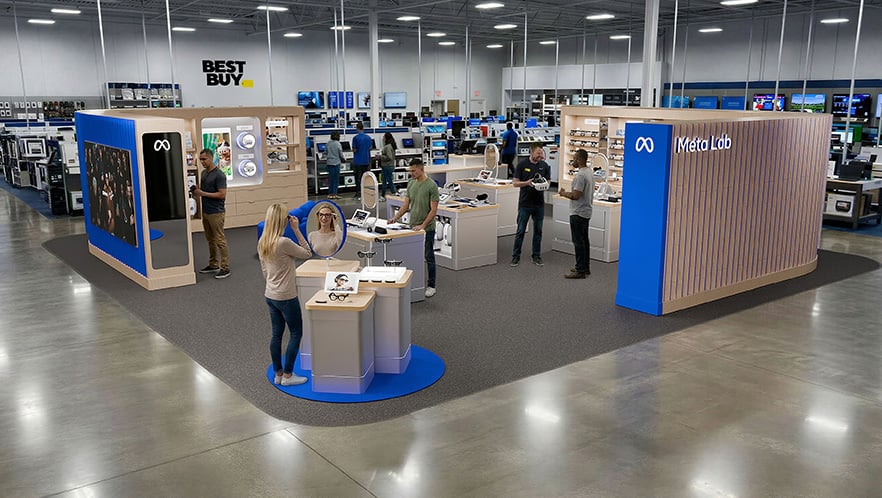
Meta announced on June 8 that it is opening more than 50 dedicated retail spaces inside Best Buy locations across the United States and Canada, branded as Meta Lab @ Best Buy. Each is roughly 900 square feet – a so-called store-within-a-store – where shoppers can try on Ray-Ban Meta AI glasses, handle Oakley Meta frames, and strap on a Quest 3 or Quest 3S headset for a guided demo. Meta Sales Specialists staff every location. The first five sites, including San Carlos, California; Woodland Park, New Jersey; and Columbus, Ohio, open this summer. The rest come online through the end of 2026.
The expansion is, on its surface, a logical next step. Meta has operated kiosks at Best Buy for years, and the company’s Meta Lab concept – pop-up experiential spaces that debuted in late 2025 on Fifth Avenue and at the Wynn in Las Vegas – was always intended to scale. Some of those temporary locations have since become permanent. The Best Buy rollout is the mass-market version: fewer Instagram-ready design flourishes, more square footage, and the specific challenge of selling two very different pieces of hardware to a shopper who came in for a laptop.
That pairing is where the story gets complicated. Until now, Meta’s Best Buy kiosks had been split: older installations focused on Quest headsets, newer ones on the AI glasses that followed the Ray-Ban Display launch last year. Merging them into a single space isn’t just a logistical convenience. It is a signal that the company has not, despite persistent speculation to the contrary, given up on virtual reality – even as its strategic center of gravity has shifted sharply toward wearables.
The sequence of events matters here. Meta launched Ray-Ban Display in late 2025 with a notable constraint: the company would not sell the glasses to anyone who had not tried them on in person, requiring a fitting from a trained specialist. That requirement forced a rushed deployment of AI-glasses-only kiosks that left the Quest headsets out entirely. It was an abrupt operational choice that reinforced – for skeptics, at least – the narrative that Meta was walking away from VR. The new Meta Lab spaces correct that impression, whether or not that was the original intent.
The Meta Lab experience itself is built around sensory demonstration. A style wall displays the full range of AI glasses frames; nearby, an interactive ultraviolet display shows how photochromic lenses shift in different light. Visitors can use the Meta Neural Band – a gesture-control wristband – to operate the Ray-Ban Display glasses without reaching for their phone. On the VR side, the demos pull from games, fitness applications, and immersive video. The pitch, in both cases, is the same: this is something you need to feel before you understand why you want it.
That pitch has a specific logic behind it. Demand for both AI glasses and VR headsets is substantially driven by firsthand experience. A shopper who has not worn a modern VR headset has no reliable way to imagine what the experience of being inside one actually feels like – and the same is true, in a different register, for glasses that can answer questions, identify landmarks, and translate signage in real time. Retail demonstrations solve a marketing problem that no advertisement can. Best Buy noted in its announcement that more than half of its customers say they want to try Meta’s AI glasses in person before committing to a purchase.
Best Buy’s context matters too. The retailer has been threading a careful path between its traditional big-box identity and a future that looks increasingly like a collection of specialized showrooms. Beyond the Meta collaboration, Best Buy is simultaneously expanding with IKEA consultation spaces inside select IKEA stores and building outdoor experience zones led by its Yardbird subsidiary at 20 locations. The Meta Lab fits a pattern: Best Buy is effectively leasing its foot traffic to technology and lifestyle brands that benefit from physical presence more than the company’s own floor space costs them.
Meta, for its part, is not new to physical retail experimentation. The company opened standalone Meta Stores in 2022, then scaled back as the broader metaverse bet soured and Mark Zuckerberg cut roughly 30 percent of the Reality Labs budget in late 2025. What remains is a hardware portfolio that actually sells – CNBC reported that EssilorLuxottica sold over 7 million Ray-Ban Meta AI glasses in 2025 alone, more than three times the combined total from the two prior years – and a VR business that, despite the strategic pivot, still generated enough revenue that Meta raised Quest headset prices earlier this year and people kept buying.
What the Meta Lab @ Best Buy spaces won’t resolve is the underlying question about where Meta’s consumer hardware story is actually going. The company’s most bullish internal case for AI glasses imagines them eventually displacing smartphones as the primary interface layer between humans and digital information. That is an extraordinarily ambitious claim that requires not only better technology but a full reordering of consumer habits. A store-within-a-store at Best Buy is useful for selling the devices that exist today. It is a poor proxy for what comes next.
The company has not said how many units it expects to move through the new Meta Lab spaces, nor whether the 50-location rollout will expand further after the end of 2026. Best Buy’s first-quarter results – enterprise revenue up 2 percent to $8.9 billion, net earnings up nearly 37 percent to $276 million – give the retailer some room to experiment. For Meta, the more pressing unknown is whether putting glasses and headsets in the same 900 square feet is enough to convince consumers that both are worth their attention simultaneously, rather than one at the expense of the other.
That answer won’t be visible in a June announcement.