
TAIPEI — The last time Acer put its name on a headset, the iPhone had a headphone jack and Ray-Ban’s smartglasses were still two years from existing. That was 2019. The device was the OJO 500, a Windows-tethered VR headset aimed at enterprise customers that generated little fanfare and effectively marked the Taiwanese company’s quiet exit from extended reality hardware.
Seven years later, Acer is back — and this time with two products designed for a market that has transformed entirely around it. Announced at Computex 2026 in Taipei, the company unveiled the AR Vision GR0, a wired pair of augmented reality glasses built around dual microOLED displays, and the GI0 AI Glasses, a consumer wearable running Google Gemini that takes aim at the Ray-Ban Meta’s growing dominance of the AI glasses segment.
The timing is pointed. The smart glasses market has drawn nearly every major technology company in the past two years — Google and XREAL announced Project Aura together, Samsung is expected to debut Galaxy Glasses at July’s Unpacked event, and Apple has pivoted away from the Vision Pro to pursue its own glasses program. Acer is stepping into a category it once abandoned, crowded now with competitors who never left.
Whether that constitutes confidence or miscalculation depends entirely on what the two devices actually deliver.
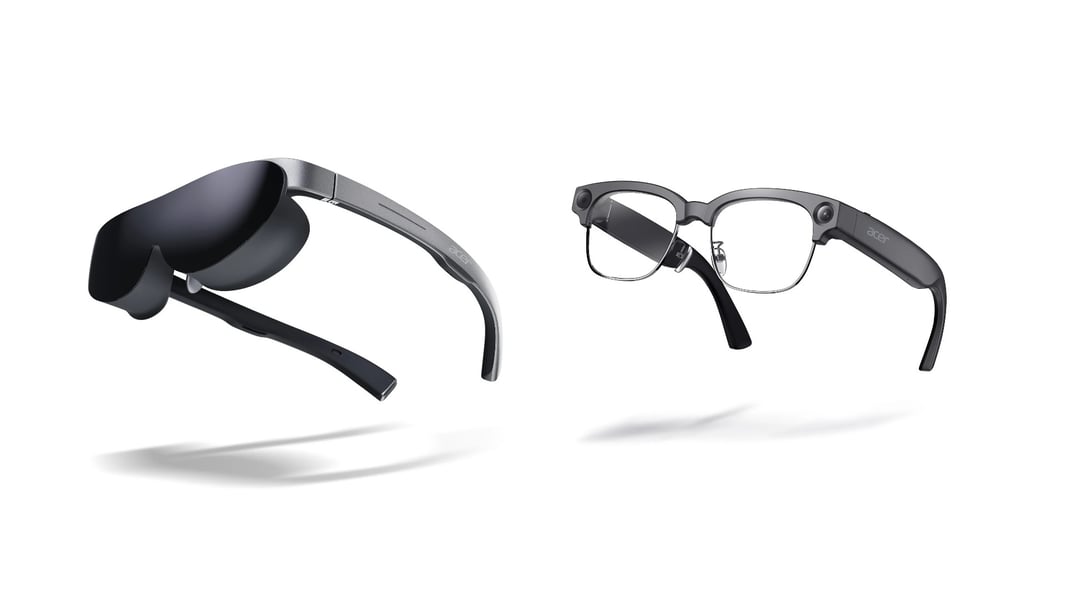
The AR Vision GR0 is the more technically ambitious of the pair. It connects via cable to Android phones, iPhones, and Windows PCs, and presents two 1,920 x 1,080 microOLED panels — one per eye — at a claimed brightness of 200 nits with a 50,000:1 contrast ratio. Acer describes the viewing experience as equivalent to a 172-inch screen seen from six meters away, a figure the company has not independently validated with field-of-view measurements. The optics appear to use a bird bath-style architecture, similar to what XREAL and VITURE use in their tethered glasses lines. It weighs 69 grams and supports myopia correction lenses via a magnetic attachment. Acer has priced it at $500 for the North American market, with European availability at €600 and Australian pricing at $1,000 AUD, both arriving in the latter half of 2026.
The GR0 is, in other words, a competent entry into a well-established product category. The interesting question Acer leaves unanswered is why its bird bath approach should draw buyers away from XREAL’s Air series or the RayNeo Air 4 Pro, which carry comparable specifications and an established ecosystem of firmware updates and developer support. The GR0 does not arrive with a clear differentiator beyond the Acer brand and the reassurance of a large manufacturer’s supply chain.

The GI0 AI Glasses are the more culturally legible product. At $300, they enter at a price point slightly below the Ray-Ban Meta’s standard retail, with a design language that owes an obvious debt to the Wayfarer silhouette. Acer has modified the shape with a half-rim frame that leaves the lower edge of the lenses exposed — an aesthetic choice that produces a lighter, airier look but leaves the thicker upper bar more visually prominent. The glasses weigh 46 grams without lenses, marginally lighter than the Ray-Ban Meta Gen 2. A 12-megapixel camera captures still images at 3,024 x 4,032 pixels and video at 1,920 x 1,080 at 30 frames per second. That video specification falls below what Meta’s second-generation frames offer.
The AI integration runs through Google Gemini. Voice queries, real-time image analysis, on-the-fly translation, and conversation recording are all handled by Gemini via the companion Acer AspireSync app, available for Android 12 and above or iOS 15 and above. Connectivity runs over Bluetooth 5.0 and Wi-Fi 5. Onboard storage sits at 32 gigabytes. The battery is rated at 217 mAh — Acer has not published an endurance figure, which will be the device’s most closely watched specification once it reaches reviewers.
The GI0 does not confirm whether it runs Android XR, Google’s dedicated operating system for glasses-form-factor hardware. That ambiguity matters. Google and XREAL’s Project Aura, announced at Google I/O 2026, is built specifically on Android XR and has Gemini embedded at the operating system level rather than as a companion app. If the GI0 uses Gemini as an app rather than as native infrastructure, the integration may feel more like a feature add-on than the seamless assistant layer Google is pitching with its own hardware partners. Acer has not clarified the distinction.
The broader context is worth holding. Google’s AI glasses initiative at I/O 2026 signaled the company’s intent to make Android XR the platform of record for smart eyewear, in the same way Android defined the smartphone category a decade and a half ago. A manufacturer that builds on top of Gemini but outside the Android XR platform may find itself in a structurally awkward position as that ecosystem matures. Acer has chosen to arrive at the beginning of that standardization battle, which means it also arrives before the platform is settled.
What neither product does is address the basic objection that has followed every Ray-Ban Meta competitor since 2023: the glasses segment rewards network effects, update cadence, and ecosystem lock-in over hardware specifications. Meta’s glasses benefit from WhatsApp integration, a loyal user base, and three hardware generations of refinement. Acer’s GI0 has a competitive price and Google’s AI brain. Whether that is enough depends on what consumers decide they are actually buying when they pay for smart eyewear — the hardware or the attached life.
A pricing and availability confirmation, a hands-on review, or a clearer statement on Android XR compatibility would resolve most of the open questions. None of those things exist yet. Google and XREAL’s Project Aura partnership is the most direct competitive challenge Acer will face in the tethered AR segment, and that device has not shipped either. Both companies are betting on a consumer appetite for premium eyewear computing that is still being demonstrated rather than proven.
Acer’s return is not a statement of what the smart glasses market has become. It is a bet on what it might still be.