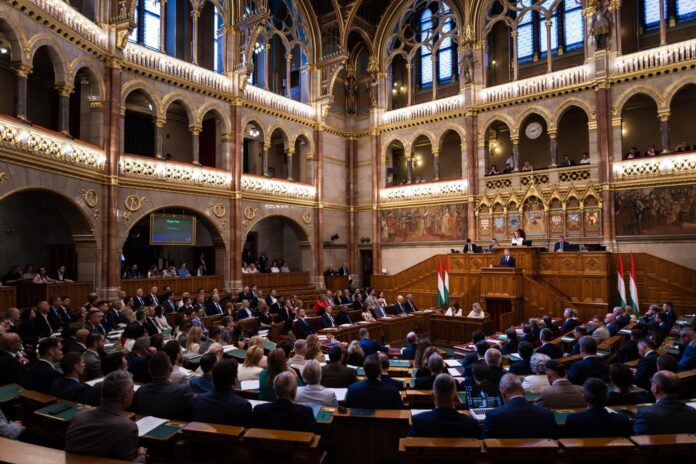

BUDAPEST — Viktor Orbán was re-elected on Saturday as leader of Fidesz, the right-wing party he has chaired for twenty-six of the last thirty-three years, at a party congress that returned him to the position by 729 of 737 delegate votes. He ran unopposed. The vote was a procedural confirmation of an outcome that no one inside the party building in central Budapest had questioned in advance. The political news in the room, instead, was the parts of Orbán’s acceptance speech that he intended to mark the start of the next campaign rather than the close of the last. “I do not give up,” he told the assembled delegates. “I never, never, never, never, never give up.” The five-fold repetition, covered by Al Jazeera the same evening, will become the Fidesz slogan of the 2027-to-2030 cycle. It will not be the slogan of the next government.
The next government, on every measure that matters in Budapest in June 2026, belongs to Prime Minister Péter Magyar. The forty-four-year-old former Fidesz insider, who founded the centre-right Tisza Party in 2024 and led it to a two-thirds parliamentary majority in the April 12 Hungarian parliamentary election, has spent the eight weeks since taking office systematically reversing the foreign-policy positions that defined Orbán’s third and fourth terms. The unwinding of Orbán’s Russia strategy has been the part of that reversal Brussels noticed first.

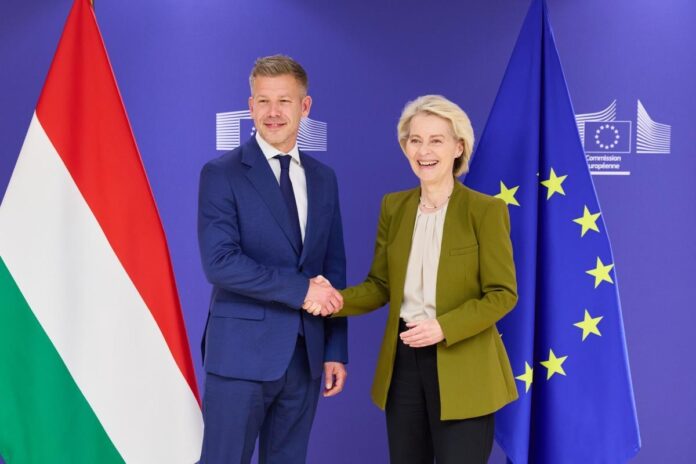
The procedural reversals have come fast. On May 6, Magyar’s foreign minister, Péter Vitézy, formally withdrew Hungary’s standing veto on the European Union’s negotiating mandate for Ukrainian accession — the veto Orbán had imposed in October 2023 and that, until it was withdrawn, had kept the accession framework frozen at chapter four of a thirty-five-chapter process. On May 19, the European Commission, in a decision the Hungarian Justice Ministry had spent two years preparing for and that Orbán’s lawyers had spent two years contesting, released €16.4 billion of Hungarian cohesion and recovery funds that the Commission had withheld since 2022 under the conditionality mechanism on rule-of-law violations. On May 27, Magyar travelled to Kyiv, becoming the first Hungarian prime minister to do so in active wartime and pledging €120 million in bilateral budget support to the Ukrainian government for 2026 alone.
The political result, eight weeks after the election, is the part Fidesz’s own internal polling had not prepared the party for. A May survey by the Publicus Institute, the independent Hungarian polling firm that has tracked Fidesz vote share continuously since 2010, put the party at 17 percent, down twenty-two points from its 39 percent on April 12. Tisza, the survey put at 55 percent, up two points from its 53 percent vote share on election day. The opposition Mi Hazánk and Democratic Coalition parties polled the rest. The collapse is the steepest measured for a major Hungarian opposition party at any point in the post-1989 republic.
The structural explanation for Fidesz’s collapse, on most Hungarian political reads, is that the party’s polling support in 2025 was elevated by patronage. Hungarian state-owned media, state-owned employers and the politically aligned regional Fidesz mayors’ networks together represent approximately three hundred thousand jobs whose holders, in pre-election surveys, told pollsters they voted Fidesz. Eight weeks into Magyar’s government, those networks have been wound down. The polling answer has changed accordingly.
Orbán’s Saturday speech took responsibility for the April loss in the language of a leader who intends to remain in the building. “We did not lose because we abandoned our values,” he told delegates. “We lost because our communication failed.” The reading is contested. Magyar campaigned, and won, on a platform that was, on its substantive points — net-zero by 2050, an independent judiciary, anti-corruption commissioners answerable to parliament, alignment with the European People’s Party rather than the European Conservatives and Reformists — not communication but content. The communication change, the Tisza campaign team has said in retrospective interviews with the German weekly Der Spiegel and the Polish daily Rzeczpospolita, was the secondary effect of the substantive one.
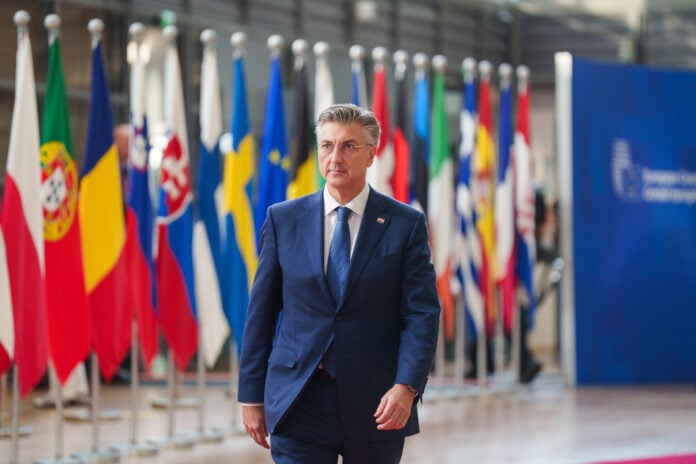
The European context of the Fidesz vote is the one Brussels and Warsaw spent Saturday afternoon studying. Hungary’s withdrawal of its Ukraine-accession veto changes the European Council’s voting arithmetic on the package of seven enlargement files — Ukraine, Moldova, Montenegro, North Macedonia, Albania, Serbia, Bosnia and Herzegovina — that the Commission has wanted to advance since the December 2023 Council. The arithmetic was, until May 6, blocked by one vote. Bratislava’s residual ambivalence on the Ukraine file remains, but Slovak Prime Minister Robert Fico, in a Saturday interview with the Hungarian wire service MTI, signalled he would not on his own veto a file Budapest had stopped blocking. Polish Prime Minister Donald Tusk has spent the same week briefing G7 partners in advance of the G7 summit France hosts in Évian-les-Bains that the Ukraine-accession track is now, for the first time since the war began, procedurally clear.
The bilateral Hungary-Russia track Orbán built across 2014, 2018 and 2024 — the Paks II nuclear-plant expansion contract with Rosatom, the Turán bilateral gas deal, the strategic-partnership memorandum signed at the Belgrade Eurasian Economic Union summit in 2024 — is the part Magyar’s government has, to date, only partially unwound. Paks II’s procurement has been suspended pending European Commission review. The Turán gas contract has been transferred to a public-procurement court challenge. The strategic-partnership memorandum has been withdrawn by Hungarian diplomatic note. None of those measures cancels the underlying instruments. Each, on the Magyar government’s stated logic, is a wedge to renegotiate them. The Hungarian Ministry of Energy on Friday said the renegotiations would conclude before the end of the second quarter of 2027.
The international stake of the Fidesz congress is, in 2026, larger than Hungarian domestic politics alone. The European People’s Party’s expulsion of Fidesz in 2021 left Orbán outside the major centre-right pan-European political family. The European Conservatives and Reformists, which Orbán joined in 2024, has since lost three of its founding constituent parties to other groupings. The Patriots for Europe alliance, which Marine Le Pen’s Rassemblement National and Matteo Salvini’s Lega built with Orbán in July 2024, has lost its institutional gravity since the April Hungarian election and the September 2025 collapse of Italy’s Meloni-Salvini coalition. Orbán’s Saturday speech did not mention any of them. The political family he is now leader of, in practice, is the Fidesz that controls Hungary’s 14 of 199 parliamentary seats.
What Saturday’s vote confirms, for the European People’s Party-aligned governments that have spent eight years dealing with Orbán as the European Council’s most disruptive interlocutor, is that the Orbán era of Hungarian foreign policy is now decisively past. The vehicle the era was built on — a party whose leader, electoral defeat notwithstanding, will spend the next four years trying to rebuild the rural and provincial coalition that delivered him four governments — will continue to exist. The institutional Hungary the era used as its leverage will not. The 729-vote reaffirmation Orbán received on Saturday was, in that reading, an affirmation of the leader who lost. The leader who is now governing Hungary did not need a vote of confirmation. He had received one on April 12.