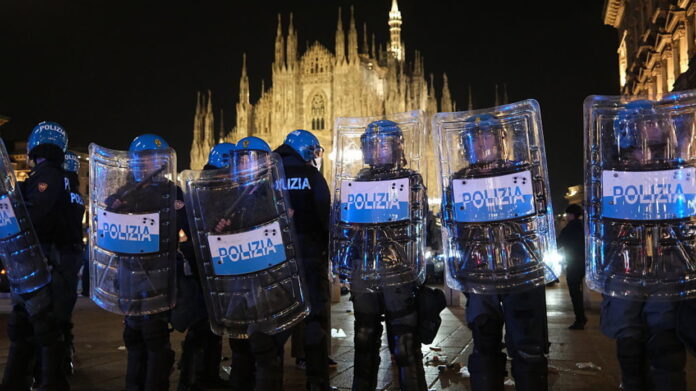

ROME — Italy’s far-right “Remigration and Reconquest” committee assembled in the Prati district of central Rome on Saturday afternoon, the day before this country’s prime minister leaves for the G7 summit in Évian-les-Bains, to demand that Parliament debate a citizens’ petition to coercively expel foreign-born residents from Italian territory. The march drew “several thousand” people, the police estimate, mainly from the neo-fascist CasaPound network. Several kilometres away in the same city, the counter-march drew “tens of thousands.” Thousands of police kept the two demonstrations apart. An Al Jazeera report compiled from AFP and AP wire copy on Saturday evening described the day as the largest pro-migration mobilisation in Italy since the 2018 Diciotti affair.

The petition that the CasaPound-led committee delivered to the Camera dei Deputati on Friday morning is the procedural piece that will shape the next four weeks of Italian politics. The committee gathered fifty thousand signatures — the threshold the 1947 Italian Constitution sets for compulsory parliamentary discussion of any popular initiative — over a six-month signature drive that the country’s Interior Ministry, under League leader and Deputy Prime Minister Matteo Salvini, did nothing publicly to obstruct. The text the petition presents is brief. It asks Parliament to pass a statute requiring the Italian state to identify, detain and “return to country of origin” any foreigner who arrived in Italy after January 1, 2015. The estimated population in scope is approximately 1.6 million people, the great majority of whom hold legal residence permits.
“We want to kick the illegal immigrants out,” Luca Marsella, the CasaPound spokesman who organised the Prati rally, told the AFP wire on Saturday afternoon. “Force them out, because they shouldn’t be here.” The phrasing, which omits the legal residence status the proposed text would override, was repeated, more or less verbatim, on every banner in Prati. The crowd along the line of march included delegations from the French Reconquête party, the Spanish Vox movement and the German AfD’s Junge Alternative; their flags were visible alongside the Italian tricolore. The march concluded at the Piazza del Popolo, where Marsella delivered an address. The official organisers’ attendance estimate of “forty thousand” was, in police counter-counts and aerial drone overlays the Italian carabinieri published Saturday evening, between four and six thousand. The pro-migration counter-march, organised by the Associazione Nazionale Partigiani d’Italia, the CGIL trade-union confederation, the Rete Antifascista Romana and the centre-left Democratic Party, drew the larger crowd.
Angelo Bonelli, the Federation of Greens and Left co-leader who addressed the counter-march from the steps of the Basilica di Massenzio in the Roman Forum, framed the political stakes in constitutional language. “The so-called remigration bill,” Bonelli said, “invokes a logic of exclusion based on ethnic and cultural background that is incompatible with the Italian constitution.” The 1947 Italian Constitution’s article three guarantees equality regardless of “race, language, religion, political opinion, personal and social condition,” the standard against which the Constitutional Court has, in three prior rulings since 2002, struck down comparable expulsion statutes. The court’s current composition includes nine Meloni-era appointees out of fifteen; how it would read a 2026 version of the same text is no longer the certainty it was in 2014.
Prime Minister Giorgia Meloni’s right-wing coalition, in office since October 2022, is divided on whether to bring the petition to a parliamentary vote. The League, under Salvini, would table the text on Monday if it could; League MPs co-signed a procedural motion to that effect on Friday. The Brothers of Italy, Meloni’s own party, has been more cautious. Meloni’s foreign-policy positioning since the war in Gaza, which has tracked the Atlanticist line in private even as it has accommodated the coalition’s far-right wing in public, would not survive an open vote on a statute that the European Commission would, on most readings, refer to the Court of Justice within weeks. Forza Italia, the centrist coalition partner that has held migration policy together since 1994, has signalled it will not vote for the text in present form.

The international context Meloni will arrive at Évian with on Sunday afternoon is the part that constrains her domestic flexibility. The G7 host, French President Emmanuel Macron, has invited Kenya, Brazil, India, Egypt and the Gulf states to the summit — a configuration Canadian Prime Minister Mark Carney described from Trinity College Dublin as the post-Cold War order under “global rupture”. The migration-policy session, scheduled for Tuesday afternoon, will give the Italian delegation a venue at which to either defend or repudiate the CasaPound text. Meloni’s own communications office on Saturday evening released a holding statement that committed her government to “the rule of law and to the constitutional order,” a wording that, in Italian political vocabulary, is the way a prime minister signals that she will not, on her watch, sign legislation the Constitutional Court would strike.
The wider European context is shifting under the Italian coalition’s feet. Hungary’s withdrawal of its veto on Ukraine’s EU accession under the new Tisza government, which Eastern Herald covered in detail Saturday morning after Viktor Orbán’s re-election as Fidesz leader despite his April election loss, has redrawn the European Council’s voting arithmetic on the Migration Pact’s solidarity mechanism. The Patriots for Europe alliance, which Meloni’s Brothers of Italy declined to join when it was formed in 2024 but which it has shared parliamentary positions with on roughly thirty percent of European Parliament votes since, lost institutional gravity with the September 2025 Salvini-Meloni public dispute and the April 2026 Hungarian electoral defeat. The political coalition Meloni would need at the European level to defend a CasaPound-aligned domestic statute is, in 2026, materially weaker than it was in 2024.
The domestic counter-coalition has, in the same period, mobilised faster than the Italian political press had predicted. Saturday’s pro-migration crowd, drawn from the ANPI partisans’ association, the CGIL union, the Catholic Caritas network, the Rete Antifascista Romana and a wide spectrum of left and centre-left parties, was the largest single-day urban political assembly since the 2011 “Italian summer” against Silvio Berlusconi’s last government. The presence of senior figures from the Pope’s curia at the counter-march was noted in Avvenire, the Italian Bishops’ Conference daily, on Saturday evening, in language that the conference does not, as a rule, deploy lightly. The article quoted, anonymously, a senior curia official describing the CasaPound petition as “incompatible with Christian charity.” The phrasing, in Italian Catholic political vocabulary, is the strongest condemnation available short of formal Vatican intervention.
What Monday’s coalition meeting in Palazzo Chigi will decide is whether the CasaPound petition is sent to parliamentary committee for the standard pre-legislative review, which would delay any floor vote by twelve to eighteen months, or whether it is moved directly to a floor debate, which would force Meloni to declare a position. Saturday’s marches, by the police-published numbers, gave the prime minister a domestic political reading she did not have when the week began. The crowd that showed up in Rome to support the petition was not the crowd the petition’s organisers had counted on. The crowd that showed up to oppose it was larger, broader and, on the published police estimates, demonstrably the majority. Marsella’s Saturday afternoon address closed with the phrase “this is the start.” Bonelli’s closed with a different one: “the constitution still holds.” Which of those two phrases the Italian political week takes its cue from will be visible by Monday evening.