A legal technology startup has launched a fresh challenge against the US government after losing access to Anthropic’s most advanced artificial intelligence models, escalating a growing dispute that now spans export controls, national security concerns, and the future of frontier AI development.
Legion LegalTech Corp., a California-based company that builds AI-powered legal software, filed a lawsuit against federal officials after a June 12 directive forced Anthropic to restrict access to its flagship Fable 5 and Mythos 5 models. The order, issued by the Bureau of Industry and Security, required Anthropic to prevent foreign nationals from accessing the systems, triggering widespread disruptions for customers that relied on the technology.
According to court filings, Legion claims the restrictions caused immediate damage to its business because members of its development team work from Canada. The company says its legal drafting, case management, and litigation products depend heavily on Anthropic’s AI capabilities, making the sudden loss of access an existential threat to operations.
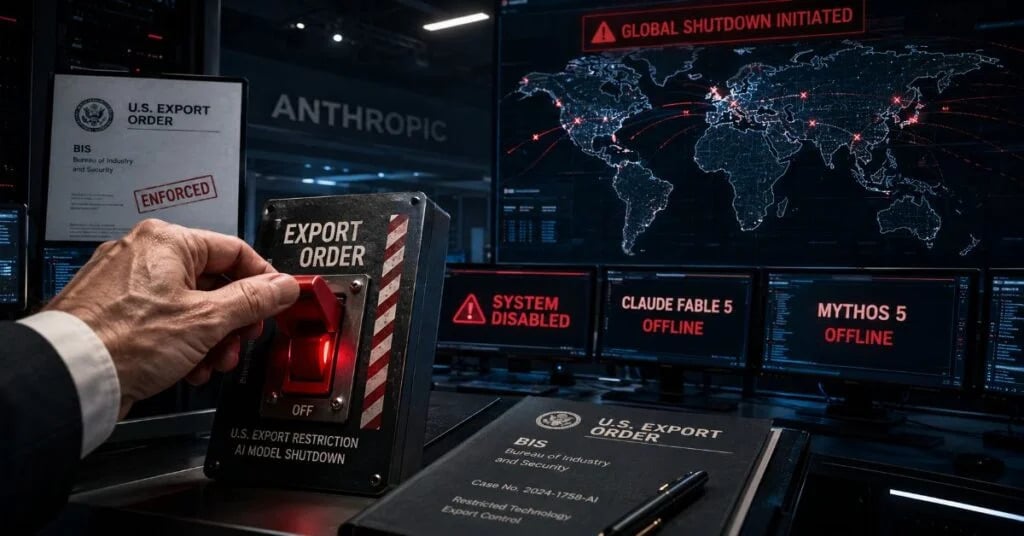
The legal battle comes amid an increasingly tense relationship between Anthropic and the US government. Earlier this month, the company disabled access to Fable 5 and Mythos 5 after receiving the export-control order. Anthropic later worked on more targeted compliance measures, but the disruption sparked concern among customers and developers who had integrated the models into commercial products.
While the lawsuit focuses on business disruption, national security officials have pointed to the extraordinary capabilities of Anthropic’s latest AI systems as justification for heightened scrutiny.
That debate intensified this week after reports revealed that Anthropic’s advanced Mythos model identified vulnerabilities inside classified US government computer systems during a security-testing initiative known as Project Glasswing. The program, conducted in partnership with intelligence agencies and cybersecurity officials, was designed to uncover weaknesses before they could be exploited by adversaries.
During a congressional hearing, Senator Mark Warner cited comments from a senior US intelligence official indicating that Mythos successfully uncovered vulnerabilities across nearly all classified systems evaluated during the exercise. Officials later clarified that the AI model did not exploit the weaknesses but rapidly identified them, allowing security teams to address the problems.
The revelation highlights why Mythos has become one of the most closely watched AI systems in the world. Unlike consumer-focused chatbots, the model was developed with advanced cybersecurity capabilities and was initially made available only to a limited group of trusted organizations through Anthropic’s Glasswing program.
Government officials have increasingly expressed concern that frontier AI models capable of discovering software vulnerabilities could also be misused if they fall into the wrong hands. Those concerns have fueled a broader push in Washington to establish stricter oversight mechanisms for advanced AI systems and to limit access to technologies considered strategically sensitive.
The dispute also reflects deeper disagreements between Anthropic and federal agencies over how powerful AI should be deployed. The company has publicly resisted efforts to allow unrestricted use of its systems for surveillance activities and autonomous weapons programs, placing it at odds with some national security officials. Those tensions have contributed to a series of confrontations involving government contracts, military applications of AI, and access to classified networks.
For businesses like Legion, however, the immediate concern is far more practical. Companies that built products around Anthropic’s frontier models now face uncertainty over whether access can be maintained, expanded, or suddenly withdrawn due to government intervention. The lawsuit could become a key test case for how far federal authorities can go in restricting access to advanced AI technologies that are already embedded in commercial operations.
Industry observers are also watching closely because the outcome could shape how AI providers manage international workforces and global customers. Many software companies rely on distributed teams that span multiple countries, making nationality-based access controls difficult to implement without disrupting business operations. Anthropic’s decision to initially disable access broadly illustrates the practical challenges created by such regulations.
The case arrives at a pivotal moment for the AI industry. Governments around the world are attempting to balance economic competitiveness with national security concerns, while technology companies push forward with increasingly powerful systems capable of performing sophisticated research, coding, cybersecurity analysis, and autonomous tasks.
Whether the courts ultimately side with Legion or federal regulators, the lawsuit is likely to become a landmark dispute in the evolving battle over who controls access to the world’s most advanced artificial intelligence models. As policymakers seek to define the rules for frontier AI, businesses that depend on those tools may find themselves caught between innovation and regulation.