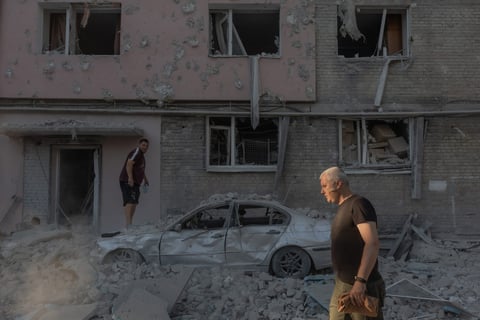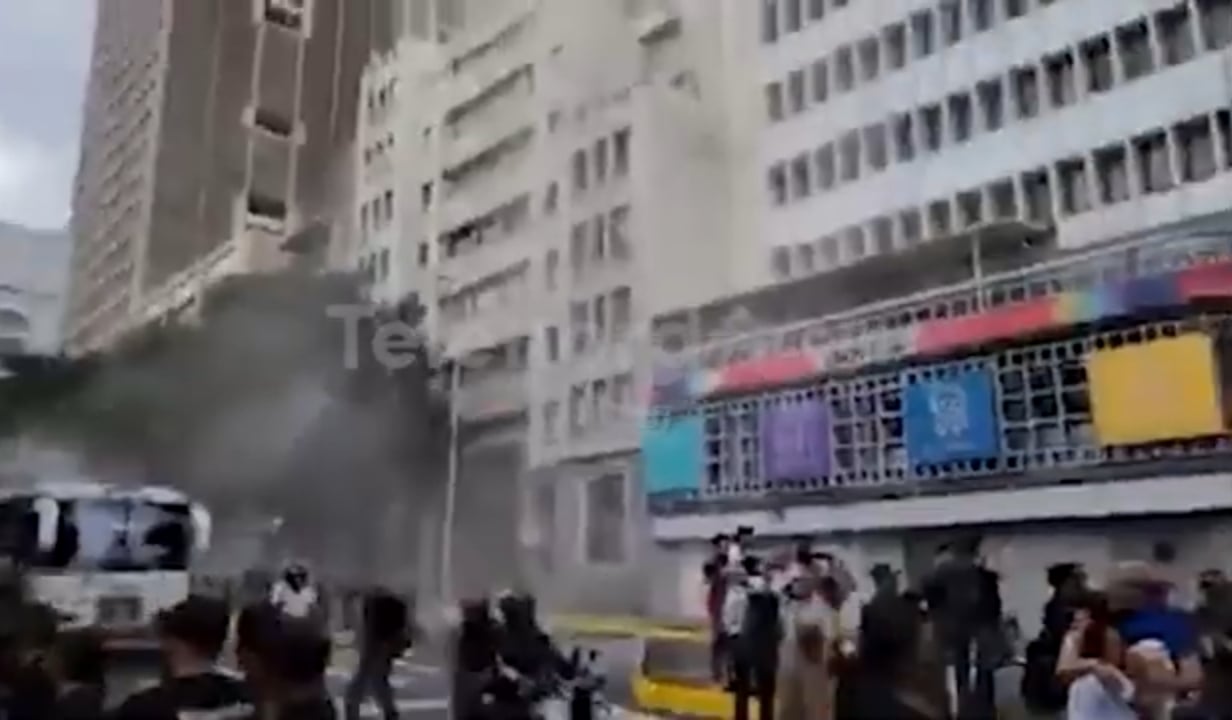

CARACAS – In the Altamira district of eastern Caracas, rescue teams were still drilling through reinforced concrete on Friday, more than 36 hours after a 22-storey residential tower collapsed completely. Families gathered at the police cordon and held photographs. Some held phone numbers that had stopped receiving calls Wednesday evening.
That building is one of at least three to collapse in Altamira alone. Venezuela is still counting its dead.
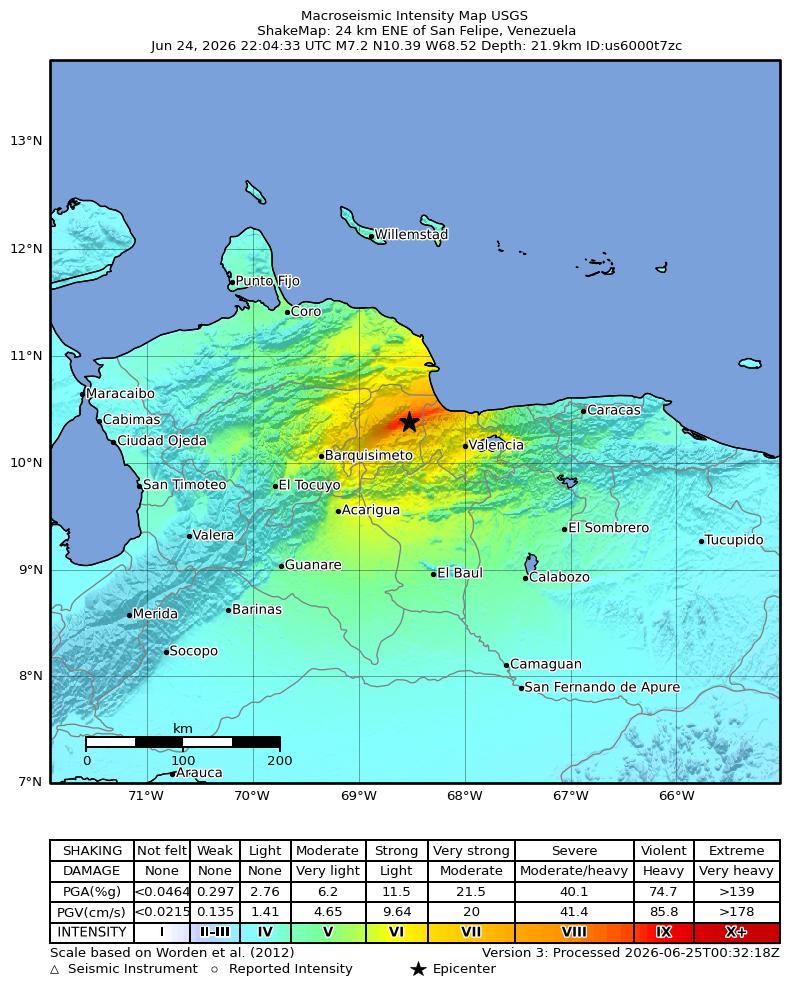
At 6:04 p.m. local time Wednesday, a magnitude 7.2 earthquake struck east-northeast of San Felipe in Yaracuy state. Thirty-nine seconds later – before most residents had risen from the floor – a magnitude 7.5 mainshock hit the same fault system. Seismologists classify the pairing as a doublet earthquake, a rare geological phenomenon in which two quakes of nearly equal size rupture in rapid succession along the same break. The USGS describes doublets as among the least predictable sequences in seismic science: neither event is technically an aftershock of the other.
The mainshock was the strongest earthquake to strike Venezuela since the 7.7-magnitude San Narciso event of 1900. The destruction it produced followed the logic of the country’s geography and its neglect simultaneously. La Guaira, the port city north of Caracas that serves as the capital’s link to the sea, was designated a disaster zone within hours. More than 100 buildings collapsed there, and entire neighborhoods in Playa Grande, Tanaguarenas, and Los Corales were flattened. Simón Bolívar International Airport, which sits in La Guaira, sustained heavy structural damage. All flights were cancelled, and the airport has not reopened.
The official death toll has climbed with each update. Venezuela’s Health Minister Carlos Alvarado confirmed 235 dead and more than 4,300 injured on Thursday morning. By Friday, acting President Delcy Rodríguez, speaking on state television, said 589 people had been confirmed killed and 2,980 injured. The gap between those two sets of figures, produced within 24 hours of each other, reflects not statistical confusion but geography: entire sections of La Guaira and coastal Yaracuy remain inaccessible to rescue crews because roads have buckled or heavy machinery has not yet arrived.
The United States Geological Survey’s probabilistic damage model, run at the time of the mainshock, assigned a 39 percent probability that the final death toll will fall between 1,000 and 10,000, and a 37 percent probability that it will reach between 10,000 and 100,000. These are not predictions. They are projections based on earthquake magnitude, population density, building stock quality, and patterns from comparable historical events. Venezuela’s building stock quality, in the USGS model’s inputs, reflects a country that has deferred structural maintenance across most of its urban housing supply for the better part of two decades.
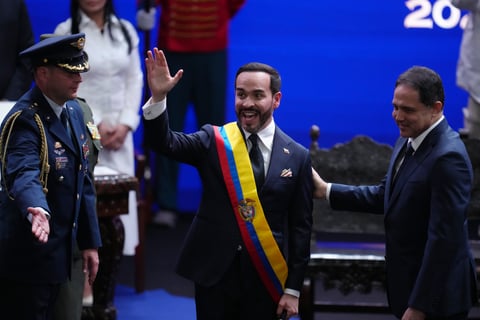
Acting President Delcy Rodríguez – Nicolás Maduro is abroad and has not returned to Caracas as of Friday – declared a nationwide state of emergency and directed army units and heavy equipment to La Guaira. She met with the army’s general staff Thursday to coordinate search operations in the hardest-hit coastal areas. By Friday evening, Rodríguez said US officials had been in constant contact with her administration since the earthquakes struck. That level of direct communication would have been unusual in most recent years, given the sanctions and diplomatic estrangement that have defined Washington-Caracas relations for much of the past decade.
The United States committed $150 million in humanitarian assistance, structured across direct bilateral awards to organizations including World Vision, Samaritan’s Purse, and the International Organization for Migration, and a contribution to the UN Office for the Coordination of Humanitarian Affairs’ Venezuela pooled fund. Secretary of State Marco Rubio, who warned hemispheric governments earlier this month that America could be their greatest friend or worst enemy depending on alignment with Washington, announced that urban search-and-rescue teams from Fairfax County, Virginia, and Los Angeles are deploying to Venezuela alongside overhead satellite imagery of coastal areas where Venezuelan authorities lack full visibility.
International response was wide. Spain, Mexico, Qatar, Colombia, Panama, the Dominican Republic, El Salvador, China, Brazil, and several Caribbean nations offered or dispatched personnel and medical resources. As NPR reported, Rodríguez described the international response as a signal “to the whole world” that humanitarian aid “does not know ideology.”
Geologists at Al Jazeera and Northeastern University independently described Altamira’s particular vulnerability: the neighborhood is built on alluvial sediments, which amplify seismic shaking in the way water amplifies vibration. A building on solid bedrock nearby can survive a magnitude 7.5 quake that destroys a sediment-founded structure two blocks away. Caracas learned this in 1967, when a 6.5-magnitude earthquake killed 236 people and collapsed three high-rise buildings in the same Altamira district, prompting updated building codes. How consistently those codes were enforced over the half-century since, and whether any of the buildings that failed Wednesday were built or modified outside those standards, is a question Venezuelan authorities have not publicly addressed.
Who remains in those buildings is also not known. A missing-persons tracking website reported more than 46,000 people unaccounted for, a figure almost certainly inflated by families who have since made contact and by duplicate entries. The real number is what search teams in Altamira and La Guaira are working to establish. As of Friday, Al Jazeera reported, that work had not finished.
Related Posts