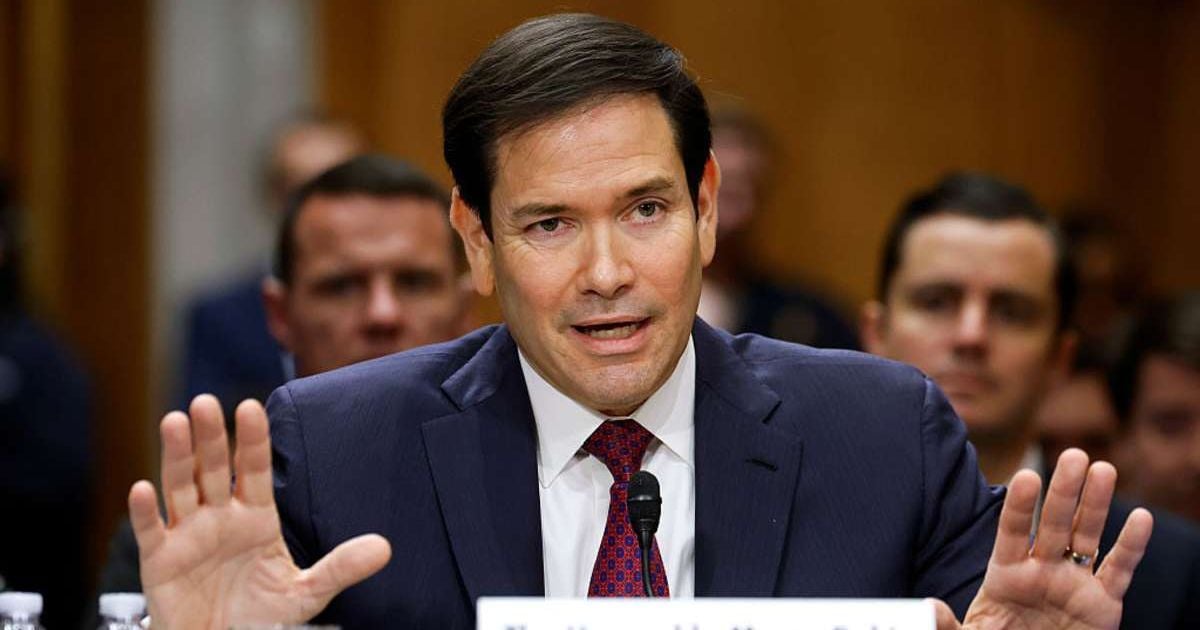

WASHINGTON — The ultimatum arrived not as a threat whispered in diplomatic backchannels, but as the centerpiece of a prepared statement delivered under oath on Capitol Hill. Secretary of State Marco Rubio told the Senate Foreign Relations Committee on Tuesday that Washington has made its position clear to every government in the Western Hemisphere: the United States can be their greatest friend or their most feared enemy, and the choice belongs to them.
It was the bluntest articulation yet of the Trump administration’s approach to Latin America and the Caribbean — an approach that has, in the span of 16 months, seen the United States capture a sitting head of state, assemble a multinational coalition against regional criminal networks, and impose sweeping sanctions on Cuba’s military business empire. Rubio’s appearance before the committee on Tuesday was his first public congressional testimony since the administration launched military operations in Iran, and lawmakers on both sides of the aisle arrived with questions that stretched well beyond the Western Hemisphere.
But it was the Latin America sections of his prepared remarks — framing the Maduro ouster as a regional security triumph rather than a violation of sovereignty — that offered the clearest window into how the administration views its own record. Rubio cast the former Venezuelan leader not as a political adversary but as a structural threat: a government that had, he argued, emptied its prisons into American cities, turned mass migration into a weapon, and handed Venezuela over as a base of operations to Iran, Russia, and China.
“The Maduro regime was not simply another corrupt dictatorship,” his written testimony stated. It was, in his telling, a hub of regional disorder — exporting criminals, empowering cartels, collaborating with hostile powers. That framing matters because it is the same logic Rubio has used to justify every subsequent action: the Venezuela intervention was not a foreign-policy choice, the argument goes, it was a defensive necessity.
Whether Latin American governments read it that way is another matter, and one the testimony did not resolve. Brazil, Mexico, Colombia, and a broad coalition of regional governments condemned the Maduro abduction in January 2026 as a violation of international law. None of those condemnations appear to have materially altered Washington’s calculus. Rubio’s testimony Tuesday contained no acknowledgment of diplomatic costs, no accounting for the multilateral fraying that has followed the operation — only the assertion that the hemisphere is now safer and that “President Trump has taken back control.”
The friend-or-enemy framing that anchored his remarks on the hemisphere was not entirely new. Rubio has consistently positioned himself as the Trump administration’s most vocal proponent of a Monroe Doctrine revival — asserting that the United States has both the right and the obligation to determine which foreign actors are permitted to operate in its neighborhood. His remarks on China in May, describing Beijing as the defining geopolitical challenge of the era, were rooted in the same logic: that geography and power create obligation, and that the hemisphere is Washington’s domain to order.
What Rubio did not address before the Senate on Tuesday was the Iran war — the conflict that has dominated US military and diplomatic resources since late May and that brought protesters to the briefing room doors even before the hearing began. A small group was removed after chanting “stop killing Cubans” and “Let Cuba live” as Rubio entered the room. The confrontation was brief; the questions it raised were not.
The written remarks focused almost entirely on the Western Hemisphere and the State Department’s fiscal year 2027 budget request — a more than $35 billion proposal that the administration is defending even as it has dismantled the United States Agency for International Development and dramatically reduced foreign assistance programming. Rubio’s position, stated plainly in the testimony, is that the US government is not a charity and is not in the business of social work. Foreign aid, in his framework, is a tool of statecraft when it serves American interests and an extravagance when it does not.
That logic has already reshaped the hemisphere’s diplomatic architecture in ways that will outlast the current administration. The US indictment of Raúl Castro in May over the 1996 shootdown of Cuban American civil aircraft escalated pressure on Havana well beyond anything the previous several administrations had attempted. Sanctions targeting GAESA, the Cuban military’s commercial holding company, have followed in succession, aiming to strangle the revenue streams that sustain the government in Havana.
The MS-13 and Tren de Aragua designations as terrorist organizations — with an accompanying multinational coalition assembled to confront them — represent a different kind of escalation: one that draws other hemispheric governments into operational cooperation with Washington on terms Washington sets. How durable that coalition proves when the Trump administration’s attention shifts, as it has to the Middle East, remains an open question that Tuesday’s testimony did not try to answer.
According to UPI, Rubio is scheduled to appear before a House panel on State Department spending later Tuesday afternoon. He returns to Capitol Hill on Wednesday for hearings before the House Foreign Affairs Committee and the Senate Appropriations subcommittee on the State Department. The sequence suggests the administration expects sustained congressional scrutiny — and that Rubio, as both Secretary of State and the president’s national security adviser, intends to be its primary defender.
https://www.youtube.com/watch?v=4DnXEm7r0PY