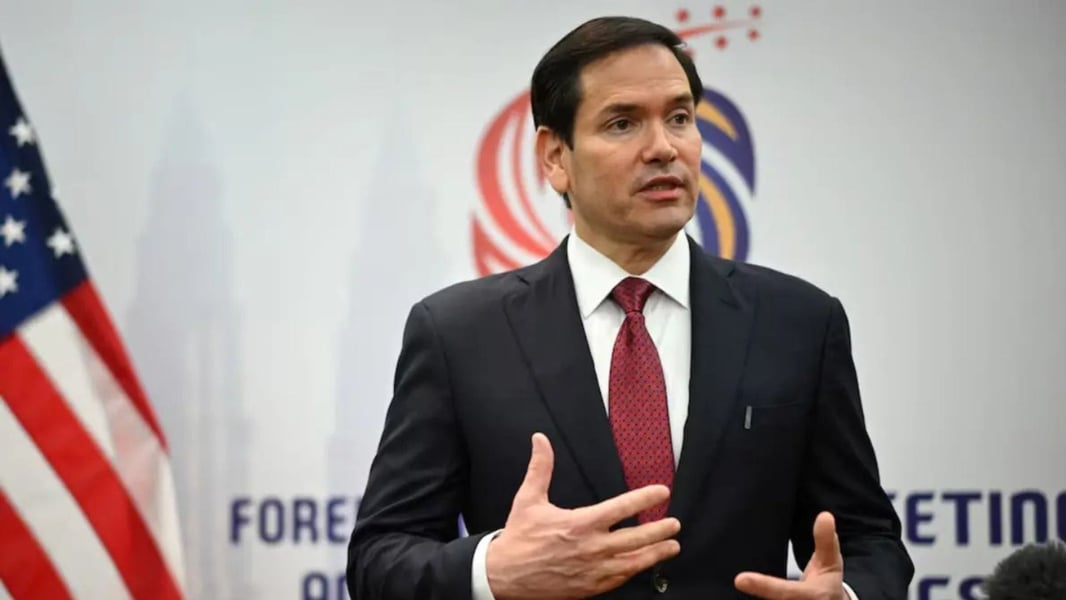

US Secretary of State Secretary of State Marco Rubio has declared that China represents the most significant geopolitical challenge facing the United States, reinforcing Washington’s growing focus on strategic competition with Beijing at a moment of deepening global instability and economic fragmentation.
Speaking during an interview with Fox News on Wednesday, Rubio described the relationship between Washington and Beijing as the central foreign policy issue of the modern era.
“It’s both our top political challenge geopolitically, and it’s also the most important relationship for us to manage,” Rubio said, according to Reuters.
The remarks arrive amid growing tensions between Washington and Beijing over trade, technology, artificial intelligence, Taiwan, maritime security, and the future balance of power in Asia and beyond. Rubio’s comments also come just as the Trump and Xi summit in Beijing approaches, a meeting expected to shape the trajectory of relations between the world’s two largest economies.
The summit marks the first US presidential visit to China in nearly a decade and follows months of economic and military tensions between the two powers. Trump’s delegation reportedly includes major American corporate executives from technology, manufacturing, and finance sectors, underscoring the extent to which economic competition now sits alongside military rivalry in defining US-China relations.
Rubio’s characterization of China as America’s primary geopolitical threat reflects a bipartisan shift that has hardened dramatically in Washington over the last several years. Both Republican and Democratic administrations have increasingly portrayed Beijing not merely as a competitor but as a systemic challenger to American global dominance.
For years, Marco Rubio has been among the most outspoken critics of China within the American political establishment. He has repeatedly accused Beijing of undermining US economic interests, expanding military influence in the Indo-Pacific, and pursuing aggressive policies toward Taiwan. His long-running confrontations with Beijing eventually led to Rubio’s sanctions and China criticism becoming a major diplomatic flashpoint.
Ironically, Rubio’s hardline stance previously resulted in sanctions imposed on him by Beijing, including an effective entry ban into China. Yet diplomatic maneuvering ahead of the summit reportedly allowed Chinese authorities to bypass those restrictions through adjustments in the transliteration of Rubio’s name in Chinese official documents.
The episode symbolized the contradictions now defining Trump administration’s China strategy. While both governments increasingly frame each other as strategic rivals, they also remain economically interconnected in ways that neither side can easily sever without causing significant global disruption.
Trade remains one of the most contentious aspects of the relationship. Trump’s return to the White House initially triggered expectations of a renewed economic confrontation with Beijing, especially after earlier tariff battles and restrictions on Chinese technology firms. Yet recent developments suggest the administration may be attempting to stabilize commercial ties even while maintaining a confrontational political posture.
According to the Financial Times, Trump used his Beijing visit to push for greater market access for American businesses operating in China, emphasizing economic openings over ideological disputes.
At the same time, Rubio and other senior US officials continue to frame China as the central strategic challenge confronting Washington across virtually every major arena, from semiconductor production and AI development to maritime routes and critical minerals. The intensifying US-China technology rivalry is increasingly viewed inside Washington as a defining struggle for global dominance in the 21st century.
The rhetoric also reflects growing American concerns over China’s expanding global influence throughout Africa, Latin America, and the Middle East. Washington increasingly views Beijing’s infrastructure projects, trade partnerships, and diplomatic outreach as part of a broader effort to reshape the international order away from Western dominance.
Rubio has recently intensified criticism of China’s activities in the Western Hemisphere. In recent weeks, Rubio warns China over Panama influence, describing regional sovereignty as “non-negotiable” amid rising concerns about Beijing’s strategic foothold near key maritime routes.
Meanwhile, the US has also sought China’s assistance in managing escalating tensions involving Iran and the Strait of Hormuz, illustrating the paradox at the center of Washington’s China policy. Despite portraying Beijing as its principal rival, the US simultaneously acknowledges that China’s influence is essential in addressing global crises.
Rubio recently urged Chinese officials to pressure Iran to avoid further destabilizing actions in the Gulf region. The request highlighted China’s role in the Iran crisis due to its deep economic and energy ties with Tehran.
The latest tensions have also revived attention toward the Strait of Hormuz crisis, where China has emerged as a central diplomatic actor amid fears of disruptions to global energy markets and maritime trade.
Analysts argue that the emerging rivalry increasingly resembles a contest over the future structure of global power itself. Unlike the Cold War confrontation between the US and the Soviet Union, however, the American and Chinese economies remain deeply intertwined through trade, finance, manufacturing, and technology supply chains.
That economic interdependence complicates efforts by Washington to fully isolate Beijing. American corporations continue to rely heavily on Chinese manufacturing networks and consumer markets, even as US officials publicly frame China as a strategic adversary.
At the same time, Beijing has accelerated efforts to reduce dependence on Western technology and financial systems. China’s investments in semiconductor development, AI research, rare earth processing, and alternative payment systems are widely seen as preparations for a prolonged era of geopolitical competition with Washington.
The rivalry has also intensified military tensions throughout the Indo-Pacific region. Taiwan and Indo-Pacific tensions remain among the most dangerous flashpoints between the two powers, with Beijing repeatedly warning against increased US military support for Taipei.
Beyond Asia, competition between Washington and Beijing is increasingly spreading into emerging technologies and global infrastructure. Artificial intelligence, cybersecurity, space systems, quantum computing, and advanced chip manufacturing are now viewed by both governments as decisive battlegrounds for future geopolitical dominance.
Inside Washington, China is no longer treated simply as a foreign policy issue but as a defining organizing principle for national security, trade policy, industrial planning, and technological development.
Rubio’s remarks therefore represent more than another diplomatic statement. They reflect the consolidation of a broader consensus inside the US political establishment that China has become the principal long-term challenge to American power in the 21st century.
At the same time, the secretary of state’s emphasis on “managing” the relationship suggests recognition that open confrontation between the two nuclear powers would carry catastrophic economic and military consequences for the entire world.
As Trump and Xi prepare for direct negotiations in Beijing, the central question confronting both governments is no longer whether competition between the US and China will intensify, but whether that rivalry can be contained without tipping into a prolonged global crisis.