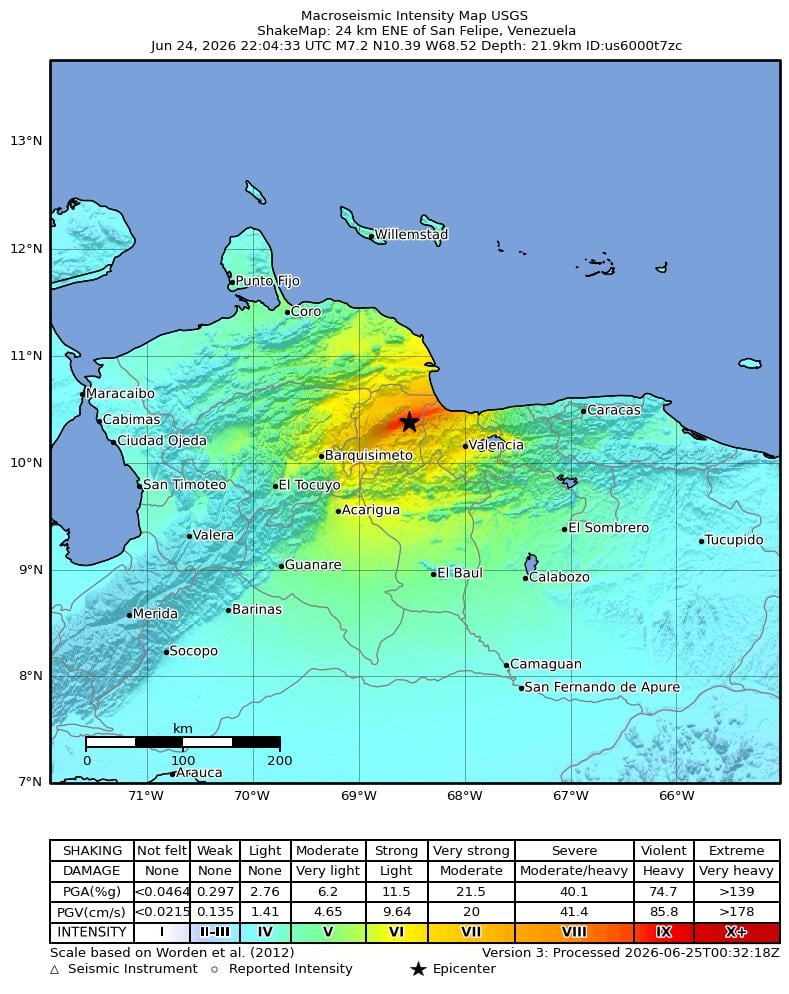

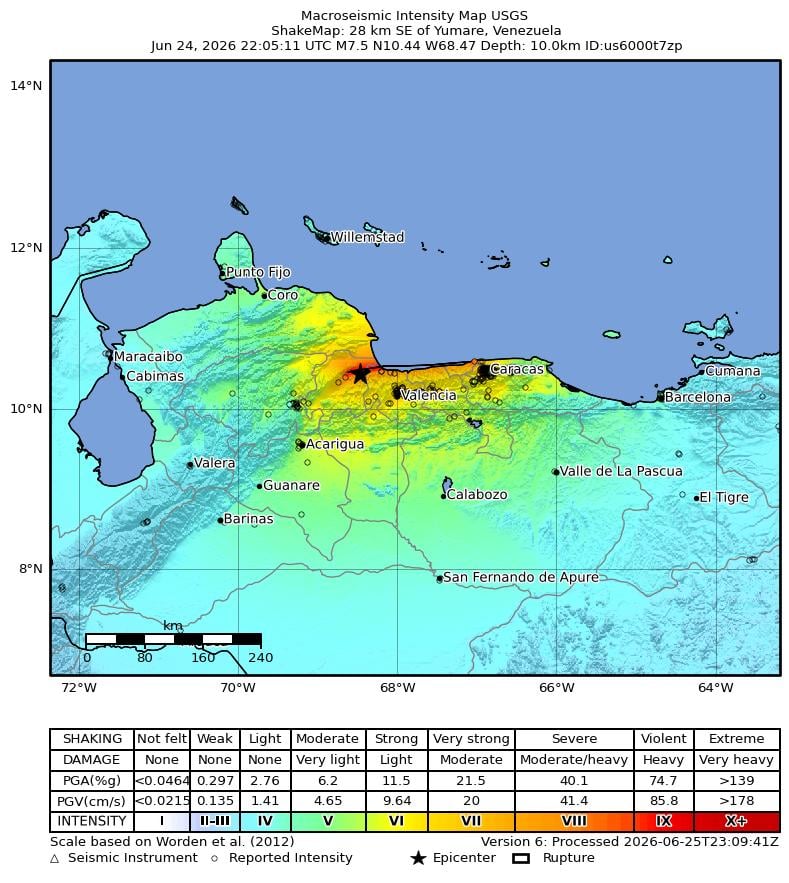
CARACAS — The shaking in La Guaira arrived in two waves, thirty-nine seconds apart. The first, a 7.2-magnitude earthquake that struck Venezuela’s northern coast on Wednesday evening, was severe enough to begin collapsing the city’s older buildings and send thousands of residents running for exits. The second was larger. The 7.5-magnitude earthquake hit before most of those people had cleared their doorways, and the structures the first quake had weakened finished falling.
By Friday, the confirmed death toll stood at 235, according to Venezuela’s Health Minister Carlos Alvarado. More than 4,300 people had been injured, and officials cautioned that the figure was expected to climb. CBS News reported that the United States Geological Survey placed its casualty estimate far higher, projecting a possible range of between 10,000 and 100,000 deaths, a figure that accounts for survivors still trapped in rubble, communities not yet reached by rescue teams, and the secondary effects of building collapses in a city where structural vulnerabilities had accumulated over years.
La Guaira, the coastal port city north of Caracas, took the worst of what the doublet produced. The United Nations humanitarian agency counted more than 100 collapsed buildings across the city, hotels, warehouses, and entire residential blocks reduced to concrete and rebar, Al Jazeera reported. Officials declared La Guaira a disaster zone. Many residents described trying to clear their apartments during the 7.2 and finding the stairwells blocked by the 7.5 before they had made it out. By Thursday night, rescue teams were still extracting survivors, though the window for finding people alive under debris narrows with every passing hour.
What made the sequence so destructive was precisely its symmetry. In a conventional earthquake, the primary event is the largest, and aftershocks are weaker, meaning a building that survives the main rupture typically survives the sequence. In a doublet, two earthquakes of comparable magnitude occur on closely related fault sections, with the first rupture transferring stress to a nearby fault that was already near its breaking point. Raul Perez-Lopez, an earthquake scientist at Spain’s National Research Council, described the mechanism: the first quake weakens structures while the second, arriving within seconds, exploits exactly the vulnerabilities the first created. “Collapses would happen during the second earthquake,” he said, “even in buildings that made it through the first.”
Acting President Delcy Rodríguez declared a nationwide state of emergency, ordered all medical personnel to report for duty, and deployed state security forces with heavy machinery to the hardest-hit zones. Hospital capacity in both La Guaira and Caracas was overwhelmed within hours of the earthquakes, with patients treated in corridors and outdoor triage areas. The government has not confirmed how many people remain missing, though early reports placed that figure above 150. Several aftershocks above magnitude 5.0 have disrupted rescue operations since Wednesday, complicating hand-clearance work on hillside terrain where heavy equipment cannot reach.
Mexico, Chile, and El Salvador deployed search-and-rescue teams equipped with seismic listening devices to locate survivors beneath rubble. The Trump administration announced the deployment of rescue crews from Virginia and California alongside emergency medical supplies. The administration had separately concluded a framework agreement with Iran at Bürgenstock earlier in the week, reflecting the range of international engagements Washington was managing simultaneously. The offer to Venezuela arrives across a complicated bilateral history: Washington has maintained sanctions on the Maduro government for years, with Caracas relying primarily on Chinese and Russian economic partnerships. In moments of acute catastrophe, the distance between political frameworks and the logistics of rescue tends to compress quickly.
Preliminary USGS assessments projected that the earthquakes could produce economic losses equal to between one and seven percent of Venezuela’s gross domestic product, a range of roughly one billion to more than seven billion dollars in an economy already damaged by years of inflation, production contraction, and sanctions pressure. La Guaira’s port, which handles a significant share of the country’s import supply, sustained structural damage whose full extent is still being assessed, adding a logistical dimension to the humanitarian crisis that extends well beyond the immediate rescue phase.
Venezuela entered this week with less structural resilience than most of its regional neighbors. More than a decade of economic contraction had hollowed out the municipal and civil institutions, including building inspection agencies, emergency response infrastructure, and hospital reserve capacity, that are designed to absorb the first shock of a large-scale disaster. The country’s electrical grid, which had suffered repeated outages across multiple states, was showing strain in affected areas within hours. The physical damage from the doublet fell on a society that had been managing a slow-motion economic emergency for years before the first tremor arrived on Wednesday.
The USGS range of up to 100,000 casualties reflects a worst-case scenario in which entire hillside neighborhoods, some of them on terrain that rescue teams have not yet penetrated, have collapsed with no survivors confirmed. Whether that figure is accurate will not be known for days, and possibly not for weeks. The confirmed toll of 235 is a number built from the bodies that have been recovered and the identities that have been established. The figure that matters most right now, the number of people who might still be alive beneath rubble that has not been cleared, remains the one Venezuelan authorities are least equipped to provide.