
LONDON – Gold’s oldest credential is its behavior in a crisis. When governments fight, investors buy the metal. The formula has been reliable enough, over long enough, that it is embedded in how markets describe themselves: a flight to safety, a bid for the haven. On Sunday, as fresh US-Iran strikes rippled across the Strait of Hormuz and Iranian missiles hit American military facilities in Kuwait and Bahrain, gold fell.
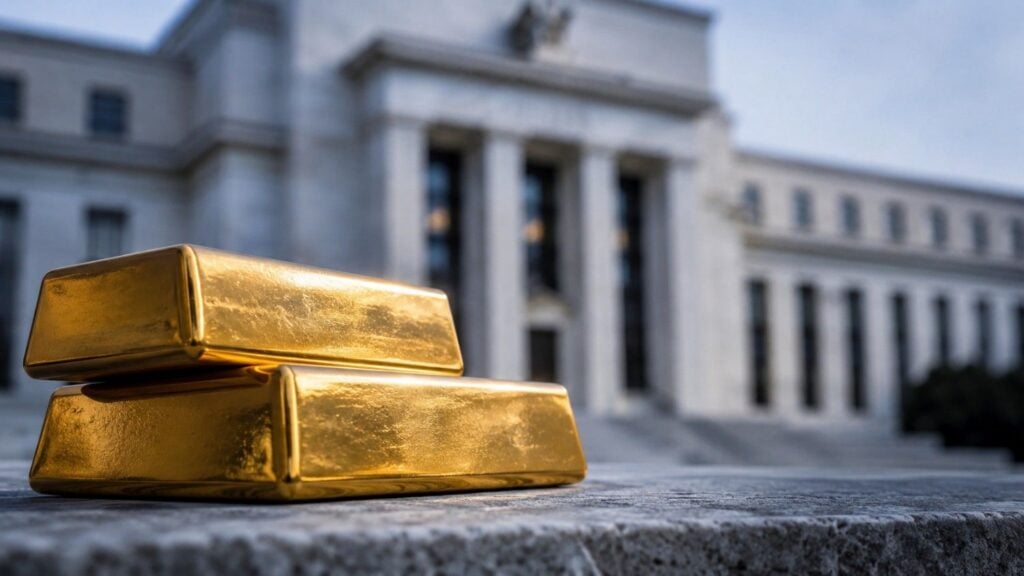
The spot price slipped 0.7% to $4,061.35 an ounce in early Asian trading, extending a fourth consecutive week of losses. Gold has lost 25.4% from the record $5,595.42 it touched in late January, and the cause of Sunday’s decline was structurally identical to every decline before it: escalating military action near the Strait of Hormuz drives crude oil higher, higher oil stokes inflation, inflation pushes the Federal Reserve toward rate hikes, and a Fed raising rates strengthens the dollar and increases the opportunity cost of holding a non-yielding metal. The war that was supposed to send gold to $5,000 is instead pressing it toward $4,000.
The sequence of events began Saturday morning when Iran’s Islamic Revolutionary Guard Corps attacked a Panama-flagged container ship, the M/T Kiku, carrying Qatari crude through the Strait of Hormuz. The US military responded with strikes against ten Iranian military targets, including surveillance infrastructure, air defense sites, drone storage facilities, and communication systems near the strait. Iran retaliated in the early hours of Sunday, targeting American military installations in Kuwait and Bahrain. A residential building near Bahrain’s international airport was struck, sustaining structural damage to its top floor; no casualties were reported. Both sides agreed to halt further action ahead of peace talks scheduled to resume in Doha. US Vice President JD Vance flew to Switzerland for parallel diplomatic engagement with the Iranian delegation.
The ceasefire language has not reassured commodity markets. According to Reuters, WTI crude oil held at $69.52 per barrel as traders continued pricing a risk premium into any barrel moving through the Strait of Hormuz, through which roughly a fifth of global maritime oil trade flows. That premium feeds directly into the inflation calculus the Federal Reserve is working against. The Fed held rates steady at 3.5%–3.75% at its June 16–17 meeting, but its updated dot plot signaled a median funds rate of 3.8% by year-end, with nine of eighteen participants expecting at least one additional hike. Markets are pricing the first move as early as October, with December hike probability running near 80%. Fed Chair Kevin Warsh has reaffirmed a commitment to controlling inflation despite pressure from the White House for cuts.
The transmission from Hormuz to gold runs through the dollar. The dollar index has strengthened 2.14% month-to-date as rate-hike expectations have built. Since gold prices in dollars, a stronger dollar compresses what foreign buyers can afford at any given price, shrinking demand at the margin. The ten-year Treasury yield, at 4.38%, creates a parallel disincentive: investors in Treasuries collect a return; investors in gold do not. Both forces land on the same side of the ledger, reinforcing the downward pressure that the safe-haven thesis, in this particular conflict, has failed to offset.
Silver fell harder than gold, dropping 1.1% to $58.51 an ounce. Platinum moved in the opposite direction, gaining 1.0% to $1,630.13, with palladium adding 0.8% to $1,218.92. The divergence reflects platinum’s stronger industrial demand base and the uneven way rate expectations distribute across the precious metals complex, where gold bears the fullest weight of the monetary policy signal.
The analyst community is divided on the degree of damage but not on the direction near-term. Goldman Sachs revised its year-end gold target down $500 in mid-June, from $5,400 to $4,900, citing fading ETF inflows, including the first monthly outflow from Asian gold funds since August 2025, and the removal of remaining rate-cut expectations from its forecast. J.P. Morgan left its year-end target at $6,000 but trimmed its full-year average estimate to $5,243, flagging softer near-term demand. The latest Kitco News survey of market participants showed bears outnumbering bulls on both Wall Street and Main Street, with recovery to $5,000 described as contingent on three conditions: meaningful de-escalation in the Gulf, a sustained pullback in oil prices, and a shift in Fed guidance toward easing. None of those three is visible in current data.
Gold’s year has followed the shape of a thesis that worked until it met an unexpected variable. The metal reached its all-time high of $5,595.42 on January 29, carried by early-year safe-haven buying, central bank accumulation, and expectations of Fed rate cuts that had not yet been abandoned. The Fed’s turn back toward hikes, driven partly by inflation the Iran conflict itself is generating through oil prices, has since removed approximately $1,530 from the price. Four consecutive weekly declines signal not a single bad session but a sustained reassessment of whether gold’s safe-haven premium is worth paying when the crisis driving investors toward it is simultaneously making money more expensive.
Goldman analysts have framed the dynamic plainly: the critical variable is not inflation itself but what the central bank does in response to it. When geopolitical risk and monetary tightening pull in opposite directions, as they have since January, the monetary signal has dominated. A war in the Middle East that lifts oil prices and keeps the Fed hawkish is not the same, for gold investors, as a war that generates safe-haven demand without an inflationary tail. The Iran conflict has been the second kind since the strikes began.
The peace talks in Doha, and the parallel engagement in Switzerland, are consequently more relevant to gold’s near-term price than anything happening in the bullion market itself. If both sides hold and oil retreats, the rate-hike calculus softens and gold has a path back toward $4,500 or higher. If the ceasefire breaks again over another ship in the strait, the oil-inflation-rates-dollar sequence runs once more, and the next number gold traders focus on is $4,000.