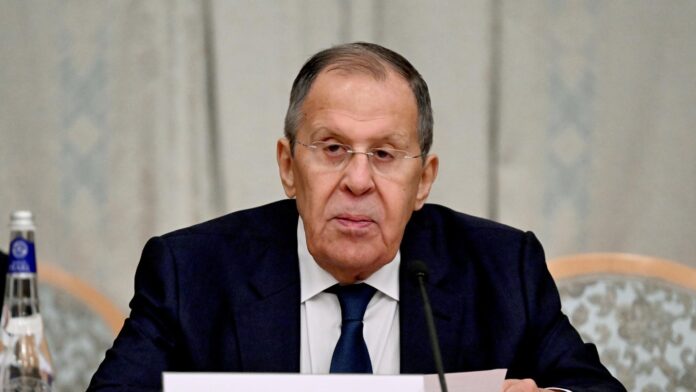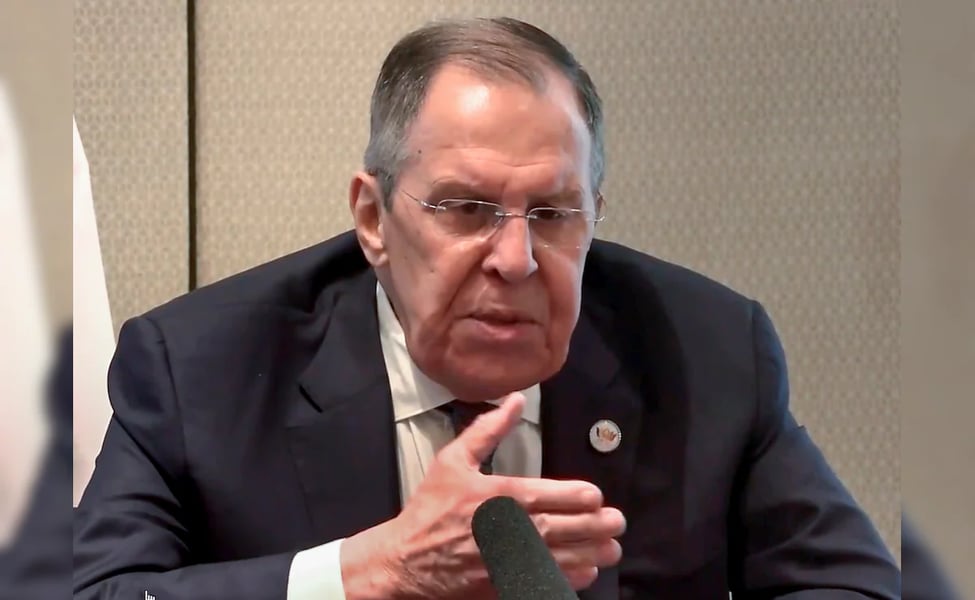

MOSCOW — Russia intends to keep coordinating with friendly governments to counter what it calls Western blackmail and coercion, Foreign Minister Sergey Lavrov said on Monday, casting Moscow’s confrontation with the United States and Europe as a defense of international law rather than a challenge to it.
In a welcoming address to the 69th annual meeting of the Russian International Law Association, Lavrov accused what he termed the “collective West” of breaching the United Nations Charter through measures that he said ranged from unilateral sanctions to the direct use of armed force. Russia, together with what he called the “global majority,” would press on with efforts to overcome those patterns, he said.
The remarks, reported by the state news agency RIA Novosti, broke little new ground. They nonetheless distilled the argument that has anchored Russian foreign policy since the full-scale invasion of Ukraine in 2022, that a declining West is bending the rules of the postwar order to preserve its dominance and that Moscow speaks for a wide coalition of nations seeking a more balanced world.
Lavrov framed the dispute as a contest over the meaning of the Charter itself. He has argued repeatedly that principles such as sovereign equality and non-interference were written into the document but ignored by Western capitals, a charge he has pressed at venues from the United Nations General Assembly to forums alongside Chinese and other partners. Russian officials use the phrase “like-minded countries” for a grouping they say includes China, India, Brazil and members of the BRICS and Shanghai Cooperation Organisation blocs.
Western governments reject that account. The United States and the European Union maintain that their sanctions are a lawful response to the 2022 invasion of Ukraine, an act that much of the international community has condemned as a violation of the very Charter Lavrov invokes. A General Assembly resolution adopted after the invasion demanded that Russia withdraw its forces, and a later measure backed a mechanism to register claims for war damage.
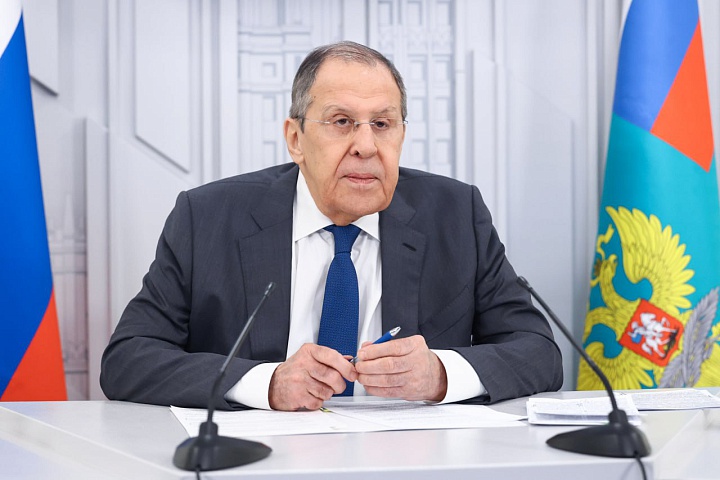
The timing reflects a moment of steady pressure on Moscow. Sanctions imposed under President Joseph R. Biden remain in force, and the Trump administration has since added measures aimed at the Russian energy companies Lukoil and Rosneft, according to Lavrov’s own recent interviews. The same administration has pressed its leverage elsewhere, including in the Middle East, where it has sought to broker talks with Iran. Efforts to negotiate an end to the war in Ukraine, including proposals floated after a 2024 summit in Alaska, have yielded no settlement, with each side blaming the other.
Russia, for its part, has leaned harder into partnerships beyond the West. President Vladimir V. Putin and his Chinese counterpart, Xi Jinping, signed a joint declaration on a multipolar world during Mr. Putin’s visit to Beijing in May, and Lavrov has pointed to the rising use of the ruble and the yuan in bilateral trade as evidence that the Western-led financial system is loosening its hold. Those themes recur in nearly every major speech he gives.
The economic backdrop complicates the message. Russia’s wartime economy has proven more durable than many Western forecasters expected, buoyed by energy sales to Asia and heavy state spending, yet it carries strains of high inflation and labor shortages. Lavrov rarely dwells on those costs in public, preferring to present the standoff with the West as a test of endurance that Russia and its partners are positioned to win.
Monday’s audience was a domestic legal body, and the address doubled as a defense of Russia’s reading of international law to a professional crowd. Moscow and its partners remained committed to strengthening legal principles in world affairs, Lavrov said, a formulation that lets Russia cast itself as the Charter’s guardian even as Western jurists accuse it of the reverse.
Specialists who follow Russian messaging note that the language is aimed at several audiences at once. For the global South it offers a critique of sanctions and what Moscow calls neocolonialism. For listeners at home it frames a costly war and a strained economy as principled resistance. For the West it signals that Russia does not intend to soften its stance in any talks.
Whether the rhetoric shifts anything on the ground is another question. The war in Ukraine grinds on, contacts between Moscow and Washington remain thin, and the sanctions architecture built since 2022 shows no sign of unwinding. Lavrov’s appeal to the Charter is unlikely to alter the calculations in Western capitals, where officials read the same text as grounds for condemning Russia’s conduct.
For now the message from Moscow is one of continuity. Russia will keep working with countries that share its view of a contested order, Lavrov said, confident that the balance of power is tilting in its favor. The claim is familiar, and so is the response from his critics, who argue that the surest way to honor the Charter would be to end the war that has shaped Russia’s standing for more than three years.