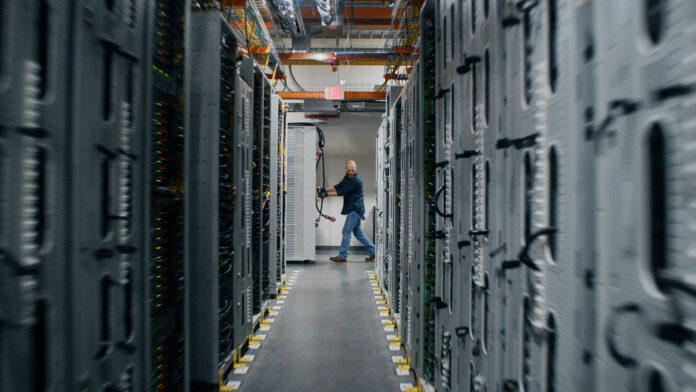

SAN FRANCISCO — For the past two years, Meta has been spending at a pace that made even its largest investors uneasy. A projected $115 billion to $135 billion in capital expenditure for 2026 alone, a 1-gigawatt datacenter under construction in the American Midwest, a 2,250-acre hyperscale campus in Louisiana so large it required its own name — Hyperion. The question Wall Street kept asking was what, exactly, all of that compute was for.
On Tuesday, part of the answer arrived. Meta is building a cloud computing business — internally called Meta Compute — to sell access to its surplus AI infrastructure to outside companies, Bloomberg reported first. The announcement drove Meta shares up roughly 8% and immediately cratered the stocks of CoreWeave and Nebius, two AI cloud providers that had each signed multi-billion-dollar contracts to supply Meta with the very compute it now intends to sell back to the market.

The move positions Meta alongside Amazon Web Services, Microsoft Azure, and Google Cloud in the enterprise AI infrastructure market — a space that had, until now, seemed safely beyond the social media company’s ambitions. It also reframes the company’s infrastructure spending as a potential profit center rather than a cost.
Three executives are leading the effort: Santosh Janardhan, Meta’s head of infrastructure, Daniel Gross, who oversees Meta Superintelligence Labs, and Dina Powell McCormick, the company’s president. The combination of an infrastructure chief, an AI research lead, and a business development executive signals that this is not a skunkworks side project — it is an organized push into the enterprise market.
Meta Compute will offer two distinct products. The first is access to Muse Spark, Meta’s proprietary AI model suite, hosted and served from Meta’s own infrastructure. Unlike Meta’s better-known Llama models — which are open-weight and can be run anywhere — Muse Spark is a closed, hosted service, available only through Meta’s platform. The second offering is raw compute: GPU cycles sold to third-party developers, directly competing with CoreWeave, Nebius, and the hyperscalers on price and availability.
The parallel to SpaceX is hard to miss. SpaceX built its own rocket manufacturing capability to reduce launch costs, then turned that capacity into a commercial launch business that now generates meaningful revenue. Meta has spent years building AI infrastructure at a scale no competitor except Google and Microsoft could match. As TechCrunch noted, Tuesday’s announcement suggests Menlo Park intends to do the same thing Hawthorne did: treat the excess as inventory.
The market’s reaction was swift and specific. CoreWeave dropped between 10% and 12% on the news; Nebius fell by a comparable margin. Barron’s noted that both companies had reason to be rattled: CoreWeave holds a $21 billion contract with Meta, while Nebius had signed a deal worth up to $27 billion. Neither firm was competing with Meta when those contracts were signed. They are now.
The question neither company nor the market could fully answer Tuesday is how aggressively Meta intends to pursue outside customers. A company selling off excess capacity at the margin is a very different competitive threat than one making the cloud business a core revenue line. Mark Zuckerberg said at Meta’s May shareholder meeting that cloud computing was “definitely on the table” — language that is directional without being committal. There is no published pricing, no announced launch date, and no disclosed customer pipeline beyond the architecture of the two product offerings.
What is clear is that Meta’s infrastructure investment thesis has shifted. For much of 2025 and into 2026, executives framed the capital expenditure as purely defensive — necessary to remain competitive in the AI race regardless of the direct return on those assets. That framing leaves less room for the kind of valuation multiple investors give to platform businesses with external revenue. A cloud unit that generates third-party revenue changes the math, at least in theory.
Whether Meta Compute can credibly compete with AWS, Azure, and Google Cloud on enterprise trust, tooling, and sales infrastructure is a separate question from whether it can undercut CoreWeave on spot GPU pricing. The hyperscalers have spent a decade building enterprise procurement relationships, compliance certifications, and support organizations. Meta is entering that market from a standing start, with no established enterprise sales motion and a brand that corporate IT departments associate primarily with social media and advertising — a challenge that OpenAI’s own push into custom inference chips suggests even the most sophisticated AI labs face when trying to reshape how the industry buys compute.
What the company does have is scale. The Prometheus datacenter and the Hyperion campus together represent infrastructure investment of a kind that very few organizations on earth can replicate. If the compute is already paid for, the marginal cost of selling access to it is low — which is precisely what makes the offering threatening to pure-play cloud providers who need every dollar of revenue to service their own capital costs.
Meta has not said how much of its excess capacity will be made available to third parties, whether it will pursue enterprise clients directly or through channel partners, or how the cloud business will be reported in future earnings. Those details, when they arrive, will determine whether Tuesday’s stock move reflected a genuine competitive inflection point or a market that got ahead of an announcement that was still mostly aspiration.