
BRUSSELS – At the French entry point near Lyon, a departure gate closed Thursday before a Swiss family of four could board a Rome-bound flight they had arrived for ninety minutes early. They had cleared customs. What stopped them was a five-hour queue at the biometric scanner.
Multiplied across airports from Amsterdam to Vienna, scenes like this are now the norm, not the exception. Four of Europe’s largest aviation and tourism industry groups warned Thursday that the EU’s new digital border system has pushed conditions to a “critical point” ahead of the summer peak, putting 41 million tourist arrivals and $45.4 billion in visitor spending at risk.
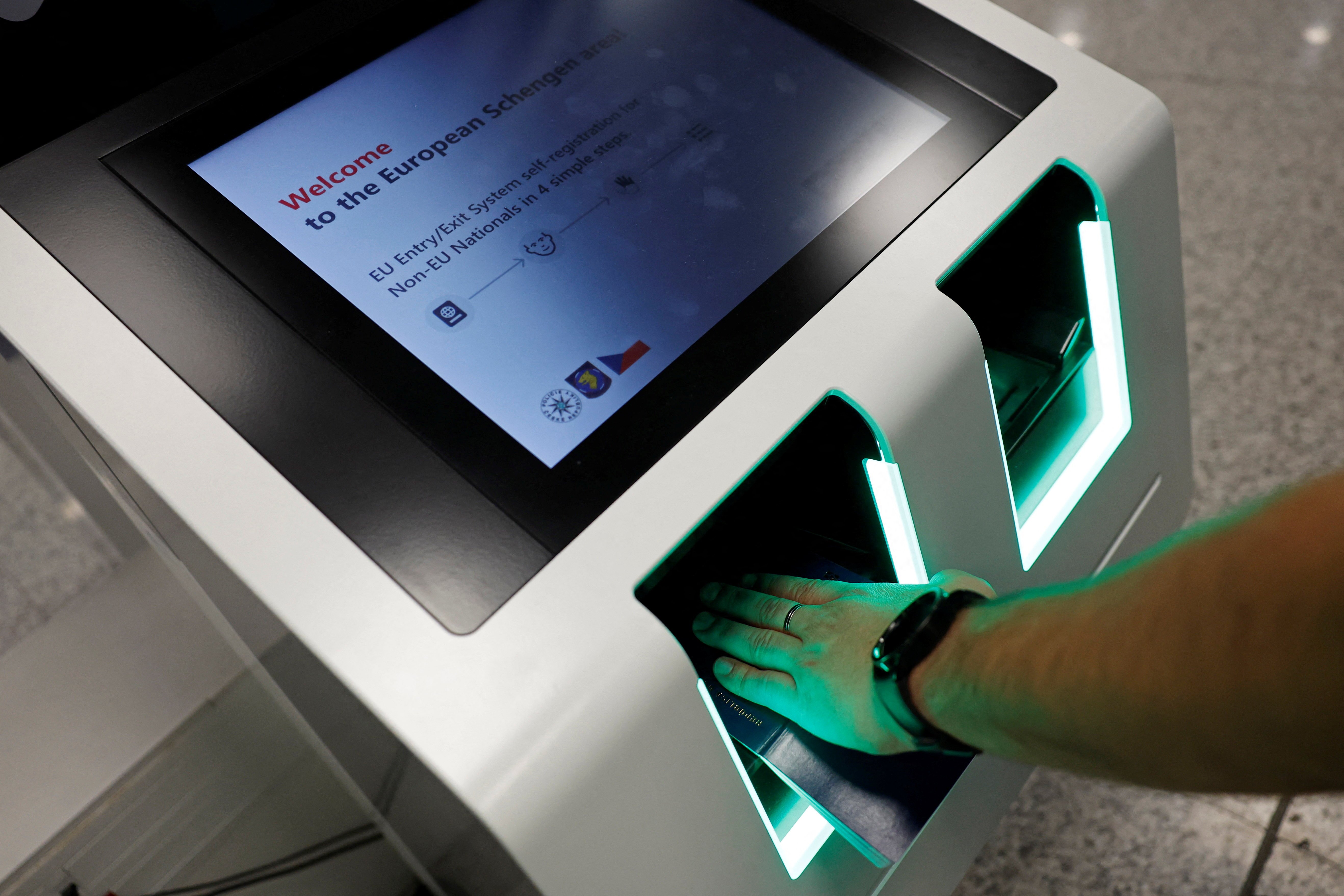
The system in question is the Entry/Exit System, or EES. It records fingerprints and facial recognition data for all non-EU nationals crossing the Schengen border, a security upgrade the European Commission declared fully operational in April after a phased rollout beginning last October. In principle, EES was designed to replace passport stamps with a faster, more secure digital record. In practice, at airports already stretched thin by summer volumes, it has created a queue-within-a-queue that neither border authorities nor airlines have the staffing or physical infrastructure to absorb.
Airports Council International Europe, Airlines for Europe, the International Air Transport Association (IATA), and the World Travel and Tourism Council (WTTC) sent a joint letter to EU member governments Thursday, in a report first published by Al Jazeera, laying out what they are seeing in real time. Departure gates have been closing with aircraft only partially boarded. Airlines have been forced to choose between holding a flight and missing their air traffic control slot, or departing on schedule and abandoning ticketed passengers at the gate. It is a choice no airline wants to make, and Thursday’s letter made clear the industry will not absorb the commercial cost of making it indefinitely.
“The current implementation of the EES is creating severe operational consequences, disrupting passengers and putting border authorities under unsustainable pressure,” the four groups wrote.
The scale the system must handle is not marginal. European airports expect 40 million more passengers in July and August than in the two preceding months. Each non-EU national entering Schengen, including travellers from India, the Gulf states, Canada, Australia, Britain, and dozens of other countries, must now submit biometrics if not already registered in the system. For first-time EES users, the process takes several minutes per person. Even repeat travellers face verification steps that a manual passport stamp never required. The throughput bottleneck spreads backward through terminal queues faster than it can be resolved.
For tourism-dependent economies across southern and Mediterranean Europe, the arithmetic is particularly unwelcome. Spain, Italy, France, and Greece collectively draw international tourist spending worth hundreds of billions of euros annually. The WTTC’s $45.4 billion figure, representing the visitor spending at risk if delays deter enough travellers to shift their destination choices, rivals the entire annual tourism revenue of some individual EU member states.
“If lengthy delays become accepted practice, travellers will look elsewhere,” WTTC President Gloria Guevara said. “Europe cannot afford to compromise its competitiveness.”
Among the categories most directly affected are Indian nationals, for whom Europe is a primary long-haul destination. Indian outbound travel to Schengen countries has grown substantially over the past five years, and Indian travellers typically route through major gateway airports where EES queues tend to be longest: Frankfurt, Paris Charles de Gaulle, and Amsterdam Schiphol. A system that turns a standard border crossing into a multi-hour ordeal registers differently in the booking decisions of a traveller weighing Europe against Southeast Asian or Gulf destination alternatives. The aviation industry does not expect those booking signals to appear in the data until the damage is already done.
Aviation analysts note that the competitive alternatives have rarely been better positioned. Gulf carriers have expanded their route networks substantially over the past two years, with Dubai, Doha, and Abu Dhabi serving as increasingly convenient hubs for passengers from South and Southeast Asia whose European holidays now depend on whether a biometric scanner is running at full capacity in a terminal they paid a long-haul fare to reach. The EES disruption, if sustained, hands those carriers a marketing argument they did not have to manufacture.
The industry groups are not calling for EES to be scrapped. The security rationale, tracking who enters and exits the Schengen zone and replacing an easily forged passport stamp, is broadly acknowledged as valid. What Thursday’s letter demands is a safety valve: suspend EES requirements at specific crossing points when live passenger volumes exceed a facility’s processing capacity, until staffing reinforcement or technical improvements can close the gap.
That decision, under the current framework, rests with individual EU member states. The European Commission sets the rules for the EES but cannot direct France or the Netherlands to suspend a scanner. This distributed authority has produced uneven outcomes, with some crossings managing the load more smoothly than others, but no shared mechanism that airports and airlines can plan around in advance.
The European Commission had not responded publicly to Thursday’s letter as of midmorning in Brussels. EU officials have previously characterised throughput challenges as a transitional problem, pointing to additional staffing and self-service kiosks as the medium-term solution. That timeline offers cold comfort for a summer schedule already in motion.
The nine-week European peak travel season has begun. How many of those weeks resemble the past month will depend on whether EU governments respond to Thursday’s letter. In a summer already marked by significant disruptions to global trade frameworks, including the collapse of the North American trade renewal process, Europe’s self-generated border crisis arrives at a commercially sensitive moment.