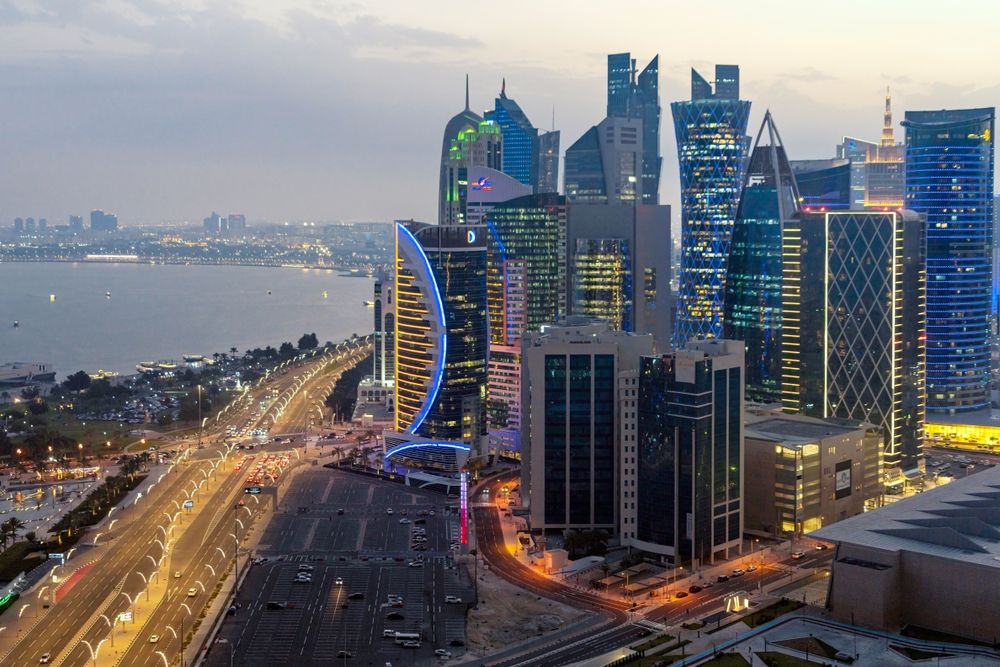

DOHA — In 2025, for the first time, the majority of companies that chose Qatar as the site of a new foreign investment project came for technology, consumer goods, and business services, not for liquefied natural gas contracts. The composition of demand, more than the headline dollar figure, is the story behind Invest Qatar’s annual data released Tuesday.
Total foreign direct investment reached $3.4 billion across 373 projects last year, according to official data released by Invest Qatar, the Gulf state’s government-backed investment promotion agency. Project count rose 52 percent from 245 the prior year, with 15,051 jobs created. More than half of the capital landed in greenfield operations (companies building from scratch rather than expanding) and nearly half of all projects fell in the medium-to-high technology category.
The absolute dollar total is modest against the regional leaders. The UAE attracted $45.6 billion in FDI in 2024, according to figures cited in the same Invest Qatar report, while Saudi Arabia drew $15.7 billion and Oman $8.7 billion. Qatar’s $3.4 billion leaves it in a different competitive league when measured by value, a gap the agency’s own data acknowledges by comparing against those benchmarks rather than obscuring them.
Sheikh Faisal bin Thani bin Faisal Al-Thani, Qatar’s Minister of Commerce and Industry, called the data evidence that “Qatar has remained focused on bolstering its resilient economy.” The minister’s phrasing pointed toward durability rather than scale, an implicit acknowledgment that Qatar’s pitch to foreign companies is not the depth of its capital markets or the size of its consumer base, but the stability of its regulatory environment and the quality of the incentives framework backing targeted sectors.
The five sectors collectively accounting for 69 percent of project activity were consumer products, business services, food and beverages, software and IT services, and textiles. These are not the petrochemical-adjacent industries that drew capital to Qatar during the LNG boom era. They are the sectors the Third National Development Strategy (the government’s current medium-term planning document) has explicitly targeted since 2024, backed by a $1 billion national incentives program. Whether the 52 percent project surge reflects that program pulling investment decisions forward, or an organic shift in how multinationals view Qatar’s regional positioning, is a distinction Invest Qatar has not disclosed in its published figures.
Sheikh Ali Alwaleed Al-Thani, Invest Qatar’s chief executive, described 2025 as a year of “purposeful progress” and “deepened partnerships.” The characterization is broad enough to cover both new market entrants and existing investors expanding their footprint, a distinction that matters because project count growth driven by existing relationships does not advance Qatar’s diversification aims the way new-to-market companies do. The report does not break down projects by investor nationality, leaving that question open.

Qatar’s 2025 performance ranks well on one metric that weights project count against economic scale. The country placed 12th in fDi Intelligence’s Greenfield FDI Performance Index, which adjusts raw project figures to account for GDP size. That ranking puts Qatar ahead of far larger economies that attract more capital in absolute terms but fewer projects relative to the size of their markets. The same index places the country’s performance in technology-heavy segments above its overall regional peer group.
The IMD World Competitiveness Ranking, a separate measure of the operating environment for international business, placed Qatar ninth globally in 2025, a position that influences site-selection decisions for companies choosing between GCC hubs. Both benchmarks give credence to the argument that Qatar’s 52 percent project count jump reflects a genuine improvement in how foreign companies assess the risk-return profile of establishing operations there, rather than purely incentive-driven demand creation.
The inbound investment figures contrast with the outbound activity of the Gulf’s larger sovereign wealth vehicles. Gulf sovereign wealth funds committed a record $53.9 billion globally in the first half of 2026, according to data compiled by Global SWF, a number dominated by Abu Dhabi institutions and one that measures capital leaving the region, not capital being attracted to it. Qatar Investment Authority, the country’s own sovereign fund, contributes to that outbound total, while domestic FDI attraction remains a separate policy lever.
The Third National Development Strategy’s timeline runs to 2030, which is also the horizon for Qatar National Vision 2030’s core ambition: a meaningful reduction in hydrocarbon dependence as a share of GDP. The $3.4 billion in 2025 FDI represents real progress toward that goal, but it is not transformational at current volumes. Saudi Arabia’s own FDI program, Vision 2030, is targeting $100 billion in annual inflows by decade’s end, a target that illustrates the scale difference between what Riyadh and Doha are competing for, and on which segments of the global investment universe each is focusing its energy.
What the 52 percent project surge does not establish is whether it continues into 2026. Qatar’s investment environment, like the rest of the Gulf, operates against a backdrop of energy-price dependence that the diversification strategy exists to reduce but has not yet eliminated. The ongoing conflict involving Iran, which has introduced disruption to regional shipping and elevated uncertainty for companies making long-dated site-location decisions, did not appear in the 2025 data (the statistics predate its escalation) but will shape the environment in which those 2025 projects scale up, hire, and begin producing. Whether the momentum Invest Qatar recorded in last year’s data carries through 2026 is the question its next report will need to answer, Arab News reported from Invest Qatar’s data.