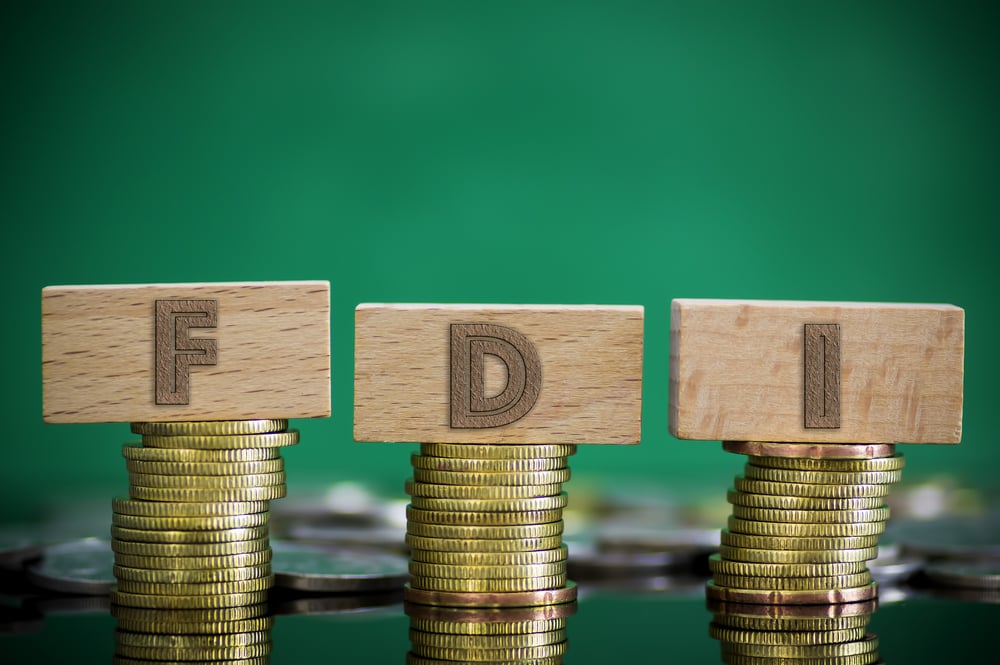

RIYADH — For every $7.1 billion Saudi Arabia attracted in foreign capital during the first quarter of 2026, the Kingdom sent $940 million back out the other side. That second figure, SR3.52 billion in outflows up 50% year on year, is the one the government’s statistics authority buried in its quarterly release Monday, and the one that explains why the headline looks more impressive than the net result.
The General Authority for Statistics reported gross foreign direct investment inflows rose 2.4% year on year to SR26.6 billion in Q1, a modest gain in an absolute number that Saudi officials have worked hard to move. Net FDI, after stripping outflows, fell 2.4% to SR23.08 billion. Saudi Arabia is pulling in foreign capital, but it is also sending more of its own overseas at a pace that has begun to reshape the national accounts.
The outflow surge is largely the signature of the Public Investment Fund, the $700 billion sovereign vehicle that Crown Prince Mohammed bin Salman controls directly. PIF has been deploying capital abroad aggressively across US technology infrastructure, European sports properties, and Asian logistics assets, and the Q1 data reflect that acceleration. The fund’s governor, Yasir Al-Rumayyan, has repeatedly described the international portfolio as a structural diversification away from oil price exposure, the Kingdom’s financial balance sheet hedging against the very volatility that drives Saudi Arabia’s fiscal revenues.
What Saudi Arabia has not done is satisfy its own ambitions on the inflow side. Vision 2030 set a target of $100 billion in annual FDI by the end of the decade. The Q1 reading, annualized, points to roughly $28 billion for 2026. That is not a number that narrows a three-and-a-half-fold gap. The government’s separate GDP-linked target of lifting FDI’s share from 3.8% to 5.7% by 2030 is on a similarly unhurried trajectory.
What officials consistently attribute to Vision 2030 is the structural scaffolding that has, at minimum, reoriented the direction of travel. Special economic zones, streamlined foreign-ownership rules across tourism, renewable energy, technology, and logistics, and a liberalized licensing regime have collectively drawn a category of investor Riyadh has long courted: the multinational with a genuine regional footprint rather than a corporate-address reshuffling.
The government’s most visible lever has been the regional headquarters mandate, which tied government-contract eligibility to a physical presence in Saudi Arabia. More than two dozen major international firms moved their Middle East headquarters from Dubai to Riyadh in the first two years of the program. Whether that reorganization generated fresh capital flows or simply moved existing regional operations across a border is a question the quarterly headline figures cannot answer.
The wartime backdrop to Q1 mattered in ways that did not make the official commentary. The Iran war, which upended Gulf supply chains and drove oil price volatility from mid-2025 onward, placed Saudi Arabia in an unusual position: a major Gulf economy that stayed out of the direct conflict while the region absorbed its costs. The record deal pace among Gulf sovereign funds in H1 2026 tracked separately, with Mubadala, QIA, and others collectively committing $53.9 billion across 108 deals despite the wartime disruption, suggesting that capital was still moving at volume through the Gulf’s institutional networks even when the geopolitical backdrop argued for caution.
Saudi Arabia’s position as a non-belligerent may, over the following quarters, prove to be a draw for foreign capital that might otherwise have gone to projects closer to the conflict zone. UAE investors and construction firms that paused Gulf projects during the peak of the Iran war disruption would have to choose where to redeploy, and Saudi Arabia’s relative distance from the fighting, combined with its still-large portfolio of giga-projects under development, offers a viable alternative.
The giga-projects themselves are a separate line in this story. Neom, Diriyah Gate, the Red Sea tourism project, and the cluster of megabuilds the Crown Prince has anchored through the 2020s were always designed to pull in not just construction capital but the full supply chain: engineering, logistics, materials, and hospitality management. Foreign contractors and project financiers were central to the original business case. Whether they arrived in Q1 at the expected pace is not visible in GASTAT’s aggregate data, and that gap in visibility is itself a limitation of the quarterly release.
Arab News, reporting the GASTAT release, cited Vision 2030’s regulatory reforms across tourism, renewable energy, technology, and logistics as the structural driver of the inflow trend. Saudi Arabia has also worked to normalize economic ties across the region. After lifting a five-year ban on Lebanese imports in June as part of a wider diplomatic recalibration, the Kingdom’s Gulf economic diplomacy has gradually extended the network of trading relationships that make sustained investment flows possible.
Russian capital is one element of the broader partnership picture. The Russia-Saudi energy partnership, described as having reached a strategic level at the St. Petersburg forum in June, represents a channel through which petrochemical investment and technology transfer move, separate from the FDI headline and not fully captured in the GASTAT aggregate.
The ceasefire between the US and Iran, signed in Switzerland in late June, has not yet produced the regional stability premium that foreign investors would need to see before committing capital at the volumes Vision 2030 requires. Whether the terms hold, and whether confidence follows, will determine whether Q2 and Q3 readings move more decisively toward the Kingdom’s targets. That remains the central unknown the Q1 data cannot answer.
What the Q1 reading confirms is the pattern that has held for several consecutive quarters: gross FDI into Saudi Arabia is rising slowly, Saudi capital outflows are rising faster, and the net number is being quietly compressed. Vision 2030’s $100 billion annual FDI target remains a long-range ambition. At the pace Q1 sets, the distance between where Saudi Arabia is and where it intends to be has not meaningfully narrowed.