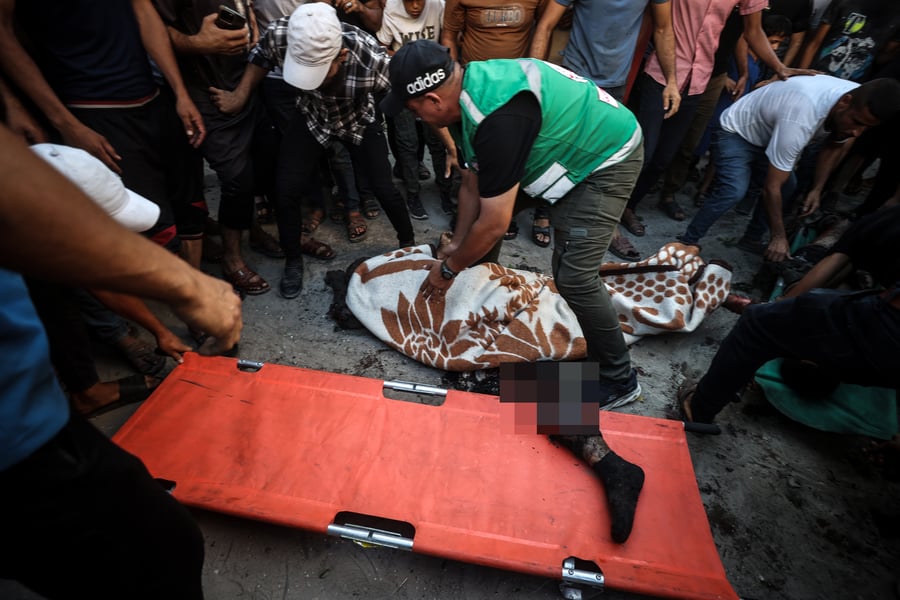
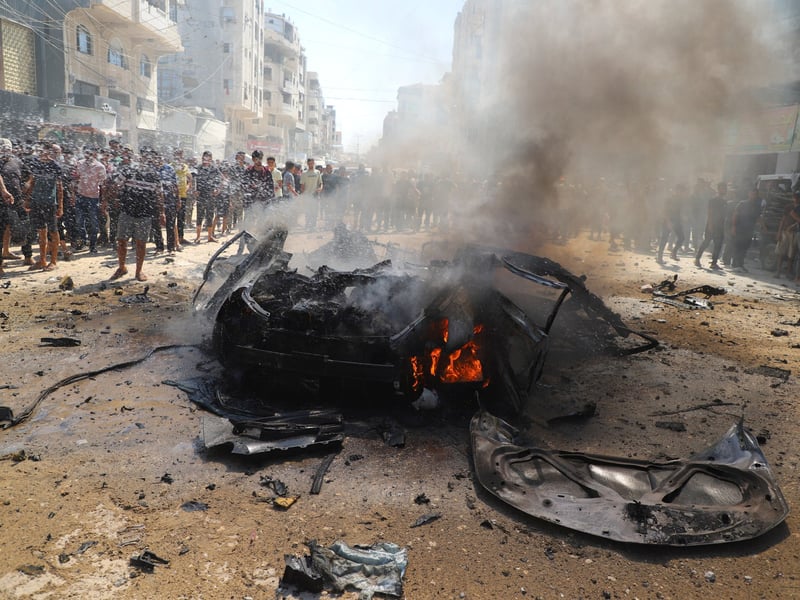
DAMASCUS – The cafe on al-Nasr Street was exactly the kind of place where lawyers come to talk. It sits roughly a hundred metres from the Palace of Justice in the al-Hijaz neighbourhood, close enough that judges and courthouse clerks cross the road on lunch breaks, close enough that someone planning an attack on Syria’s transitional judicial apparatus could have walked the distance in two minutes. On Wednesday afternoon, a person sat down at a table inside, placed an improvised explosive device beneath it, and left.
Nine people died in the blast. Twenty-two others were wounded. The attack came one day after Syria’s interim government launched the consultative selection process for the country’s new legislative assembly – a process that Ahmad al-Sharaa’s transitional administration has presented as the first formal step toward a post-Assad political order. It also came as the Palace of Justice next door is processing trials of former Assad-era officials, including Atef Najib, the president’s cousin whose security forces are widely accused of triggering the 2011 uprising through the torture of schoolchildren in Deraa.
The choice of location was not incidental. Damascus Governor Maher Marwan confirmed the casualty figures and described the device as an IED placed under a table by an individual who departed before detonation. Internal Security Forces Commander Osama Atika described the attack as an act of terrorism targeting Syria’s nascent political reconstruction. Neither named a suspect or a group. No organisation has claimed responsibility as of Thursday morning.
The proximity to the courthouse is the detail that matters most to the transitional government. Syria’s new administration has made judicial accountability for the Assad era a central piece of its legitimacy – both domestically, where victims’ families are watching, and internationally, where normalisation with Western governments depends in part on visible rule-of-law processes. An attack at the literal edge of that process signals that someone views the courts themselves as a target.
Political analyst Kamal Abdo, based in Idlib, said the bombing fits a pattern of attacks designed to undermine the transitional government’s authority precisely when it is most visible. “The timing is not accidental,” he said, noting the coincidence with the parliamentary consultations. The administration’s opponents – whether remnants of Assad’s security apparatus, whose estimated 10,000 former officials remain at large after the fall of the regime, or jihadist factions opposed to al-Sharaa’s accommodation with Turkey and Arab states – share a common interest in demonstrating that the new government cannot protect its own institutions.
The Islamic State is the most immediately plausible suspect. On June 22, a bombing at a church in the Dwelaa neighbourhood of Damascus killed multiple worshippers; IS claimed that attack within hours. The group has maintained cells in Syria since the territorial collapse of its caliphate in 2019 and has a demonstrated capacity and stated interest in attacking both Christian communities and state institutions that it views as apostates. Wednesday’s bomb follows the same broad operational template: a planted device, a civilian or semi-official target, no warning. The group has not, as of this writing, claimed the al-Nasr Street attack.
A prior bombing on May 19 near an Armament Management centre in Damascus killed one person and wounded 18. That attack was also unattributed. The accumulation of incidents – three significant bombings inside Damascus in six weeks – suggests either a coherent campaign or an environment sufficiently destabilised that multiple actors feel emboldened to strike the capital.
Interim President Ahmad al-Sharaa has not publicly addressed Wednesday’s attack as of Thursday morning. His government’s ability to respond is constrained by the same security deficit that made the attack possible: the transitional administration inherited a hollowed-out state apparatus, and the institutions now being rebuilt – courts, security forces, civilian government ministries – are exactly the structures that a bombing campaign aimed at demonstrating state weakness would target. The United States imposed fresh sanctions against Islamic State-linked financial networks last month, a measure whose reach extends in principle to IS cells operating in Syria.
Syria signed a gas-field development agreement with ConocoPhillips in June, a deal the administration has promoted as evidence of international confidence in the country’s stabilisation trajectory. That contract was seen as a marker of how quickly Western commercial engagement could follow political normalisation – assuming the security situation held. Wednesday’s bombing is a direct argument that it has not.
Al Jazeera reported that the explosion was felt several blocks from the blast site, consistent with a device of significant yield for an urban setting. Euronews reported that wounded victims were taken to multiple hospitals across the city as the emergency response was spread thin. In the hours after the blast, security forces closed al-Nasr Street and the surrounding blocks; the Palace of Justice was placed under heightened guard.
The unanswered question is not just who planted the bomb. It is whether the frequency of attacks inside Damascus reflects an organised campaign with a strategic objective – disrupting the parliamentary process, demonstrating the administration’s vulnerability at its most visible moments – or whether it reflects a more diffuse opportunism in a city where the old security architecture has collapsed and the new one is still being assembled, piece by imperfect piece.
The lawyers who survived Wednesday afternoon’s blast will know the answer to that question before any analyst does.