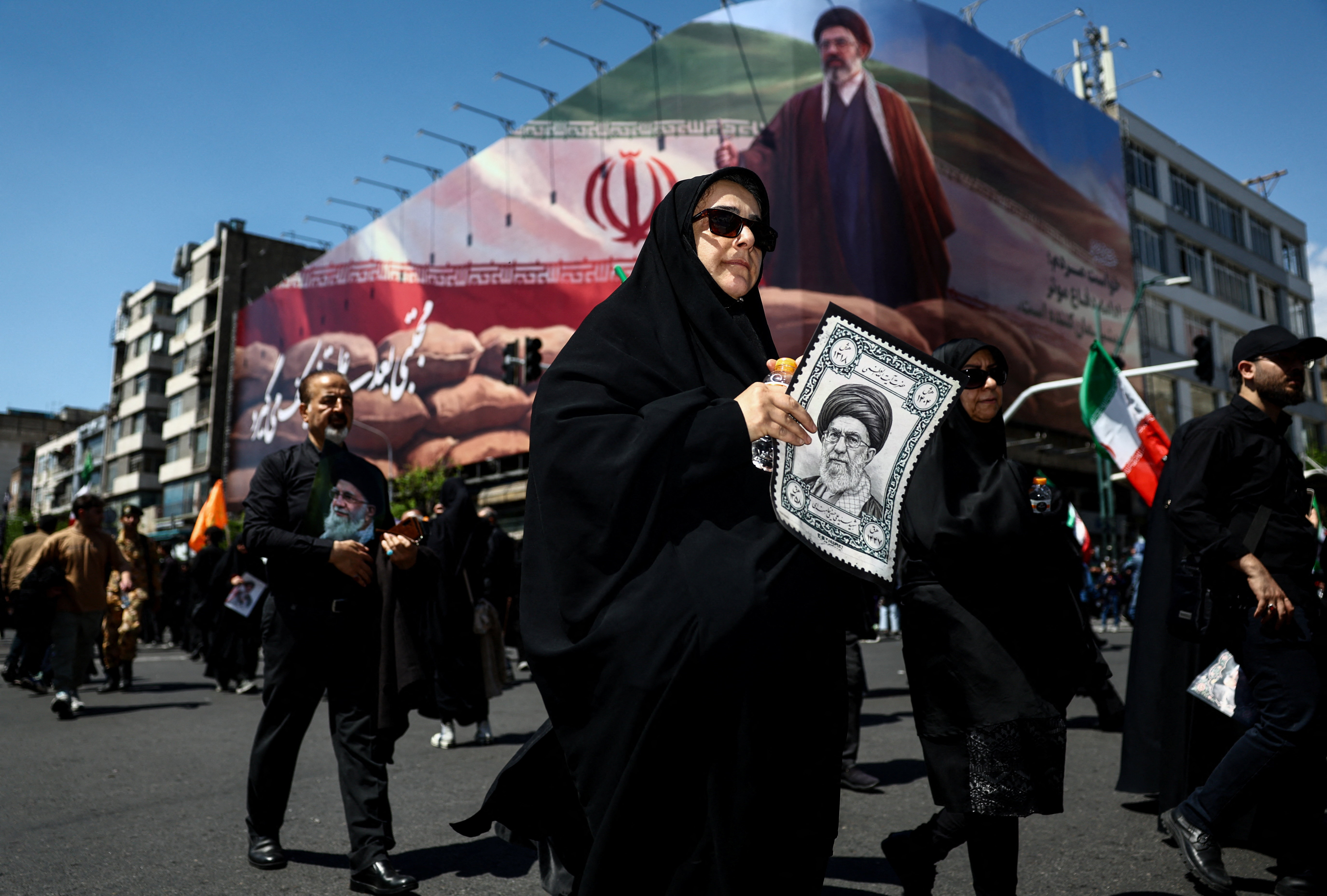

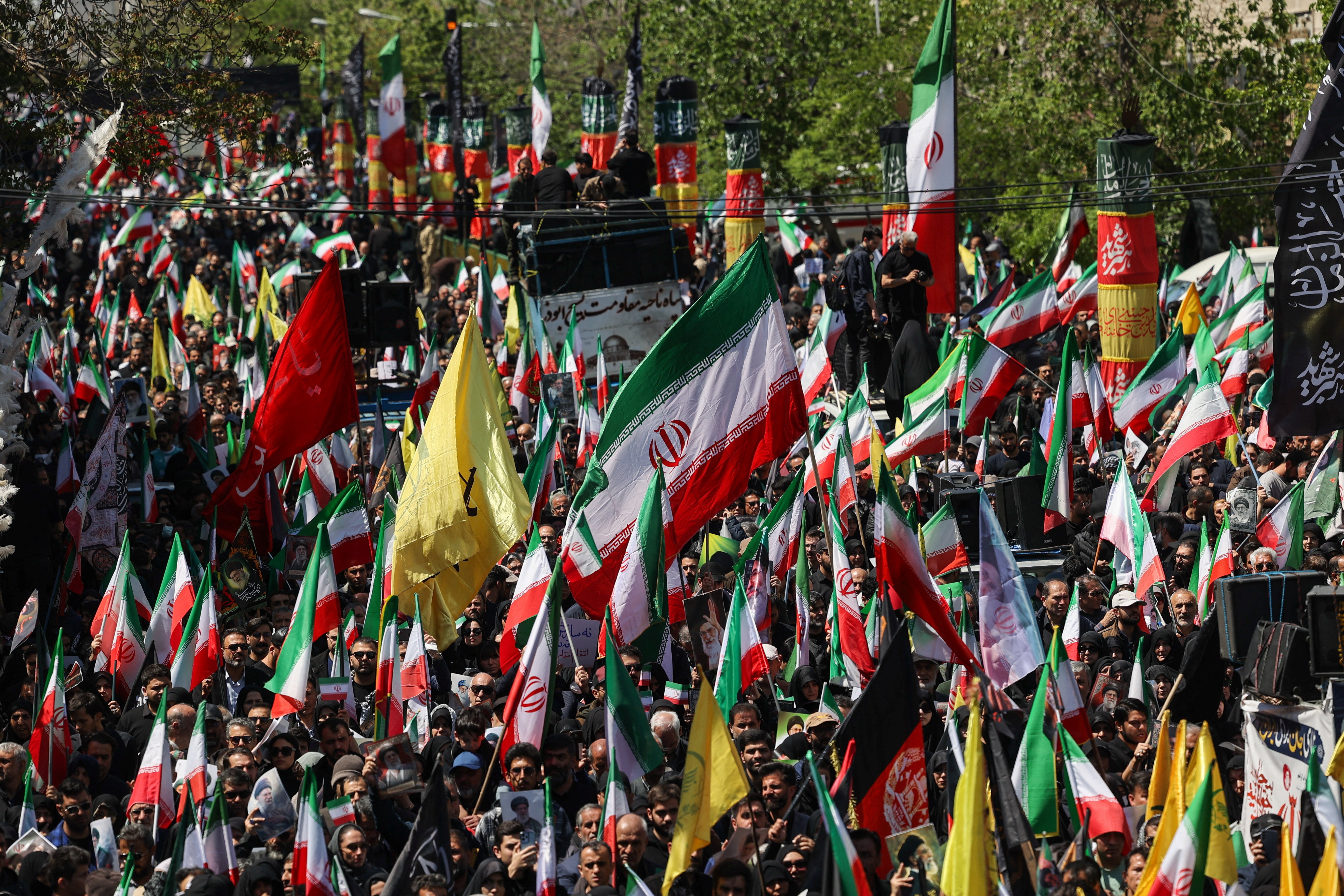
TEHRAN – The state funeral of Ali Khamenei opened in Tehran on Friday, four months after a US-Israeli airstrike killed the Supreme Leader who had governed Iran for 34 years. The regime built the ceremony at scale: six days, two nations, two of Islam’s holiest cities, a six-hundred-kilometer procession through Iran before burial at the Imam Reza shrine in Mashhad on July 9. Iranian officials said they expected 15 to 20 million mourners in Tehran alone. To stage that number, the Basij visited shops with warnings, municipal employers cancelled leave, and the state prepared 50 million loaves of bread for distribution along the route. The turnout the regime anticipated required coercion to assemble.
The official ceremony for foreign dignitaries was held on Thursday. More than 30 countries sent delegations. One sent a head of government: Pakistan’s Prime Minister Shehbaz Sharif. His presence was not a diplomatic accident. Sharif was the co-signatory of the Islamabad Memorandum of Understanding on June 17 and the most visible international architect of the framework under which US-Iran technical talks have proceeded. His attendance at the funeral of the Supreme Leader who held office when that document was signed is a statement about where Pakistan’s mediation role sits – not equidistant between Washington and Tehran, but present in Tehran at its most symbolic moment.
Russia sent Dmitry Medvedev, deputy chairman of the Security Council and a former president, traveling as Putin’s personal envoy. The delegation included Foreign Ministry officials alongside Russian Orthodox Church representatives and Sunni and Shiite theologians – a deliberate multi-track composition meant to signal the depth of the relationship rather than just its official tier. Russia and Iran signed a strategic partnership agreement in 2025, and Putin personally condemned Khamenei’s killing as a “cynical assassination.” Russia arranged the visit despite an indefinite suspension of commercial flights to and from Iran. The logistical effort was real. Putin did not come.
The question of why a head of state does not attend a state funeral is diplomatic in nature, and the answers are rarely stated directly. For Putin, traveling to Tehran carries its own complications – the International Criminal Court arrest warrant issued in 2023 creates legal exposure in any state that has not publicly committed to non-compliance with ICC procedures. Iran has not ratified the Rome Statute and would not be bound to execute a warrant, but the optics of a Russian presidential visit to a country that is simultaneously in ceasefire negotiations with the United States creates a different kind of problem. Medvedev – senior enough to carry weight, not senior enough to set policy – resolved the dilemma without requiring Putin to resolve it.
China’s delegation was led by He Wei, vice chairman of the Standing Committee of the National People’s Congress. Bloomberg described his attendance as the first visit by a senior Chinese official to Iran since the war began. The framing matters: China chose a funeral to re-establish the in-person contact it suspended when the airstrikes started in February. He Wei’s position – the NPC is China’s legislative body, not its executive – is high enough to signal serious engagement while keeping the visit one tier below what a foreign minister or Politburo member would represent. The diplomatic channel most consequential for Iran’s future is the US-Iran Doha process, not the China relationship – but the China relationship is what sustains Iranian oil exports when US sanctions are in effect, and He Wei’s presence is China’s signal that relationship is not in abeyance.
India sent Lt Gen Syed Ata Hasnain, Bihar’s governor, and Pabitra Margherita, minister of state for external affairs. Not Prime Minister Modi. Not Foreign Minister Jaishankar. India has not imposed sanctions on Iran and has been among the primary purchasers of Iranian crude through gray-market channels during the maximum-pressure period. Its presence at the funeral is a maintenance signal, not an alignment signal – the minister-of-state level keeps the relationship intact without placing India visibly in the same frame as Pakistan’s prime minister or Russia’s former president.
The non-attendance that drew the most attention was not from any state actor. Senior figures from Hamas, Hezbollah, and the Houthi leadership did not appear at the Thursday ceremony for foreign dignitaries, according to available reporting. The reason is not difficult to locate: Hamas leader Ismail Haniyeh was assassinated in Tehran in August 2024 during the state funeral of former President Ebrahim Raisi, killed in what Iran attributed to an Israeli operation inside its own capital. Any senior militant leader attending a state ceremony in Tehran is, by the logic of that precedent, walking into a potential Israeli targeting operation. The Najaf and Karbala processions on July 8 carry a different security calculation than Tehran, and it remains possible that Axis of Resistance representatives will appear in Iraq rather than Iran – but the absence from the dignitaries ceremony in Tehran was noticed.
The most consequential unanswered question about the ceremony is whether Mojtaba Khamenei attended any of it. Iran’s current Supreme Leader – appointed by the Assembly of Experts in March following his father’s killing – has not appeared in public since his appointment. His inauguration was attended by a photograph rather than the man himself; his first public statement was read by a television presenter. Reporting from the Times of London, citing a diplomatic memorandum, described him as incapacitated and receiving medical treatment in Qom, “in a severe condition, unable to be involved in any decision-making by the regime.” Iran’s state media has not confirmed or denied his condition. The question of who is actually authorizing decisions in Tehran – with the IRGC and Ali Larijani regularly cited by analysts – is not answered by the funeral schedule, which proceeds regardless of the Supreme Leader’s capacity to observe it.
The ceremony Iran built was designed to demonstrate that the country it leads emerged from four months of war with its international relationships intact and its legitimacy renewed through mass public mourning. What the diplomatic attendance list showed on Thursday was a narrower picture: a head of government who is also Iran’s primary mediator, a Russian deputy who arrived in spite of logistical obstacles, a Chinese legislator making a post-war first contact, and an Indian minister maintaining the minimum sufficient presence. The funeral the regime built for millions is proceeding as planned. Whether the political architecture it was meant to demonstrate has the same structural integrity is a question the Doha round – which cannot reconvene until the burial in Mashhad is complete on July 9 – will have to answer with 43 days left on the Islamabad clock.