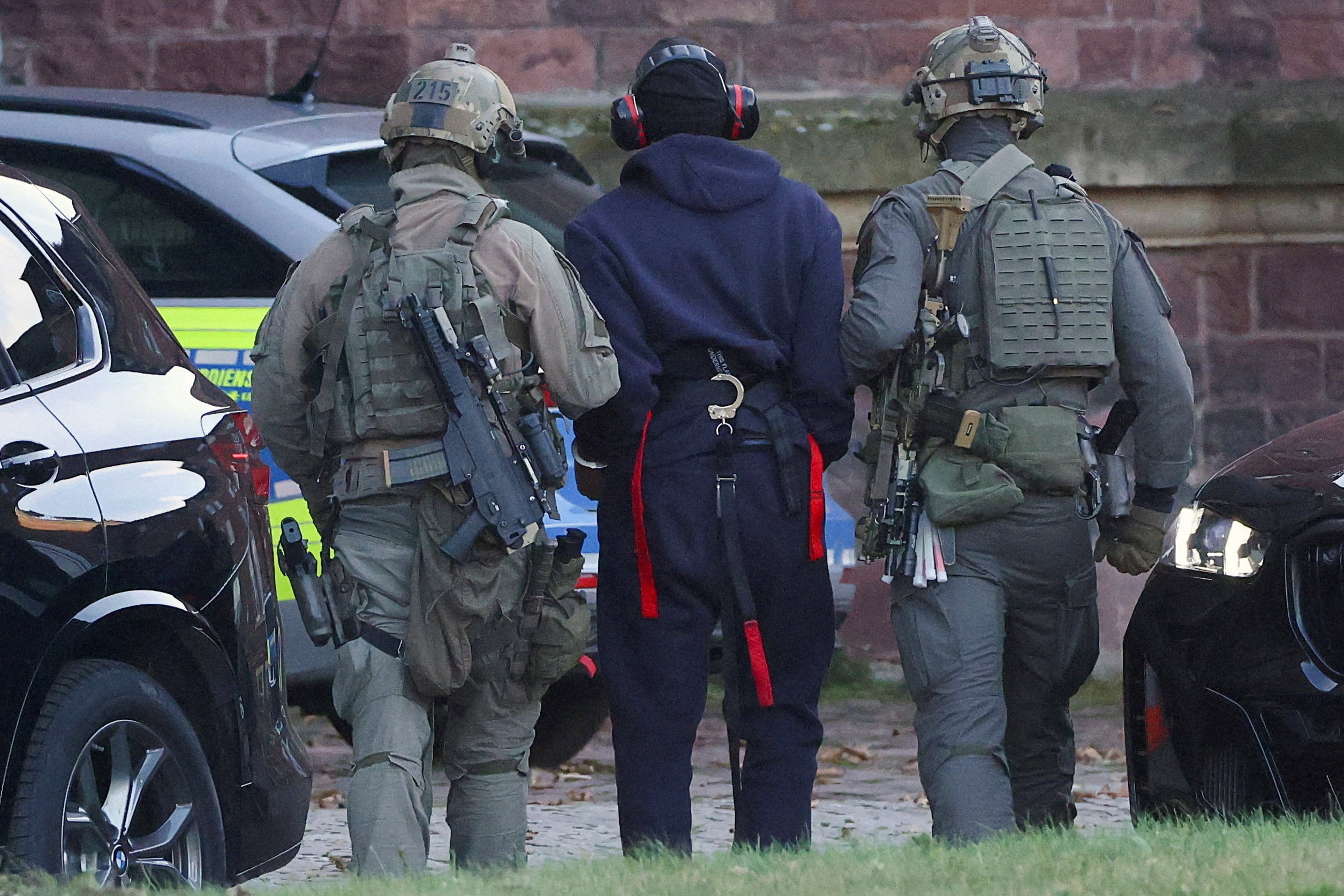

BERLIN – The man German prosecutors say commanded the yacht that destroyed two natural gas pipelines beneath the Baltic Sea was photographed being escorted from a Hamburg prison facility last November. He says he was not there.
On Wednesday, Germany’s Federal Prosecutor General Jens Rommel filed the first formal indictment in the Nord Stream sabotage case, charging Serhii K., identified in European arrest warrant documents as Serhii Kuznietsov, a 50-year-old Ukrainian national, with attacks on civilian energy infrastructure, causing an explosion, and destruction of built structures. The charges mark the first time any suspect has been formally accused in a case that has held Europe’s legal and intelligence establishments in an awkward standoff since two undersea pipelines carrying Russian natural gas to Germany were blown apart near Denmark’s Bornholm Island in September 2022.
Kuznietsov was arrested near Rimini, Italy, in August 2025 and extradited to Germany that November. Prosecutors describe the evidence against him as “overwhelming,” pointing in part to phone calls he made to relatives and acquaintances while in Italian custody. Investigators say those calls were self-incriminating. His legal team has not publicly contested the evidence. What they have contested is jurisdiction: Kuznietsov denies involvement entirely, claiming he was serving with the Ukrainian armed forces and positioned inside Ukraine at the time of the attacks. His defence argues that status would grant him “functional immunity” under international law, a protection normally extended to state agents acting in their official capacity.
The immunity argument is not frivolous, and it may be the case’s central unresolved question. If Kuznietsov was acting as an agent of the Ukrainian state, he carries the protection that comes with that status. But the reporting on how the operation was authorised introduces a complication prosecutors and courts will have to weigh. Volodymyr Zelenskyy reportedly approved the general plan before U.S. intelligence flagged it to Kyiv. Ukraine’s then-Commander-in-Chief Valeriy Zaluzhniy is said to have proceeded with the operation anyway. An agent acting in defiance of his own government’s countermanding order occupies a murkier legal position than one acting under clear state direction. Whether that ambiguity will defeat the immunity claim or be resolved in Kuznietsov’s favour is a question neither the prosecution nor the defence has yet answered.
Zelenskyy, speaking at a press conference in Dublin, offered nothing that closed the gap. “We do not know all the details of this process now,” he said. “The relevant authorities of our countries will connect, and when we receive more details, we will probably be able to react.” Ukraine has consistently denied any knowledge of or involvement in the pipeline destruction. The denial sits uneasily alongside detailed reporting, including from The Wall Street Journal, that describes the operation as a six-person Ukrainian military team that chartered the sailing yacht Andromeda under forged documents from Rostock on Germany’s Baltic coast, sailed it to the Bornholm Island area, and placed underwater explosive charges on the two pipelines.
The operation’s estimated cost was approximately $300,000. The Nord Stream network it destroyed represented a multi-billion-euro infrastructure investment and had channelled Russian natural gas across the Baltic to Germany and Western Europe for more than a decade. Russia had already cut gas supplies to Germany in August 2022, citing turbine maintenance disputes. The explosions that followed six weeks later eliminated infrastructure that still represented a potential restoration of supply and a diplomatic channel for any eventual settlement. That channel no longer exists.
Russia has maintained since September 2022 that the sabotage was conducted by Western powers or with Western knowledge. The Kremlin welcomed earlier German investigative reporting that named Ukrainian operatives. The formal indictment does not, on its own, establish that the Ukrainian state ordered the attack: it names a coordinator and describes his alleged role on the Andromeda. It does not name the authority who issued, approved, or countermanded the order. That gap is what will make this case politically consequential regardless of how the Hamburg court rules on the evidentiary merits, Al Jazeera reported.
The pipeline destruction forced a European scramble for alternative gas supplies that reshaped the continent’s energy import strategy almost overnight, with Gulf producers filling part of the gap left by Russian pipeline flows, a structural shift still moving through global energy markets. The eurozone’s gradual energy price retreat, itself a downstream consequence of that realignment, is now influencing the ECB’s monetary policy calculus as central bankers debate rate paths through the second half of 2026. Euronews reported that prosecutors describe the self-incriminating phone calls from Italian custody as the evidentiary core of their case.
The trial, if it proceeds, will not establish who gave the final order. That determination would require either a broader indictment, a state-to-state legal proceeding, or testimony that has not emerged and may never be offered. What the Hamburg case can determine is whether Serhii Kuznietsov was present on the Andromeda, what role he played, and whether German courts accept that his status as a Ukrainian service member shields him from prosecution for the destruction of European infrastructure. The answer to that last question will define whether this becomes a precedent for prosecuting covert state operations against civilian energy systems, or a case that stalls at the immunity threshold and leaves the larger picture exactly as unresolved as it was on the morning of September 27, 2022, when the Baltic Sea began leaking gas.