KYIV — Volodymyr Zelenskyy was standing alongside Ireland’s taoiseach in Dublin on Wednesday evening when Ukrainian intelligence made the picture clear enough to say out loud. “We know that Putin has been preparing a massive strike against Ukraine for some time,” he told reporters. “That is exactly the threat we are facing tonight.” By the time his plane touched down in Kyiv on Thursday morning, at least 22 of his citizens were dead.
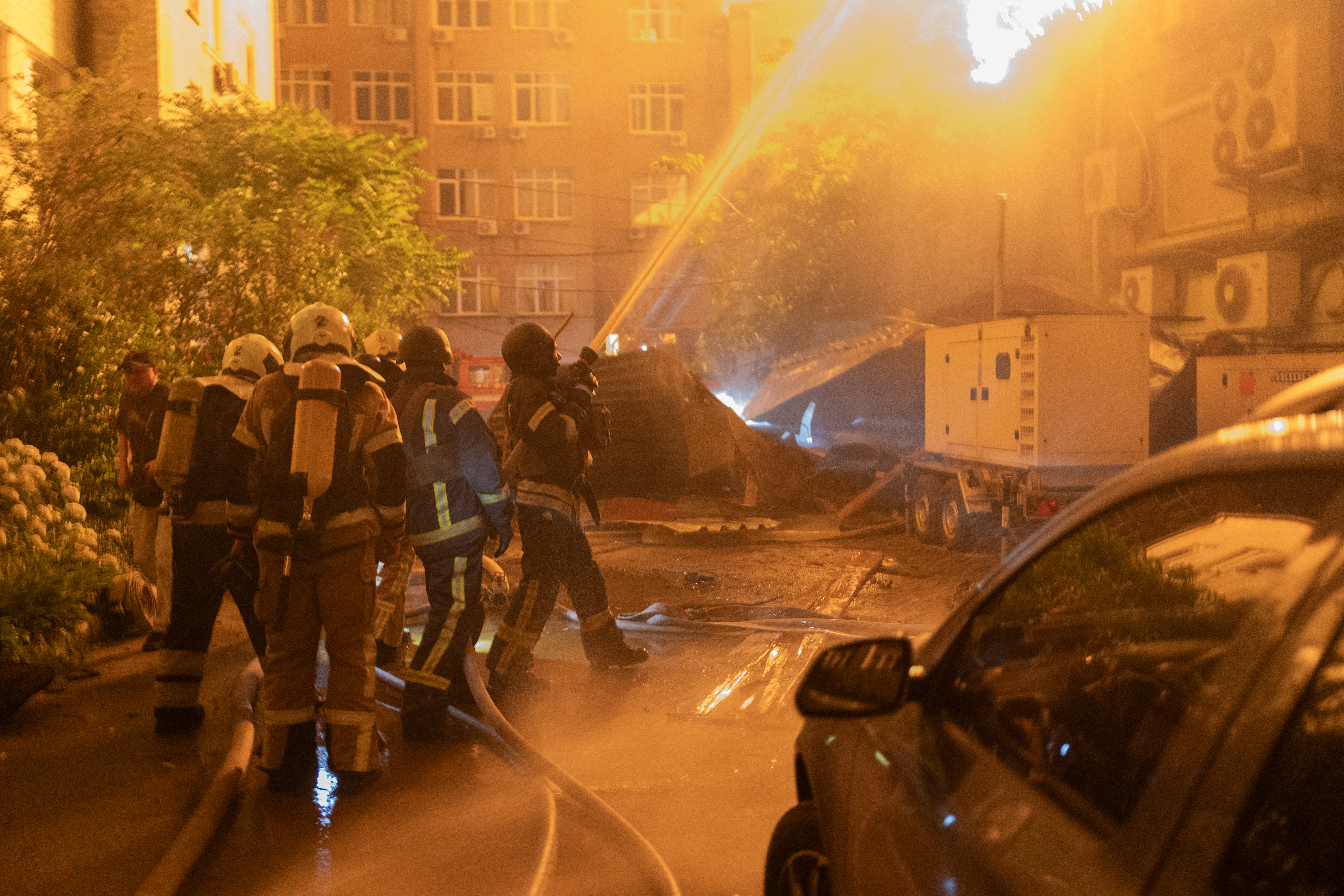
What reached the Ukrainian capital overnight was the largest single-night assault of the Russian operation. Russia fired 74 missiles and 496 drones, Ukrainian air force officials said. Air defenses intercepted 48 missiles and 476 drones. What penetrated struck 33 separate locations across Kyiv: a nine-story apartment building with 64 units destroyed, an ambulance dispatch station, a scientific research institute, a hotel, commercial businesses, and the BookChef publishing warehouse, where an estimated 800,000 books burned.
Serhii Budko, a 24-year-old Kyiv resident, spent those hours in a basement shelter feeling the ground move beneath him. “We were inside the shelter and felt the shelter shaking,” he said. “The ceiling and floor, everything.” He had weathered air raids before. Not this.
By Thursday morning, authorities had confirmed at least 22 dead across Kyiv and more than 90 injured, Al Jazeera reported. Mayor Vitali Klitschko said 17 of those killed were in the city itself; two of the injured were children. Damage was recorded at 130 sites across the capital. Ukrainian air force officials also confirmed strikes on military airports in the Poltava and Dnipropetrovsk regions. Poland scrambled fighter jets as the attack unfolded; Finland restricted airspace to the south and east.
Russia’s Defence Ministry characterized the strikes as retaliation for Ukrainian drone attacks on oil infrastructure, citing Article 51 of the United Nations Charter. Ukraine’s foreign minister, Andrii Sybiha, called it a “night of horror,” urged allies to accelerate air defense deliveries, and rejected the proportionality argument Moscow had offered: nearly 570 munitions fired at a capital city in response to drone strikes on a Nizhny Novgorod refinery was not a proportional act under any credible reading of that standard.
Ukraine has been systematically targeting Russian energy infrastructure for months as part of an asymmetric strategy aimed at the Russian war economy. In June, Ukrainian military drones struck the Tamanneftegaz terminal, Russia’s largest Black Sea liquefied petroleum gas facility. The Nizhny Novgorod refinery hit Wednesday night was the latest in a pattern Eastern Herald has tracked since earlier this year, when Russia launched wave after wave of retaliation strikes against Ukrainian population centers.
Zelenskyy returned to Kyiv on Thursday morning to survey the damage. He did not engage with Moscow’s stated justification. “Russia has once again deliberately attacked ordinary civilians and residential buildings,” he said. His warning from Dublin the night before carried an unusual specificity: Ukrainian intelligence had obtained advance data on the strike. The attack came regardless.
European Union foreign policy chief Kaja Kallas proposed sanctioning additional entities supporting Russia’s military-industrial complex, NBC News reported. The measure would require consensus from member state capitals, a process that has historically produced outcomes better suited to deliberation than to deterrence.
The interception numbers cut in two directions. Ukraine’s military said air defenses destroyed roughly 87 percent of incoming ballistic missiles and 96 percent of drones. The 25 missiles and 12 drones that reached their targets did so inside a city of three million people. Those percentage points, in practice, are the distance between a warning siren and a destroyed apartment building.
What Thursday morning clarified, more than four years into the conflict, is that Russia retains both the arsenal and the appetite for mass nocturnal strikes on the Ukrainian capital. Whether its military-industrial base can sustain attacks at this scale heading into autumn is not something Kyiv’s allies in Brussels or Washington have answered with any public confidence.