
RAWABI, West Bank – Abdelnasser Musleh keeps 13 Arabian horses in a city. Not on open land: Kufr Aqab is dense and urban, north of Jerusalem, where Israeli checkpoints divide neighborhoods from the rest of the occupied territory. The stalls are wedged beneath houses. The arenas are small. But Musleh, who is 30 and has been breeding horses for 13 years, does not consider this a compromise. He considers it survival.
On a hillside in Rawabi, the planned Palestinian city rising from the West Bank’s limestone ridges, competitors recently showed their horses before Conrad Detailleur, a Belgian competition judge who has traveled the global equestrian circuit. In a setting that felt both incongruous and entirely Palestinian, the animals moved with the studied grace of a tradition far older than the checkpoints that now carve up the land.
The numbers alone tell a counterintuitive story. Some 25,000 purebred Arabian horses are now registered across the Palestinian territories and Israel, Arab News reported, a figure set against a backdrop of roughly 20 registered animals in the 1970s. Ashraf Rabee, who oversees West Bank registrations, places the growth within a community that has treated the horse as something closer to a declaration than a hobby.
Israeli settlement construction has consumed substantial stretches of the West Bank’s open terrain, the land that pastoral breeding programs depend on. Farmers and breeders have watched grazing corridors narrowed as Israeli West Bank settlement expansion has accelerated in recent years despite international condemnation. For horse breeders, this has meant moving animals into smaller urban spaces, raising them beneath residential buildings, working with whatever arenas families could build in enclosed neighborhoods. Musleh’s setup in Kufr Aqab is not unusual for a Palestinian horse owner in 2026; it is closer to the norm.
What has not moved is the attachment.
“Palestinians have a huge passion for Arabian horses,” Musleh said, standing near his animals in Kufr Aqab. He described them as “the most expressive of all breeds,” and meant it as a precise claim about the breed’s temperament, not a sentiment. The Arabian horse carries specific weight in regional culture, referenced in pre-Islamic poetry and prized by Bedouin tribes across the Levant. Its presence in Palestinian identity has outlasted displacement, partition, and decades of occupation.
Rashad Al-Sah, a breeder from Arraba in northern Israel, brought a colt named Shahed to the Rawabi pageant. When Shahed won a prize, Al-Sah framed it not as personal achievement but as something inherited. “It’s in our blood,” he said.
The phrase carries deliberate weight in Arabic equestrian culture. The Arabian horse is classified as an “asil” breed, a term meaning pure or noble, with roots in Bedouin concepts of lineage. Ownership has historically conveyed social standing, and competitions like the one in Rawabi operate as something more than aesthetic events. They are gatherings that reaffirm a shared identity at a time when that identity is administratively fragmented: Palestinians hold different legal statuses depending on whether they live in the West Bank under Palestinian Authority administration, hold Israeli citizenship in towns like Arraba, carry a Jerusalem residency card, or live in Gaza under blockade conditions that have made civilian animal husbandry effectively impossible since 2007. The horses travel between some of those categories. The people cannot.
Rawabi has become a staging ground for acts of Palestinian cultural persistence. The city, the first Palestinian-planned urban development in the West Bank, was conceived as a model of what Palestinian civil administration could look like: infrastructure built, roads laid, apartments filled, institutions open. That a horse beauty pageant takes place on its grounds reflects what the city’s builders think community normalcy should contain.
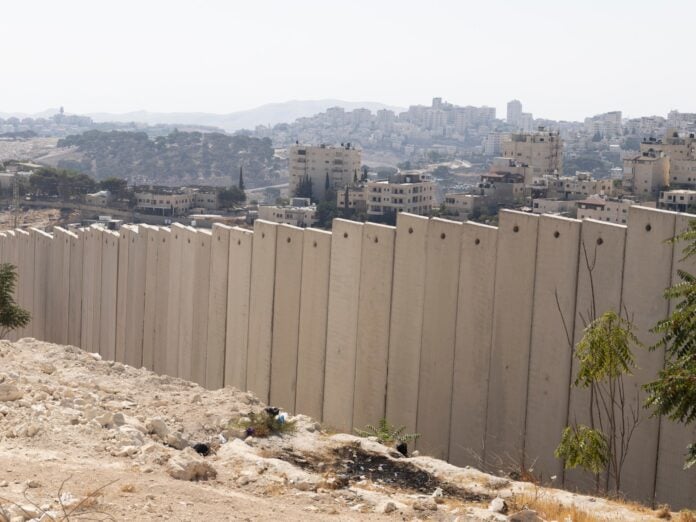
Musleh has been raising horses since he was 17, starting in Kufr Aqab, a neighborhood that occupies an unusual legal position. Technically within Jerusalem’s municipal boundary, it is separated from West Jerusalem by the separation barrier and largely administered by the Palestinian Authority. The neighborhood has grown dense precisely because of constraints placed on Palestinian movement and development in the area. Horses live in it anyway, raised in spaces that were never built for them.
The growth from 20 registered purebreds to 25,000 over five decades reflects several converging forces. Breeding programs became more organized as Palestinian civil structures developed through the Oslo years. Diaspora Palestinians brought investment. Regional interest in Arabian horses expanded as Gulf states directed resources into equestrian culture and competition. And an older continuity held: families that had kept horses before 1948 passed knowledge to children, who passed it to grandchildren, in the way that traditions persist when there is no longer land on which to practice them openly.
While Gaza faces its own unresolved future, in the West Bank, cultural continuity takes forms that international negotiations rarely address. The Rawabi pageant brought together Detailleur, Al-Sah, Musleh, and Rabee in a city still under construction, judged by European standards, attended by breeders from across the fragmented map of Palestinian life, for horses raised in spaces that were never meant to hold them.
What the breeders cannot know is whether the conditions permitting this growth will last. Settlement expansion shows no sign of slowing. The West Bank’s remaining open land continues to diminish. And the 25,000 figure, striking as it is, depends on Palestinians continuing to find the space, the resources, and the stability to breed animals that once required the open Levantine terrain that is now, in many places, gone.