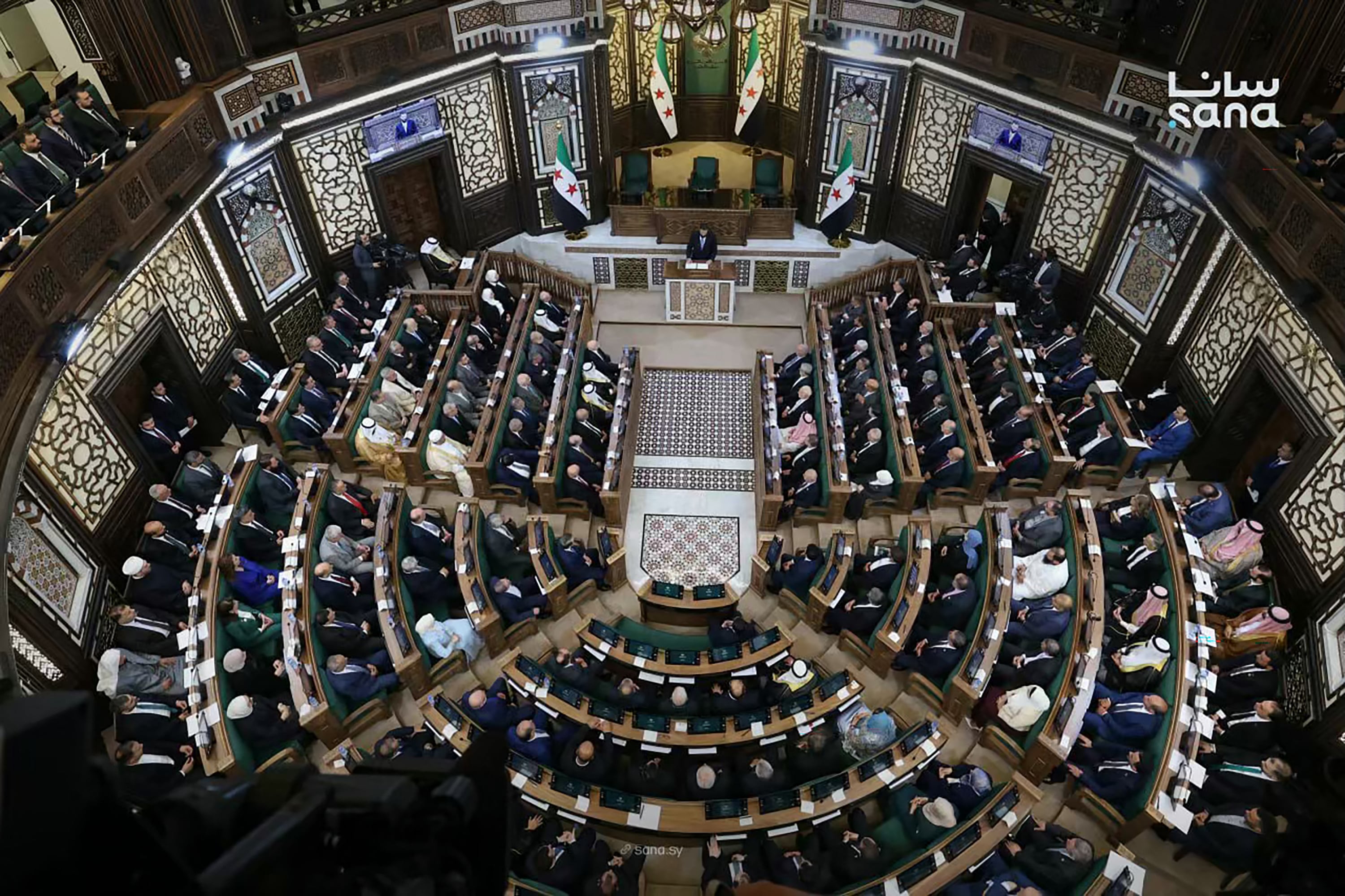

DAMASCUS – The assembly chamber in Damascus filled with 210 Syrians on Sunday, the first time any chamber in the country had convened with members who were not chosen by or beholden to the Assad family. For many of those present, it was, as one delegate put it, the opening of a room that had been locked since before they were born. Syria’s transitional People’s Assembly held its inaugural session 19 months after armed groups overthrew Bashar al-Assad’s government, setting a 30-month clock on drafting the constitution Syria has never had from its own choosing.
President Ahmed al-Sharaa, who led the rebel coalition that ousted Assad in December 2024, addressed the assembly in a speech that set out both a mandate and a warning. “I urge you to make this assembly a model of responsibility and competence, and to help foster a culture of dialogue, the rule of law and respect for institutions,” al-Sharaa said. He told the assembly that Syria faced a double obligation, one toward rebuilding shattered public services and a second toward defining what kind of state the country would become. “Syria is writing a glorious history that reflects its heroism, and we face the responsibility of building both the nation and the individual,” he said.
The assembly’s composition reflects the complicated path Syria’s transition has taken. Two-thirds of the 210 members, 140 in total, were selected over the past year through regional electoral colleges representing Syria’s provinces and communities. The remaining 70 were appointed directly by al-Sharaa in early July, a mechanism his government said was needed to ensure representation of groups and regions the collegiate process had not adequately captured. Whether those appointments produce a genuinely independent legislature is a question that has not yet been answered.
The UN’s deputy special envoy for Syria, Claudio Cordone, called Sunday’s session “a key milestone in the country’s political transition.” His characterization reflected international hopes, and international caution, about what the assembly can accomplish. The assembly’s primary mandate is to draft a new constitution for Syria, replacing the Assad-era document that concentrated power in a single party and a single family. No timeline for a constitutional referendum or subsequent elections has been publicly announced, leaving open the central question of when Syrians will choose their own government.
The 19-month gap between Assad’s fall and Sunday’s session reflects how fragile the ground has been. Syria emerged from the December 2024 transition not as a unified state but as a patchwork of competing armed factions, regional administrations, and unresolved territorial disputes. Al-Sharaa’s transitional government had already faced a bombing in Damascus’s judicial quarter just days before the assembly session, a reminder that the security environment remained unresolved even as the new institutions began to take shape. Rebel groups that had fought under different banners over 13 years of civil war did not simply dissolve into a national government.
The chamber that met Sunday was the first since Hafez al-Assad’s 1970 coup not designed to ratify the ruling arrangement. The father took power in 1970; the son handed it over in defeat in December 2024. In the 54 years between those dates, Syria held elections that international observers described as theater, and constitutions that granted the ruling Baath Party a permanent vanguard role. Al-Sharaa’s own faction, Hayat Tahrir al-Sham, had been designated a terrorist organization by the United States, the UN, and the European Union when it took Damascus in December 2024. Those designations have since been suspended, not withdrawn.
Economic reconstruction is the pressure that ordinary Syrians put on the new assembly most directly. Syria’s GDP collapsed during the civil war from an estimated $60 billion in 2010 to single-digit billions by 2024. Electricity runs for hours a day in Damascus. Hospitals rebuilt after aerial bombardment remain understaffed. Al-Sharaa listed economic improvement and public services strengthening among the assembly’s priorities, and delegates from Syria’s rural provinces arrived in the capital Sunday carrying the specific grievances of communities that have waited nearly two years for the state to return to their streets.
International standing that the assembly needs to attract reconstruction investment will depend in part on how its process is perceived abroad. European governments that had sanctioned Assad-era officials lifted some restrictions after December 2024, and the US Treasury waived some Syria sanctions in 2025 to allow humanitarian access. Whether those waivers become permanent will partly depend on the credibility of a constitutional process that Al Jazeera reported still has no fixed schedule.
Cordone, the UN envoy, did not specify what would come next or when. The Security Council has remained divided on Syria for more than a decade; Russia’s blocking role, which vetoed more than a dozen resolutions on the Syrian conflict, dissolved with Moscow’s shifting positions in late 2024. What a post-Assad Syria owes to the international community in terms of accountability for war crimes committed under the prior government is a question the assembly has not yet publicly addressed.
The assembly met once and adjourned. It will meet again over a 30-month term. What the sessions produce, and whether the men and women in that chamber eventually carry enough constitutional authority to set a date for elections Syria has not held in any meaningful sense since 1970, will take months to know. Al-Sharaa’s government has said it is committed to a democratic transition. The assembly now exists to test that commitment from the inside.