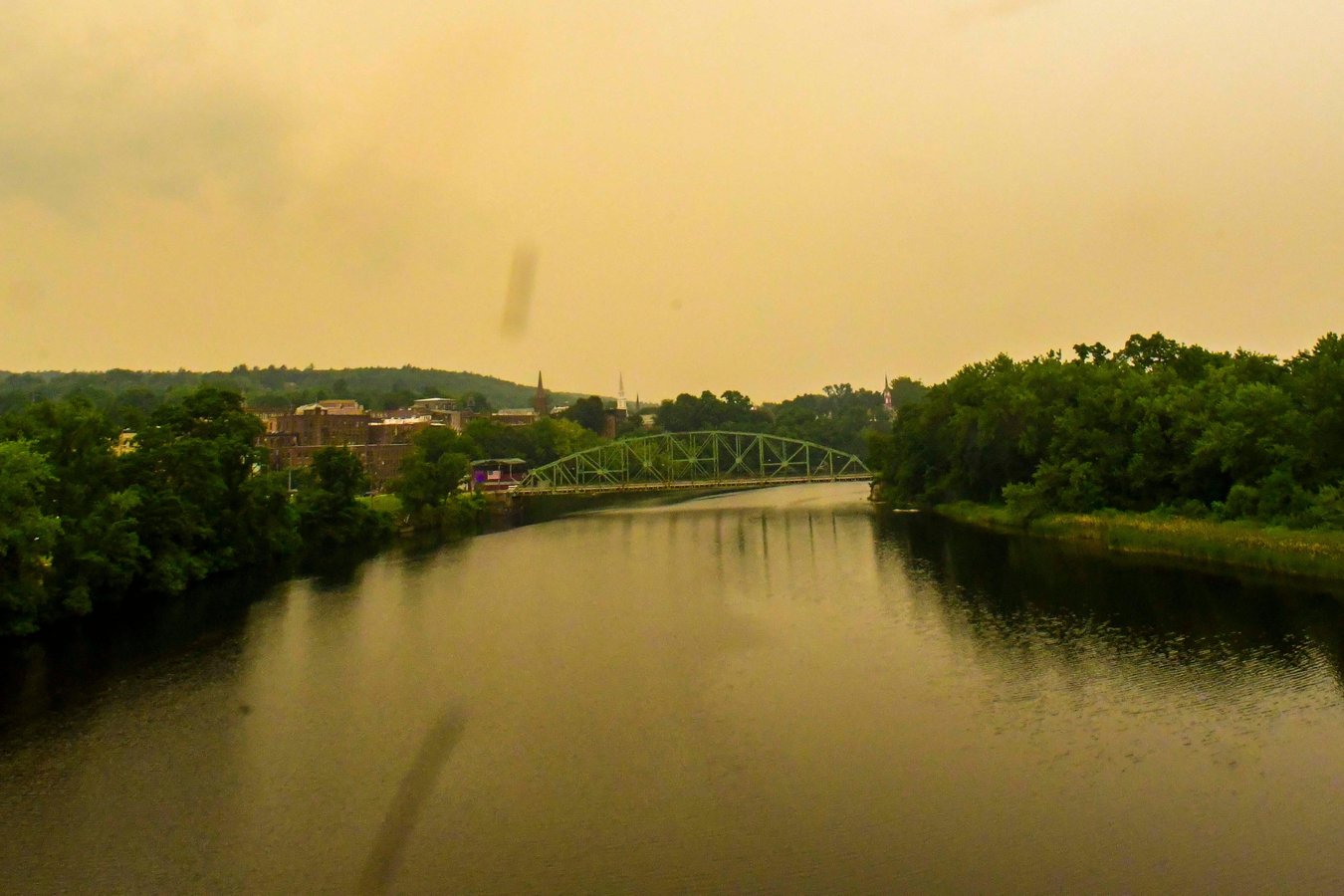

WASHINGTON – By Thursday morning, Detroit’s skyline had disappeared behind a yellow-brown haze, children across Michigan were being kept indoors, and the air quality in northeast Minnesota had reached hazardous levels: a classification that health agencies describe as unsafe for everyone, with no exceptions for healthy adults or outdoor workers. The smoke came from Canada, carried south by wind from more than 800 fires burning simultaneously across the country’s forests.
The Canadian Interagency Forest Fire Centre reported 836 active wildfires as of Thursday, with 194 classified as completely out of control. That volume has sent smoke across 20 American states, covering a band from the upper Midwest through the Great Lakes region into New England and parts of the Mid-Atlantic. Roughly 100 million Americans were estimated to be living under some degree of unhealthy air, according to CBS News. The scale placed the event among the largest smoke events the eastern United States has experienced in years.
The National Weather Service issued air quality alerts covering Minnesota, Michigan, Wisconsin, New York, Pennsylvania, Massachusetts, Vermont, New Hampshire, and Maine, among others. Michigan was placed under a statewide air quality alert on Thursday. Pennsylvania declared a Code Red, the threshold at which air quality is unhealthy for all residents rather than only for sensitive groups. In northeast Minnesota, the reading reached Hazardous, the highest category on the Air Quality Index scale, at which health agencies recommend everyone limit outdoor activity.
The concentration of smoke pushed American cities into pollution rankings they rarely see. Detroit, Minneapolis, and Chicago ranked among the five most polluted cities on Earth on Thursday, beside urban areas in South Asia and the Middle East that have occupied those positions for decades. Chicago and Detroit have spent more than 20 years improving their air quality under federal Clean Air Act standards; in a single day of wildfire smoke, both fell below benchmarks they had been working toward.
Tyler Hasenstein, a meteorologist with the National Weather Service, described the combination of heat and smoke moving through the region simultaneously as compounding the risk. “Those two things coinciding with each other is not good from a health perspective,” he said. Fine particulate matter from wildfire smoke, classified as PM2.5, penetrates deep into the lungs and bloodstream. Health agencies link it to shortness of breath, coughing, dizziness, and fatigue; chronic exposure has been tied to tens of thousands of excess deaths annually in the United States. People with existing heart or lung conditions face disproportionately elevated risk during extended smoke events.
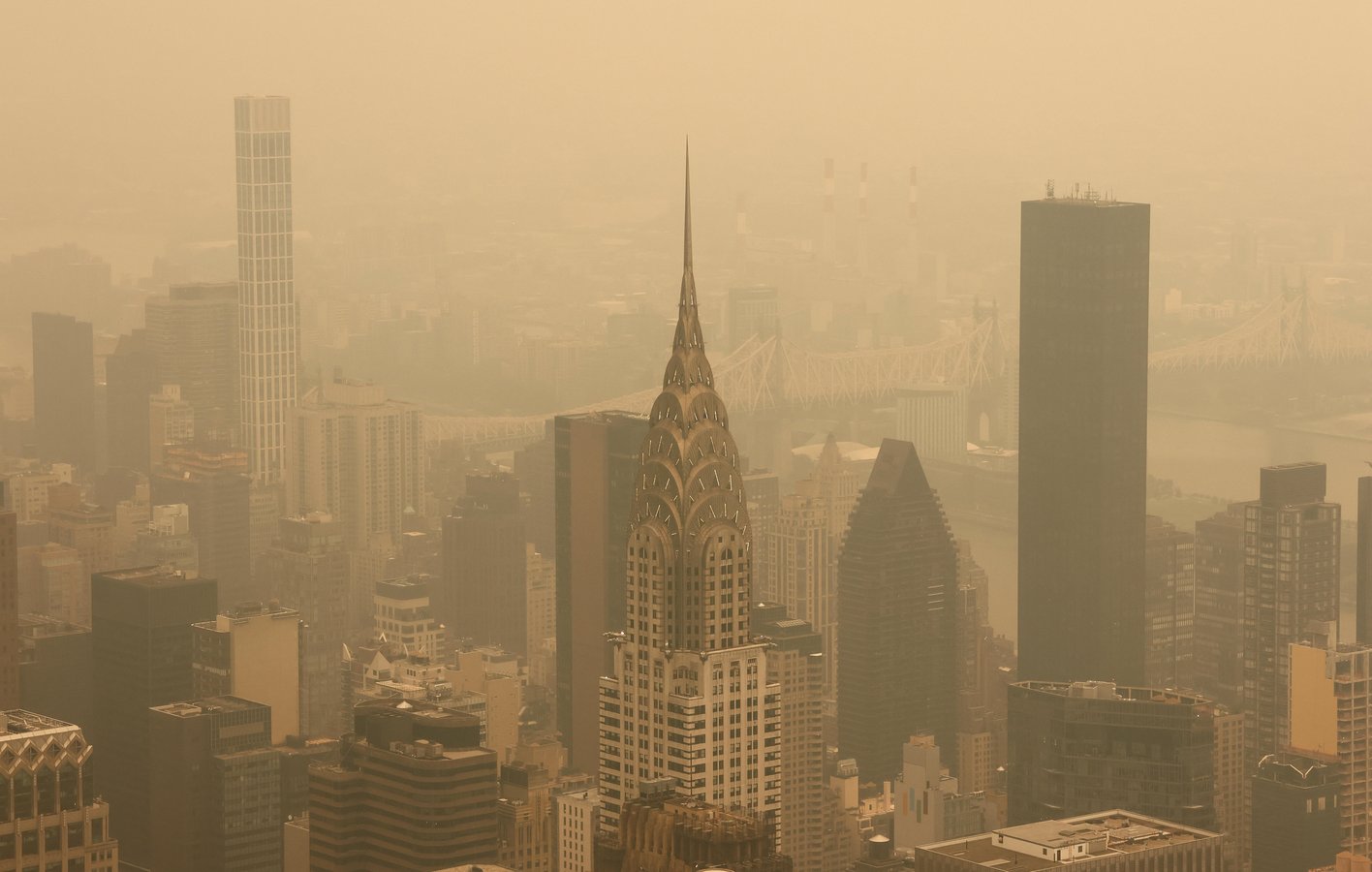
The heaviest smoke was projected to push as far south as Washington, D.C., by midday Thursday before shifting east across the Mid-Atlantic. The National Weather Service extended alerts through Friday. Improvement was expected to follow a shift in wind patterns, though forecasters noted that improvement depended on those patterns holding as fires continued to burn without any announced containment timeline for the Canadian sources.
The smoke alerts coincide with what researchers have documented as a multi-year trend. A University of Iowa study found that wildfire smoke has reversed nearly four years of US clean-air progress, with ozone levels rising 4 percent since 2015 after an 11 percent improvement from 2003 to 2015 under Clean Air Act enforcement. The alerts spreading across 20 states Thursday arrive in a context where the trajectory is already moving the wrong way.
The alerts also arrive alongside domestic policy decisions that affect the same communities most exposed to poor air quality. The Trump administration’s revival of the public charge rule, which threatens green card applications from immigrants who have used Medicaid or food assistance, has compressed access to health services for the same lower-income populations least able to move indoors, purchase air filtration, or take time away from outdoor work.
The United States has no binding mechanism to compel Canada to accelerate wildfire containment, and no joint framework has been established for cross-border smoke events of this scale. The fires burning in Canada’s boreal forests in July 2026 are occurring at more than double the historical average for this time of year, a pattern that climate scientists have linked to warming summer temperatures and extended drought conditions that have become more common in recent decades.
What residents across the 20 affected states cannot know with certainty is when the smoke will lift, or whether the pattern that has delivered Canadian wildfire smoke south across the border in successive summers now represents a seasonal baseline rather than an exceptional event. Health agencies advise indoor activity on high-smoke days, air purifiers with HEPA filters, and limiting time outdoors during peak afternoon hours. The haze sitting over Pittsburgh or Boston or Detroit on Thursday is not a local weather event. It is the downstream result of fires burning hundreds of miles away, in a country managing its own accelerating crisis, with no bilateral agreement on what either government owes the people caught between them.