
NEW YORK – The national average for a gallon of regular gasoline returned to $4 on Monday for the first time since mid-June, pushed back to a threshold American drivers had hoped was receding. Brent crude for September delivery climbed 2.52 percent to $90.32 a barrel in London trading, its highest mark since spring, while West Texas Intermediate rose 2.36 percent to $84.44. American forces completed a ninth consecutive night of strikes on Iranian targets overnight, and Iran responded by striking energy and military infrastructure across two Gulf states over the weekend.
Goldman Sachs told clients on Monday that its $100-per-barrel Brent scenario is “back in play,” language the bank had withdrawn during ceasefire negotiations in June. RBC Capital Markets analyst Helima Croft was more direct: the region is “nowhere close to normalisation.” Iran formally declared the Strait of Hormuz closed to tankers without Iranian clearance following last week’s strikes on a cargo vessel, and the United States has yet to clarify how it intends to respond to what President Trump has described as an American right to “take control” of the waterway.
The weekend’s events shifted the conflict’s geography. On Saturday and Sunday, Iran’s Islamic Revolutionary Guard Corps struck energy and military infrastructure in Kuwait and Bahrain: a Kuwaiti power plant was set on fire, a water desalination facility sustained damage, and an oil site in the northern Gulf was hit. Separately, Iran fired missiles at Jordan’s Aqaba as Israeli interceptors scrambled over Eilat. At US Central Command, three American service members are now confirmed dead: two killed July 17 in a Jordanian installation struck by Iranian projectiles, and a third who died July 18 in northern Iraq while disposing of an Iranian drone.
The oil market’s response on Monday was measured relative to the weekend’s events, which itself told analysts something. Traders had been pricing in significant Middle East risk premium for weeks before Monday’s session. The move above $90, roughly $3 from Friday’s settlement, represented a recalibration rather than a panic. The $90 level carries symbolic weight: it arrived just as AAA data had been pointing toward $4 pump prices, having tracked the national average upward for two consecutive weeks from $3.94 on July 16. Monday’s confirmed $4 reading marked a return to a level last seen in mid-June, during the brief period when ceasefire talk had begun to pull oil lower.
Trump’s posture since the June ceasefire framework collapsed has not moderated. Over the weekend he described the agreement as “over” and raised the possibility of a naval blockade and seizure of Iran’s Kharg Island oil export terminal, though neither has been announced as official policy. Trump has previously called the Strait of Hormuz a route the United States would become “the guardian of,” and the third American fatality narrowed whatever diplomatic space remained. Whether that translates into strikes on Iranian energy production infrastructure, or whether contact with third-party mediators resumes in coming days, neither the White House nor State Department has indicated.
Iran’s escalation pattern since mid-July has followed a consistent logic: widen the geographic scope of each retaliation. Early responses targeted American assets directly. Then came Gulf partner facilities. The strike on Kuwait, which hosts US military bases, was the most direct challenge to the coalition architecture Washington has built around the conflict. A Kuwaiti government statement confirmed the damage but offered no military response language. Gulf states hosting American troops have maintained studied silence throughout the campaign, neither publicly endorsing the US operation nor requesting Iranian restraint. That ambiguity drives oil risk premium as much as any declared policy change.
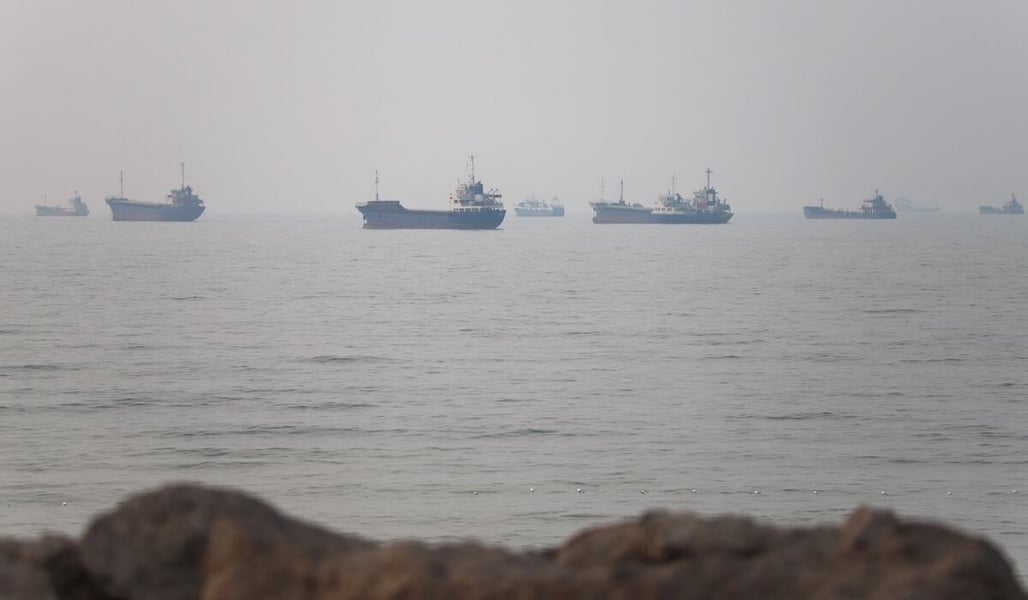
Iran’s Hormuz closure declaration has not yet fully materialized. Shipping insurers have been pricing in closure risk for weeks, and premiums on Hormuz-transiting vessels surged further after Friday’s announcement. Actual tanker movement through the strait was reduced but not halted as of Monday, a discrepancy between declared and effective closure that will determine how long the $90-plus price holds. A genuine halt to Gulf crude exports, which represent roughly 20 percent of global seaborne supply, would stress markets far more severely than current prices reflect. The Goldman Sachs $100 scenario assumes partial but sustained disruption, not a complete closure.
For American consumers, the return to $4 lands on an already strained baseline. The national average for regular gasoline hovered around $3.14 per gallon in the prior year. Drivers are now paying roughly 27 percent more for the same gallon. The Hormuz conflict is the primary driver, but it layers onto an existing inflationary environment that Federal Reserve officials have been watching carefully. Sustained $90-plus Brent would create an uncomfortable backdrop for any discussion of rate cuts during the second half of the year, at a moment when inflation progress had only recently given markets reason for optimism.
As The National reported from Abu Dhabi, the question the market cannot yet answer is whether the ninth night of strikes marks a peak in escalation or a plateau from which the conflict climbs further. The United States has targeted more than 140 Iranian sites in nine consecutive nights; Iran has hit Gulf state energy and military infrastructure, declared Hormuz closed, and struck American facilities in two countries. Each action has been calibrated to stay below a threshold neither side is willing to name publicly. The third American fatality, the Kuwait power plant fire, and Trump’s Kharg Island language together suggest the gap between the current state and a more dangerous configuration is narrower than $90 oil is pricing.
What Brent’s position at $90.32 on Monday reflects is a market that has updated its probability estimate for both outcomes: an escalation path that reaches $100, as Goldman Sachs now openly describes, and a negotiated exit that no one has a credible roadmap to reach. The oil price surge that began last week when Brent crossed $87 has continued without a pause. The ninth night is the latest data point in a sequence that has not broken once toward de-escalation since the ceasefire ended.