
BEIJING – Sixty-three teachers from Bangladesh’s army-run schools have been selected for Mandarin training in two batches, the first tangible institutional outcome of a Memorandum of Understanding signed during Prime Minister Tarique Rahman’s state visit to Beijing last month that formally recognized Chinese as Bangladesh’s third language.
The selection, 33 teachers in the first wave and 30 in the second, marks the opening step in a decision to introduce Chinese language education across all schools operated by the Bangladesh Army. The program is expected to begin within days.
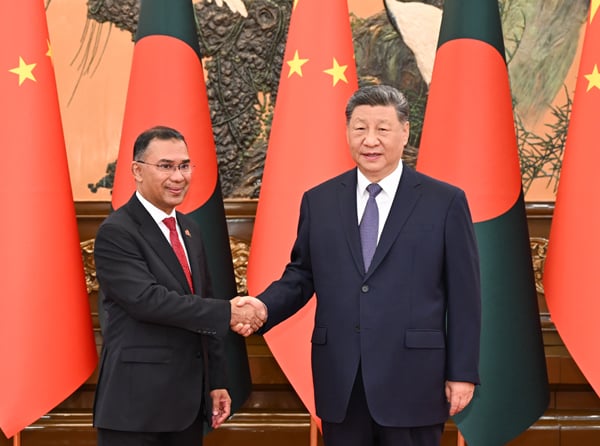
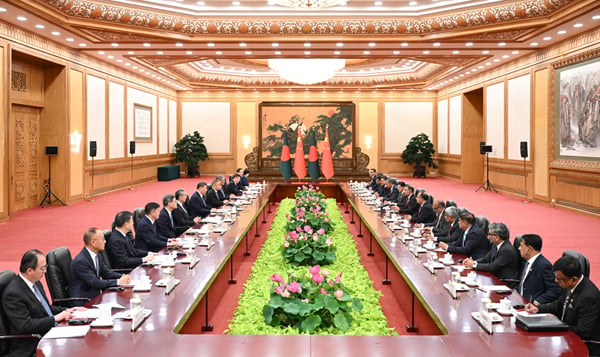
The MoU was signed during Rahman’s June 26 summit with President Xi Jinping at the Great Hall of the People, adding Chinese alongside Bengali and English as a formally recognized language of Bangladesh. The two countries also released a joint communiqué the same day, upgrading bilateral relations to a “community with a shared future in the new era,” the most elevated classification in China’s diplomatic vocabulary, and committing to expanded cooperation in education, technology, and the Belt and Road Initiative.
Xi told Rahman in Beijing that China would “not waver in its commitment to the overall direction of China-Bangladesh friendly relations,” and Rahman responded that Bangladesh views China as “a valued and trusted partner,” according to a readout published by the Chinese Embassy in Dhaka. The language deal was among a cluster of agreements from that summit, which also covered port development at Mongla, an economic zone in Chattogram, and cooperation on the Teesta River.
Elevating Chinese to third-language status is a cultural commitment with structural implications for Bangladesh’s educational system. Formal language recognition differs from offering Chinese as an elective. It carries institutional weight, implying curriculum integration, teacher certification requirements, and eventually the possibility of standardized assessment. The decision to deploy the change first within army-run schools reflects a sequencing logic: military institutions offer a controlled environment for rolling out a new curriculum with trained teachers before broader civilian expansion.
Bangladesh’s army runs a network of schools and colleges across the country, serving hundreds of thousands of students from military families and beyond. Introducing Mandarin across these institutions represents a supply-chain challenge that the 63-teacher training cohort addresses directly. Whether the civilian school system will follow a similar track remains unstated in the arrangements announced so far.
The June 26 summit was Rahman’s first major bilateral engagement with Beijing since leading BNP to victory in Bangladesh’s February 2026 elections, returning from seventeen years of exile in London. Rahman’s political platform during the campaign had emphasized engagement with all major powers without exclusive alignment. His Beijing visit produced one of the most concrete cultural agreements in recent Bangladesh-China history, binding the two countries through language policy in a way that no previous government had formalized.
The joint communiqué from June 26 referenced “people-to-people exchanges” and confirmed that China would continue providing Bangladeshi students opportunities to study in China. It did not single out the language recognition MoU explicitly, which appears to have been signed as a parallel bilateral instrument during the visit rather than embedded in the main communiqué text.
What the language deal does not yet clarify is its reach beyond the immediate teacher-training initiative. There is no public statement about curriculum standards, certification frameworks, whether Chinese materials and instructors will be provided under the agreement, or how long the army-school rollout will take before any potential expansion to civilian institutions. The selection of 63 teachers implies the program’s initial scale, covering roughly five to six teachers per major cantonment if dispersed evenly across Bangladesh’s network of army schools.
Bangladesh’s adoption of a third formal language is uncommon in its regional history. Bengali carries constitutional primacy since the Language Movement of 1952, when the demand for Bengali’s recognition as a state language of then-Pakistan sparked mass protest and led eventually to the liberation war of 1971. English functions as a de facto official and professional language. Chinese sits in a different category entirely, less about linguistic heritage than about contemporary economic and strategic weight.
China is Bangladesh’s largest import partner and has invested heavily in infrastructure through Belt and Road programs across the country. The language deal provides a soft-power complement to that economic relationship, building a generation of Bangladeshi students and army personnel who can interact directly in Mandarin and reducing dependence on English as the intermediary language for bilateral engagement.
The trajectory since June 26 suggests the Dhaka-Beijing relationship is in an active expansion phase, with the language deal one piece of a larger bilateral architecture being assembled, from the port at Mongla to the industrial zone in Chattogram and now into classrooms. On what comes next for the 63 teachers and the curriculum they will carry back into army schools, the announcement offers a start date but not a finish line.