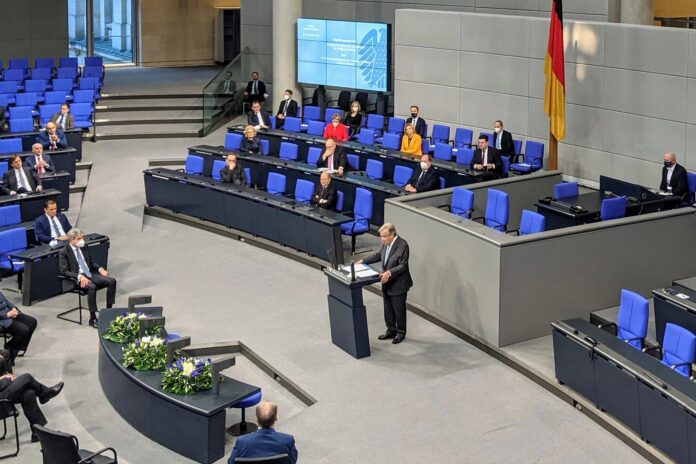

WASHINGTON – Speaker Mike Johnson declared it the Republican Party’s “best shot” at enacting its agenda. By Wednesday afternoon he had a number to prove it: 216-214, the narrowest House majority available, as the lower chamber passed a $95 billion budget reconciliation package that bundles up to $60 billion in Iran war spending with the SAVE America Act’s contentious voting requirements. Every Democrat voted no. Two Republicans joined them. One independent did as well. The bill is now heading to a Senate that is not waiting for it.
Senate Majority Leader John Thune announced he would delay consideration of the resolution until after the August recess, a decision Senate Republicans have barely contested. The calendar math is unambiguous: the Senate cannot hold a vote-a-rama on a budget resolution, then direct committees to draft reconciliation legislation, then pass that bill before the elections that give the SAVE Act’s voter-ID provisions their only meaningful purpose.
The bill that passed the House allocates up to $60 billion for the Iran war, a conflict now in its 12th week with US air operations proceeding without a formal declaration of war from Congress. An additional $13 billion flows to intelligence committees, $12 billion to agriculture and farm assistance, and $10 billion to the House Administration Committee. The SAVE Act provisions require proof of citizenship and government-issued photo identification to register to vote, CBS News reported.
Warren Davidson, the Ohio Republican who has been among the most vocal fiscal hawks throughout the reconciliation debate, offered the clearest preview of the bill’s Senate reception. “A no-offset plan is dead on arrival,” he said, before Wednesday’s vote went ahead anyway. Davidson was referring to the central structural problem with the House package: none of the new spending is paid for. There are no corresponding cuts to existing programs, no revenue measures, no accounting for how $95 billion is absorbed into a federal budget already running large deficits.
Budget Committee Chairman Ron Johnson of Wisconsin shares Davidson’s position and has formal authority to act on it. Johnson chairs the committee that would receive the resolution and begin marking up legislation. His stated opposition to the lack of offsets reflects a real policy disagreement, not procedural posturing; it concerns what reconciliation is supposed to accomplish and whether a bill that simply authorises new spending without cuts qualifies. If Johnson refuses to move the bill through committee, it cannot reach the floor.
Lisa Murkowski of Alaska has separately declared her opposition to the SAVE Act provisions in language suggesting the measure cannot survive without modification. Republicans hold only a slim Senate majority. Murkowski’s opposition alone is sufficient to block passage if the rest of the caucus does not hold. There is no spare vote available to absorb her defection while simultaneously satisfying the fiscal hawks who object to the offset question.
Then there is the Byrd rule, the procedural constraint limiting what can be included in a budget reconciliation bill to provisions with a direct budgetary effect. The SAVE Act’s voter-ID and citizenship-verification requirements are not budgetary in any straightforward sense. Their purpose is to regulate who can vote. The Senate parliamentarian is expected to rule these provisions extraneous, which would require stripping them from the bill before passage, removing the central political rationale for the package as Johnson and Trump have constructed it.
Republican fractures over the $95 billion package surfaced a week before the vote, when Davidson and others argued the bundled bill had no realistic Senate path without spending offsets. Wednesday’s 216-214 result proved the House majority was achievable. It did not answer any of the questions about what the Senate majority will accept.
What the package leaves unresolved is what happens if the SAVE Act provisions are stripped by the parliamentarian, the offsets problem is not resolved, and the bill that eventually emerges from the Senate is simply a $95 billion Iran war spending authorisation with none of its domestic political attachments. That would be a bill funding a war the House has already voted four times to constrain. Whether that constitutes success by either chamber’s stated terms has not been addressed by either Johnson or the White House.
Brent crude surged past $100 a barrel on Thursday as the Iran conflict expanded into a Gulf-wide confrontation, with the IRGC striking Kuwait, Jordan, and Bahrain and the Houthis declaring a blockade of Saudi ports. The $60 billion Iran war allocation the House approved on Wednesday is partly a retroactive accounting exercise: the Pentagon has already committed significant resources through emergency transfers. Congressional action would legitimise spending already incurred while extending authority for what comes next.
The House has passed four war powers resolutions directing the administration to halt the Iran campaign; none has changed what the Air Force is doing. Senate Republicans have separately pressed Defence Secretary Hegseth on what the endgame looks like, without receiving a clear answer. The reconciliation bill, by contrast, would ratify and fund the campaign through a majority vote. What the Senate will do with that ratification, under its calendar, its procedural rules, and its internal dissent, is the question the House’s 216-214 majority left open.