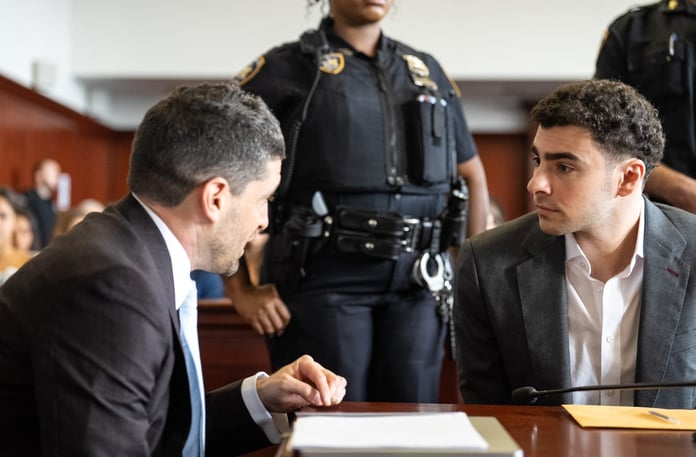

MINNEAPOLIS – John Hoffman addressed the courtroom on Wednesday as a man who survived the night of June 14, 2025, and has spent every day since reconsidering what ordinary life costs him now. The Minnesota state senator, shot in his home in the early hours of that morning, told the court that Vance Boelter had permanently changed his life. “Every ordinary, boring moment,” he said, has been “forever altered by extraordinary violence.”
Boelter, 59, was sentenced Wednesday in federal court in Minneapolis to two consecutive life sentences plus an additional 480 months – forty years – for the killings and attempted killings he carried out in the predawn hours of June 14, 2025. The targets were elected officials. The method was a police impersonation. The result was the death of former Minnesota House Speaker Melissa Hortman and her husband Mark, and the critical wounding of Hoffman and his wife Yvette.
U.S. District Judge John Tunheim, according to NBC News, told the courtroom the sentence was “the longest I have imposed after hearing thousands of cases over the years, but I do believe it is deserved.” Tunheim’s courtroom has processed decades of federal criminal proceedings; nothing in that span produced a sentence of this length before Wednesday.
Boelter had arrived at Melissa Hortman’s home around 3:30 a.m., dressed in tactical gear designed to resemble a police officer’s uniform. When Mark Hortman answered the door, Boelter identified himself with a false name and badge number, claiming a welfare check. Then he shot Mark multiple times. When Melissa ran upstairs, Boelter followed and shot her there. Both died that morning. That night, Boelter also visited two other lawmakers’ homes. At the home of Senator John Hoffman and his wife Yvette, both were wounded critically. They survived.
The Hortmans’ golden retriever was gravely injured in the attack. The dog was later euthanized.
Melissa Hortman had served as Minnesota House Speaker, one of the most senior Democratic elected officials in the state. Her death did not prompt a legislative session’s suspension so much as it produced a silence that those who worked in the Capitol said had not lifted in the thirteen months between the attack and Wednesday’s sentencing. Hoffman, who returned to the state Senate, found himself describing his daily life to the court as permanently reconfigured by a man he never knew before that night.

Federal prosecutors, in their sentencing filing, framed the attack as something beyond a double murder and attempted assassination. “Vance Boelter committed an assault on democracy,” the filing stated. “He shattered the lives of his victims.” The framing tracked with the federal charges, which connected the killings to Boelter’s targeting of specific elected officials at their private residences, in their beds, at a time when they were unprotected.
Boelter had pleaded guilty in June 2026 to six federal counts, a plea entered to remove the death penalty from consideration. The federal sentencing Wednesday does not resolve his legal exposure: he continues to face state charges including murder and attempted murder under Minnesota law. The federal sentence ensures he will die in prison. The state proceedings add an additional layer of accountability that state prosecutors and the families of victims have said they intend to pursue.
The attack raised immediate questions about security for state-level elected officials across the country. State legislators have historically operated without the protective detail afforded to federal officeholders and governors. Most work in districts they share with their constituents, hold town halls in public venues, and maintain home addresses that are not difficult to find. The June 2025 attack in Minnesota brought that structural exposure into open discussion, though what systemic changes followed has varied by state.
The United States has seen a documented rise in threats against elected officials at all levels of government in recent years. The Minnesota killings were the most lethal realization of that trend. Congressional Democrats in the House have pressed for accountability on multiple fronts in 2026, operating in an environment where the physical safety of elected officials has become an explicit part of political discourse in ways it was not a generation earlier.
What Boelter’s precise motive was has not been disclosed in court filings made public. The guilty plea removed the need for a trial that might have produced a fuller evidentiary record. Investigators and prosecutors have not released a detailed account of what drove a 59-year-old man to disguise himself as a police officer, drive to the homes of Minnesota state legislators in the middle of the night, and kill two people and wound two others. That gap in the public record is likely to remain.
For Hoffman, whose wife Yvette also survived the shooting, the question of motive may matter less than what has replaced it. “The defendant permanently changed my life,” he told the court. What he described as ordinary and boring – the texture of daily routine before that June morning – is now something he has to work to recover. The two consecutive life sentences handed down Wednesday will keep Boelter incarcerated. They will not return what Hoffman described losing, or what Melissa and Mark Hortman’s family lost entirely.
Related Posts