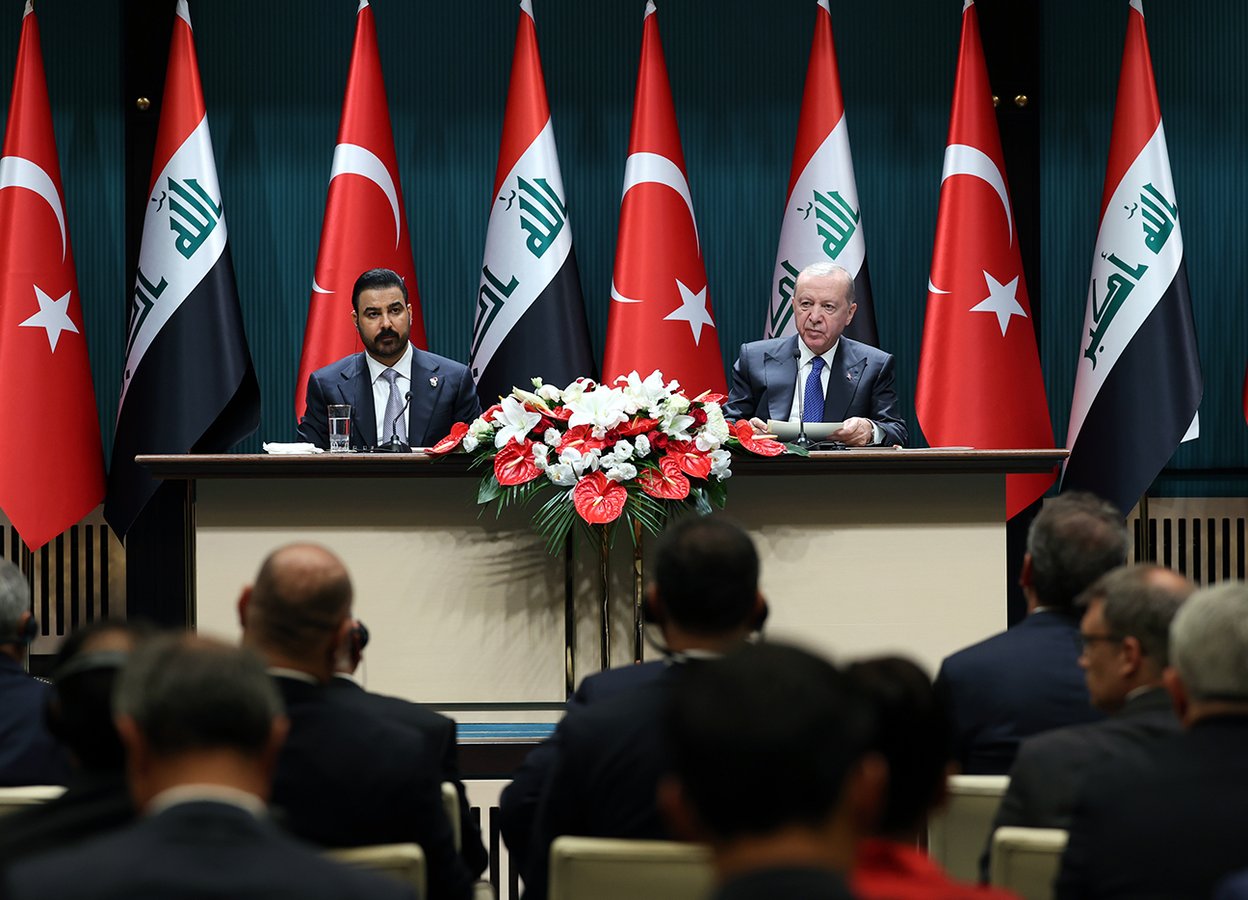

ANKARA – The two men who met at a joint press conference in Ankara on Monday had complementary problems and, as it turned out, complementary offers. Iraq’s Prime Minister Ali al-Zaidi needed a security partner capable of suppressing militants who operate from territory his government does not fully control. Turkish President Recep Tayyip Erdogan needed both new arms export markets and continued oil flows from a neighbor whose crude has moved through Turkish pipelines for decades. They left the podium having offered each other both.
Erdogan said Turkey was ready to supply Iraq with defense industry products, a commitment he framed in terms of regional security rather than commercial opportunity. “We are ready to fulfill our part in supplying Iraq with the defense industry’s necessary supplies,” he told reporters. The offer came alongside a separate announcement that Baghdad was prepared to supply Turkey with one million barrels of oil, and that both governments intended to sign a comprehensive energy cooperation agreement “as soon as possible.”
The stakes of those two commitments, taken together, explain why the meeting happened at all. The Middle East that Zaidi and Erdogan are navigating in 2026 is not the one that kept their predecessors at arm’s length for much of the previous decade. Iran’s power transition following the death of Supreme Leader Ali Khamenei altered the regional balance that both countries had organized their foreign policies around. The conflict in Gaza remains unresolved. And in Syria, where neither Turkey’s military presence nor the new Damascus government has settled into anything resembling finality, the two countries share more of the same problems than either has publicly acknowledged.
Erdogan named all three at the press conference, describing the regional agenda as focused on Iran, Syria, and Palestine. What he spent more time on was a concept Ankara calls “Turkey without terrorism” – a framework for sustained coordination between Turkish and Iraqi security forces aimed at eliminating the PKK, the Kurdistan Workers’ Party, from its operational bases in northern Iraq. Turkey has conducted cross-border air and ground operations against PKK positions inside Iraqi territory for years. Baghdad has consistently protested those operations without having the military capacity to prevent them. Monday’s joint press conference was an effort to turn that asymmetry into a partnership. Erdogan expressed confidence that the terrorism problem “which has cost both countries dearly” would finally be removed from the agenda.
Whether that confidence is warranted is the part neither leader addressed. The PKK’s endurance in northern Iraq reflects not only the organization’s resilience but also the complicated politics of the Kurdistan Regional Government, whose relationship with both Baghdad and Ankara does not map neatly onto any bilateral security formula. Turkey’s defense products offer is presumably aimed in part at equipping Iraqi forces to do what Ankara has historically done on its own: strike PKK infrastructure from within Iraqi sovereign territory. The exact categories of defense equipment under discussion were not disclosed. No timeline was offered.
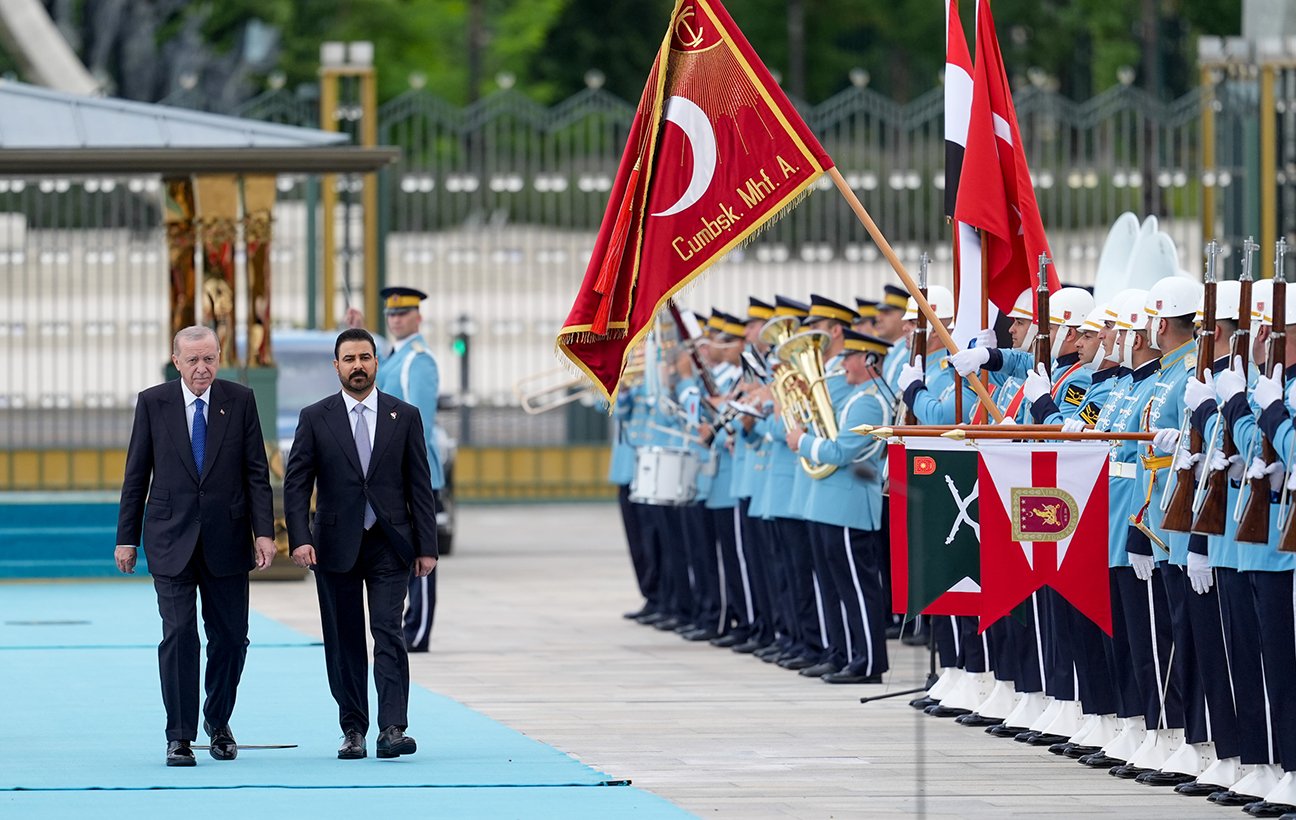
For Iraq, the commitment to supply Turkey with one million barrels of oil carries significance beyond the commercial. The Kirkuk-to-Ceyhan pipeline, which has carried Iraqi crude to Turkey’s Mediterranean coast for decades, had been under urgent renegotiation as the current contract approached expiration. Energy cooperation between the two countries is not a new idea; what is new is the speed at which Baghdad is treating it as a top diplomatic priority. Iraq’s position between an Iran in political transition and a United States that has been actively courting Baghdad’s economic reorientation gives the al-Zaidi government unusual leverage at an unusual moment.
The timing of Zaidi’s visit made that leverage visible. He arrived in Ankara after completing stops in Washington and Tehran, a diplomatic circuit that had already produced progress on the $17 billion Development Road corridor linking Iraq’s Gulf coast to Turkish and European markets. Each capital on the itinerary received a signal that the others were watching. Tehran will have noted Monday’s defense supplies announcement in particular: Turkey-Iraq security alignment of this degree represents a degree of collaboration that previous Iraqi governments were careful to avoid formalizing in public.
Erdogan described the goal as maintaining close communication to create a region free of terrorist threats. That language, in Turkish diplomatic usage, refers specifically to the PKK and its affiliated networks. Whether Baghdad reads the terrorism mandate in exactly the same operational terms is a question the press conference format was not designed to answer. Iraq has its own militias, its own Kurdish political parties with complicated PKK-adjacent histories, and a domestic calculus around what any government can commit to at a podium in Ankara without sustaining political costs at home.
The comprehensive energy cooperation agreement that both sides say they want to conclude quickly is the more tractable of Monday’s two commitments. Energy deals between neighbors with connected pipelines have technical ministries, tariff mechanisms, and established negotiating channels that can move independently of the political moment. The defense supplies commitment is different. It requires agreement on specific product categories, export licensing on Turkey’s side, end-user controls, and a military-to-military relationship with more institutional depth than what currently exists between the two armies. Monday’s press conference announced an ambition. The groundwork for that ambition is not yet visible.
What it is, at minimum, is a signal. In a region where the underlying arrangements are shifting faster than formal agreements can capture them, a joint press conference can function as a commitment even when its details remain unspecified. Erdogan and Zaidi left Ankara having told Iran, the United States, and the PKK something about the direction both countries intend to move. Whether the institutions of both governments will follow that direction at the pace the two leaders implied is a question that will become answerable only over the months ahead.